Wednesday, September 2, 2009

Betrayal by Any Other Name


Betrayal has such a black-and-white sound, doesn’t it? But like most things, it isn’t anything of the sort. Betrayal of a country, an ideal, a lover, a spouse, a friend. It’s often impossible to be loyal to all. Which loyalty comes first?

Raoul says this to Mélanie in their scene in the library late in Secrets of a Lady/Daughter of the Game. I found myself mulling over these words while driving home from a trip to the grocery store (I do a lot of my best writing thinking in the car). So many of my books deal with betrayal in one form or another. It’s at the heart of four of my mom’s and my Anthea Malcolm Regencies (Frivolous Pretence, A Touch of Scandal, An Improper Proposal, A Sensible Match) and of all four of my linked historical romances, starting with Dark Angel which I wrote with my mom as Anna Grant and continuing with Shadows of the Heart, SLinkhores of Desire, and Rightfully His. It’s the core issue of the Charles & Mélanie series. I can’t imagine writing a book about Charles and Mel that didn’t deal with some facet of betrayal.

In a 2003 ARR interview, Rachel Potter asked me about the fact that many of my books have personal betrayal as a theme. It was something I hadn’t really thought about at the time. Thinking it over, I replied, “Personal betrayal goes to the core of what hurts most, what creates the bleakest dark moment, the deepest hurdle to overcome. That’s the stuff of good drama. Trust, I think, is essential to love, so a betrayal of trust is one of the most difficult challenges a love affair can face. Betrayal raises all sorts of interesting moral and ethical questions. “

I’m particularly intrigued by the moral and ethical dilemmas of characters caught between competing loyalties, as Raoul describes. That’s what I love about Len Deighton’s Bernard Samson books (which, pretty obviously, were one of the inspirations for the Charles & Mélanie books). There’s a wonderful scene in the television adaptation of Game, Set & Match (which I wish would be released on DVD) where a number of the characters (most involved in intelligence work in one way or another) are a dinner party and the talk turns to betrayal. They are discussing it in the personal, romantic sense, but the political overtones are there as well. It’s a fabulous scene, rich in subtext.

Themes of betrayal and competing loyalties go hand and hand with stories about spies. Characters in spy stories are always caught in ethical dilemmas, torn between competing loyalties (every episode of MI-5/Spooks seems to contain an ethical dilemma). Tom Stoppard’s wonderful play about spies, Hapgood, is all about betrayal. But so is another of my favorite plays of his, The Real Thing, which is about marriage, with nary a spy in sight.

The pull between loyalty to a loved one and loyalty to a cause is summed up in Richard Lovelace’s I could not love thee, dear, so much, Lov’d I not honor more, which Mélanie quotes to Charles toward the end of Secrets. It’s a deceptively simple quote, which can seem trite (Mel, in fact, is accusing Charles of dismissing her betrayal too lightly when she brings it up). And yet it says a lot about the tension between love and loyalty or between two competing loyalties. Of course, how one defines “honor,” (a word Charles is inclined to invoke and Mel is inclined to disparage) has a lot to do with which loyalty one puts first. As Raoul is pointing out to Mélanie, there’s often no easy, clean, “honorable” answer.

Do you like stories about betrayal? Why or why not? Any favorites to recommend? Do you find yourself noticing common themes within a writer’s work? Writers, are you aware of themes you return to again and again, or are you sometimes startled when someone points them out to you (as I was when Rachel interview me)?

Monday, August 31, 2009

Welcome (back), Blythe Gifford

In The Master's Bed

by Blythe Gifford

Available Now!


She's disguised as a man in a place where women are forbidden. Now, she's met a man who, for the first time, makes her want to be a woman. What will happen when he discovers her secret and she's discovered IN THE MASTER'S BED?


Welcome Blythe! This is your fourth, fourteenth century medieval. IN The MASTER’S BED is set in Cambridge, England in 1388. Is there a particular reason you chose that setting?

The book is a spinoff from The HARLOT’S DAUGHTER. It’s the story of the sister, or the harlot’s other daughter, as I like to say. I knew I did not want a large gap between the stories, so this one starts just after the epilog of the previous book.

The location, however, did change. I knew I wanted Jane, my heroine, to run away disguised as a boy to study at University, but I originally planned for her to go to Oxford. As the story took shape and my research broadened to include the back-story for my hero, I knew that once again, King Richard’s court would play a role. I was delighted to discover that Parliament met in Cambridge (or, more properly, Caumbrigge or Cantebregge) in the fall of 1388. That fact brought the story into focus, as well as giving me some wonderful historical information about the city in that year.

Anything about the setting that constrained you or that you had to plot carefully around?

First, because I incorporated real events (the Battle of Otterburn, the Parliament in Cambridge, a subsequent meeting of the King’s Council) I wanted to be accurate in my accounts of those events. And that turned out to be particularly challenging when I discovered that there is no historical consensus as to the exact date of the Battle of Otterburn actually took place!

In addition, I tried to be very conscious of the academic year and the daily schedule. Lectures started at 6 a.m. and as a master, my hero had to be up before that to unlock the church for morning worship. I was careful of the starting and ending dates for the terms and vacations, too, as well as the requirements and accomplishments for students at each level of study.

Not a plot constraint, but a character challenge was the search for a way to portray the medieval attitude toward women. I reined in some of the accuracy so as not to offend modern sensibilities.

Anything you flat-out altered or “fudged”? If so, why?

Absolutely! The University at that time was still largely a religious, not a secular, institution. To be a master, as my hero is, you had to take “minor orders” and wear a tonsure. If you’ve seen the pictures of monks at that time, that’s the funny hairdo with the shaved head and the fringe around it. I flat out fudged that one and let my hero keep his hair! Minor orders, fortunately, did not commit him to celibacy, so I did not have to fudge that.

Tell us a little about your hero.

Since my heroine had appeared in a previous book, I knew her story well. She was inspired by a real person, the illegitimate daughter of King Edward III of England and his notorious mistress, Alice Perrers. My research at that time said she married a “Richard Northland.” “Northland” was the beginning of a voyage of discovery to find my hero, Duncan. I decided that he had come from Westmoreland, the “north land” of England, which at that time was considered barbaric. In fact, Queens College at Oxford was founded especially for students from the “north land” because of the “waste, desolate and illiterate condition of those countries.” By coming south, he would have faced ridicule and certainly been made fun of because of his speech. The best parallel is the north/south divide we have in the U.S. The southern accent is generally looked down on by speakers of “standard English.” It was the northern accent that was disdained in medieval England. That really gave me a clue to his character. He’s a man with something to prove.

How about something fun, like his favorite childhood pet, or his first kiss.

My hero plays the guitar, or, as it was called then, the gittern. That comes in handy when rowdy young students want to sing drinking songs, but it is also a window to his character and a wonderfully romantic way for him to relate to the heroine.

In your research, did you stumble across anything really interesting that you didn’t already know?

Always! Even though this is my fourth book set in the 14th century, I had much to learn about this particular period and medieval Cambridge. Since I’m talking with the History Hoydens, I’d love to share some of the fascinating bits and pieces that somehow didn’t fit into my story. If you read the book, however, you might find a phrase that captures the echo of this history.

· In 1381, just seven years before my story is set, the Cambridge townspeople, angry at what they saw as University privilege, stormed several of the colleges and even attacked the University church, dragging many chests of university documents and records into the marketplace and burning them. One woman is reported to have yelled “Away with the learning of clerks!” As a result, the documents that might illuminate the University’s history were largely destroyed. And the result was not what they were hoping for. The King gave more power to the University instead of less. The University received full control over weights and measures, and the right to punish offenders with fines and collect the fees.

· Students at medieval universities throughout England and on the continent tended to organize themselves in what they called “nations.” At Oxford, they were called the boreales, students from Scotland and the north of England, and australes, Welshmen, Irishmen, and those from the south of England. (There’s that north/south conflict I talked about.) Animosity between these “gangs” was so great that during the same school year my story is set, there were riots in the street at Oxford and students were killed.

· Cambridge was perhaps even dirtier than most medieval towns. So much so, in fact, that before Parliament met there, King Richard ordered “the removal of all pigs, pig-sties, manure heaps, trunks and branches of trees and other obstacles from the streets and lanes of the town.”

· There were seven “liberal arts” studied at University. The first three were called the trivium. Hence, trivia. “Cursory” lectures consisted of the master reading aloud from a book, a necessary and efficient way to transmit information when books were scarce.

What are you working on next?

Interestingly, researching this book lead me to my next. Learning about the “north land,” I became intrigued with life on the border of England and Scotland. My next book will be set there, only this time, on the Scottish side of the line.

Thank you for having me here. It’s a pleasure to visit the History Hoydens again. And I invite readers to visit my website, www.blythegifford.com, and check out my schedule. This is just one stop on my “Blog until you Drop” tour and I’d love to have company!


Friday, August 28, 2009

The Chinese Connection


Have you ever ridden a train through the High Sierras? Through mile-long tunnels and along tracks that cling to mountainsides overlooking deep canyons?

The most spectacular and dangerous routes were hacked out of solid rock, by hand, by small (110 lb), tough, energetic Chinese laborers who hauled off the earth and rock in tiny loads and, as winter approached, worked 3-shift, 24-hour days.

Back in 1865 these “strange little men with their dishpan straw hats, pigtails, and floppy blue pajamas” (according to one railroad owner) proved themselves the equal of burly Irish immigrants. At first, the railroad bosses judged the Chinese too frail and unmechanical for such work. [Had they known history, of course, they might have recognized the tremendous grit and cleverness of the Chinese, exhibited in the building of the Great Wall (also hacked by hand out of mountainsides) and the invention of clocks, gunpowder, paper, ceramic glaze, etc.]

The little Chinese men--actually farm boys from Canton--came to California originally to rework tailings of gold mines left by the 49ers. Finally formed into railroad crews of from 12 to 20 men with their own cook and Chinese headman, the men proved quick to learn, slow to complain, and punctual! (Apparently Irish workers were a headache--promoting strikes, drinking up their earnings, and brawling.)

The Chinese amazed everyone: they didn’t strike; they didn’t get drunk; they bathed every day and drank boiled tea instead of the dirty water that sickened everyone else. They did gamble and occasionally had fights among themselves, but overall they were looked on as disciplined, efficient, reliable working machines. The railroad bosses called them “Celestials.” (The Irish were called Terrestrials.)

Clearing the path for the laying of railroad track encouraged competition among crews. Fifty-seven miles from Sacramento, the Central Pacific Chinese crew ran into a shale mass in the flank of the Sierra, 200 feet above the gorge of the American River. Track would have to be laid along a ledge with no footholds, 1400 feet above the raging river below.

The Irish took one look and began protesting because it was so dangerous. The Chinese took over and triumphed. Lowered down the face of the cliffs in wicker baskets, the Chinese crews pounded holes in the rock, stuffed them with black powder, and set fuses. They were then hauled up out of danger, and when the smoke cleared the hunks of rocky mountainsides had come tumbling down. The Chinese crews lost not a single man during this dangerous enterprise; they were paid $35 per month and that didn’t include food or lodging. They lived in on-site wind-whipped huts or dank caves and ate Chinese delicacies shipped from San Francisco and prepared by the Chinese camp cook.

Blizzards in the winter of 1866-67 all but stopped progress, but the Chinese continued to bore tunnels through solid rock, even though the men were often cut off by snow and had to eat stockpiled food. Because of the constant avalanches, tunnels were cut under the snow for access from lodging to work site.

The Great Track-Laying Race occurred after this bitter winter when both railroads, the Union Pacific and the Central Pacific, were to connect in the desert. By this time, the Central Pacific crews included Irish men. For a time the separate Irish and the Chinese crews competed in clearing grading, with neither side warning the other of impending explosive blasts.

The Great Race between the Union Pacific and the Central Pacific began when each railroad owner wanted to beat the other to the connecting. Guess who won?

The Central Pacific’s combined Irish-Chinese crews managed to lay 10 miles of track in 12 hours and thus proved their superiority. The burly Irishmen would lug the iron track sections and drop them into position, and the Chinese would hammer and rivet them in place, by which time there would be another section of track waiting.

Thus was America built.

Source: The Railroaders [The Old West]; Time-Life Books, New York.

Wednesday, August 26, 2009

Research Karma

My post is a wee bit late today. That's because I've been chugging away on a new book, which needs to be done... well, we won't talk about that.

Every now and again, though, the great gods of research smile upon harried, desperate authors. As part of one of today's scenes, it became imperative that my characters play a game of Blind Man's Buff. As I was writing the scene, I had one of those panic attacks impossible to explain to anyone but another writer of historical fiction: the horrible fear that Blind Man's Buff might be one of those insidious Victorian additions that we blindly believe has been around longer. There are lots of those. They're sneaky little devils, those Victorian additions. My book is set in 1803. That would not have been good.

I hastily looked up Blind Man's Buff (I confess, such was the extent of my deadline-driven anxiety that I did exactly what I always told my history students not to do and googled it, instead of hauling myself out of my desk chair to walk the big ten feet to the research books on my shelf), prepared, if necessary, to grit my teeth and find another party game. The first thing to come up? This picture, from 1803:


Pretty neat, no? Not 1802 shall you count, or 1804, but exactly the year I needed. Although my book is set in winter, so my heroine won't be quite so diaphanously garbed....

Have you had any major research miracles recently?

Monday, August 24, 2009

In the U.S., we have a long-standing tradition of "history as argument" -- our history is rarely fixed, and instead is characterized by the ongoing back-and-forth arguments we have over The Truth.

It's been said that the victors write history. That may be true in the case of the American Civil War, after which many history books were modified to remove the contributions of the states that had seceded. The official school Jamestowntexts of my childhood made no mention of Jamestown, Virginia, the first permanent English settlement in the USA. Instead, I was taught that Plymoth Rock (founded a full 20 years later than the Jamestown settlement) owned that honor. (As a disclaimer of sorts, I was raised in a town barely north of the Mason Dixon line; perhaps the fighting had been particularly grim in that location).

Happy HippiesOthers say it's not the victors, but the misfits who have written much of our accepted history -- those on the fringes of society, who have nothing better to do than sit around and write commentaries on how those in power behave. This case is often made of the 1950s and 1960s in America, when the fringe elements of the Beats and the Hippies defined what "the Establishment" was doing, and painted the majority of society as conformists. The men and women who "conformed" -- who were quietly raising families, working jobs, and participating in society -- had little time or inclination to write commentaries on the times, or so the argument goes.

Historians debate how much attention to give to outliers (the "fringe" elements of an historical time). Often, the fringe elements are presented in as much detail as the majority elements, leading Colorful Hippiesto a somewhat skewed perspective. From some historical discussions of the late 1960s, for example, one might believe that 80% of the adults in the USA participated in the hippie movement. Perhaps this is a natural effect of the colorful and interesting photos we have of the hippie movement; photos of my staunchly conservative parents would not make for an exciting text book chapter.

One battle currently raging involves the history of the Japanese Internment during World War II, when over 120,000 people of Japanese descent were forced from their homes on the west coast of California into internment camps in the deserts of the interior United States. Their property and rights were stripped from them, and the popular historical perspective is that these detainees accepted their lot with passive resignation in a unified spirit of patriotic sacrifice. However, a significant number of these men not only fought relocation, they refused mandatory military service, choosing to serve years in prison rather than fight for the government that had betrayed them. Today, many Japanese-American groups are trying to suppress the actions of these men, believing them to be shameful and to tarnish the reputation of all Japanese-Americans. The argument is that the actions of a minority should not be written into the historical account, because they might outweigh the historical truth of the majority. But in my opinion, history should never be a zero-sum game.

For over a decade, a U.S. Civics textbook written by my late mother-in-law was the number one 9th grade civics text in the United States. She'd devoted much of her working life to evaluating teaching materials for societal and political biases, and worked tirelessly to ensure her text was even-handed and as free from such bias as possible. But she couldn't control everything, and one particular caption in a 1986 edition of the book bothered her greatly. In the section on Immigration and Naturalization, the editors included a photo of Albert Einstein taking the oath of U.S. citizenship.

Einstein

The caption in my mother-in-law's book read: "The world's most famous scientist, Albert Einstein, is sworn in as a new citizen of the United States." What the caption didn't say: the year was 1939, and Einstein, like many other Jews, had been driven out of Europe (in fact, I don't think I've ever seen him look sadder than he does in that photo). From the sanitized caption that was printed, many students were probably misled as I'd been misled about Plymoth Rock.

Given my woefully inaccurate historical education, I wonder if there are other "minority views" of history that I'm missing. And, if authors use minor details of history in their works, does it make the book less believable (because the details are not well-known) or does it add to the verisimilitude of the story? I'd love to hear your thoughts.

Friday, August 21, 2009

Further Research Ramblings: Sense and Sensibility Asea

I think it's Shelley's 1822 death in a boating accident (not quite 30 years old! Why, oh why, didn't he let Lord Byron teach him to swim?) that lies at the root of my interest in Regency figures at the seaside. In any case, I began The Edge of Impropriety with a boating accident, and ended it with a happier trip by water.

But what did they wear during that period when sailing?

No point patterning anyone after Shelley: this radical, atheistical, vegetarian son of a baronet (who borrowed every penny he could against his expectations, with the aim of depleting the family holdings by the end of his life) wore threadbare shirts wherever he went and rarely bothered with neckware. The prototypical romantic poet would have been sadly out of place among the gentlemen of Regency romance -- and anyway, he seems to have mostly gone sailing with his guy friends and left Mary, Claire, Mrs. Leigh Hunt, and the rest of the ladies home with the babies.

In the prologue to Edge I mentioned that Lady Hedges is "dressed for boating," but I didn't go into detail. And the guilty secret (now it can be told!) is that while I was writing it I rather imagined she and her husband board their sailing vessel dressed like Edwardians -- white linen, white flannel, perhaps even "boater" hats.

Entirely off-period, but good enough to get me through writing a prologue and imagining a set of supporting characters.

But in my current work, whose 1813 hero and heroine also go sailing (in a scene that's central to the narrative) I'm not so comfortable finessing the question. (Side issues: why, in women's fiction, do we take such pleasure in having the clothes described to us? And why couldn't Jane Austen have given us a little more to go on?)

So I posted an inquiry on the Beaumonde discussion loop, and was guided (most clearly, of course, by our own Kalen) to various period fashion plates for ladies' seaside wear, and some terrific background information about water and watering places as well.

Somewhat shorter skirts, I thought -- hmm, good point. And note the half-boots. While as for the pantalettes in the print over to the right, I decided to pass on those, agreeing with an 1806 quote from The History of Underclothes that calls them "the ugliest things I ever saw" and swears that the writer "will never put them on again.")

Of course, a truth little acknowledged (by readers -- or writers) of Regency romance fiction is that the second decade of the 19th century wasn't the loveliest ladies' fashion decade, the gowns being increasingly plagued by those hellish ruffles. Looking at the fashion plates, it seemed to me that all the clothes in the fashion plates were chosen for a certain artistic, even romantic, beach effect -- aforementioned ruffles flutter in a gentle breeze as the lady gazed poetically out to sea.

And as I pondered this, I received another response to my query, a bracing email from the prolific and perennially award-winning Regency romance author Allison Lane (who's tutored me before in period matters and consoled me when it was too late to fix my errors -- and whose complete backlist is available at RegencyReads.com):

If your female character is going to sail, make sure she's wearing fabrics that are closely woven and sturdy, in styles that don't billow. Sailing ships, from the smallest to the largest, are loaded with ropes that love to grab anything loosely woven or flapping in the breeze. She will also need a pelisse, both to control the skirts of her dress and to keep her warm since it is nearly always cool to cold on the water. So the ruffles that started appearing on clothing in the latter Regency are awkward at best on board a yacht. She will also need sturdy shoes that won't skid easily.


Sometimes there can be no doubt that you're hearing the voice of reason, not to say wisdom. And after all, I thought, how seriously do "rational creatures" take the dictates of fashion? (The phrase, btw, referring to women, is of course Mary Wollstonecraft's, though I love that Mrs. Croft uses it in Persuasion, and Fiona Shaw speaks it gorgeously in the 1995 movie version...)

But as to "rational creatures" being rational about what they wear...?

Oh. Well.

Which was when I knew what's going to happen aboard my boat -- a war between the rational and the not-so, fashion-wise. A face-off between the wearers of pelisses, sturdy shoes, etc, and the true believers in fashion.

Except, for some reason, I didn't want to say "pelisse," a word that always sounds furry to me.

And so I began to wonder exactly how Jane Austen had described the scene in Emma where Jane Fairfax is almost knocked overboard, during a sailing party. Well, how Miss Bates describes it to Emma, anyway (in a novel where much is said but not everything must exactly be believed), in reference to Mr. Dixon, who, as Miss Bates has it,

...does not seem in the least backward in any attention. He is a most charming young man. Ever since the service he rendered Jane at Weymouth, when they were out in that party on the water, and she, by the sudden whirling round of something or other among the sails, would have been dashed into the sea at once, and actually was all but gone, if he had not, with the greatest presence of mind, caught hold of her habit -- (I can never think of it without trembling!) -- But ever since we had the history of that day, I have been so fond of Mr. Dixon!"

Of course, Miss Bates only has this from the very secretive Jane -- and Emma, as we know, will make of it what she will -- but one thing I'm sure we can believe is that what Jane was wearing is a... habit, quite, as Allison put it "to control the skirts of her dress and to keep her warm."

Except that I'd though that habits were only worn by riders and nuns.

At which point in the process I had to break a rule I've lately set so that I can achieve even a minimum daily word count -- which is wait until later to check the period accuracy of a word.

Nope, in this case we were going straight to my beloved OED (free online for all holders of San Francisco Public Library cards) to... to what, check Jane Austen's period accuracy? Well, to get more of a feel for how else the word was actually used at the time. By, as it turns out, Jane Austen again -- who has Catherine Moreland wearing a habit on the rainy day she's first driven to Northanger Abbey. While Walter Scott, in 1824, points out that riding-habit as a specific use of the word feels, at least to him, relatively recent, when he refers to "The elegant compromise betwixt male and female attire, which has now acquired, par excellence, the name of a habit."

Anyway, I love "habit" as something a Regency lady would wear to sail. Even, or especially, when her sensibility might favor the flutter of ruffles, "habit" sounds to my ear more like an imposition of sense and discipline than "pelisse" does.

Want to take bets as to whether some future editor will let me keep it?

Do you love using the OED as much as I do?

And what excellent research resources (textual or human) are you especially grateful for?

Wednesday, August 19, 2009

Marie Antoinette's Makeover

This will be a short post because I'm juggling multiple deadlines, but I wanted to share one of the "eureka" moments I experienced during my research on Marie Antoinette.


Last spring I read more than a dozen biographies of her and was surprised that very few historians or academics mention the fact that the young Austrian archduchess Maria Antonia Josepha Johanna Hapsburg von Lothringen underwent a comprehensive physical makeover to make her appearance more attractive to the French.


Negotiations to wed Antonia to Louis-Auguste, the dauphin of France and grandson of King Louis XV, began in 1766 when she was only ten years old. The talks dragged on for years, not atypical for a dynastic alliance. By 1768, Antonia's mother, the Empress of Austria Maria Theresa, still had no firm commitment from Louis XV. Something had to be done to hasten the process, as Austria (with Frederick the Great of Prussia and Catherine the Great of Russia eager to chew off pieces of the empire) desperately needed France as a political ally.


In order to prove to Louis what a beauty her youngest daughter had become since their negotiations began, in 1768 Maria Theresa commissioned the French portraitist Joseph Ducreux to immortalize the then-twelve-year-old Antonia in oils. Antonia (who years later would confess "I am terrified of being bored" ) was notoriously too impatient and exuberant; and after five sittings, the result was disastrous. So Ducreux literally went back to the drawing board.


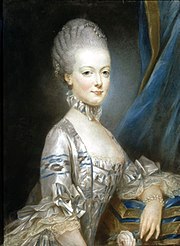
The result was this portrait of the thirteen-year-old archduchess, not completed until 1769. It was then sent to Versailles.


In order to create this image of teenage perfection Antonia's hairline had been altered. The first step was the removal of a woolen band that her governess had used for years to keep her unruly strawberry blonde curls off her forehead. The band had been so tight and had been used for so many years that it had resulted in hair loss, with bald patches near Antonia's hairline. In addition, her high Hapsburg forehead was judged too unattractive for French tastes and a Parisian friseur, or hairdresser, named Monsieur Larsenneur was sent to Vienna to soften the hairline and create a flattering new hairdo that would disguise the problem. The style, named à la dauphine, became all the fashion for the young Viennese. In Ducreux's portrait Antonia's hair has been lightly powdered.


But the new hairstyle was nothing compared to what Antonia's mouth had to undergo. Her teeth were crooked and in the early months of 1768 a French dentist, Pierre Laveran, was summoned to the Hofburg Palace to straighten them. Evidently, he used an 18th century form of braces. However, none of Marie Antoinette's biographers could enlighten me on the details (one did mention a device called "the Pelican" but had misidentified what the "Pelican" actually was, so it's a good thing I didn't take their word for it). [Since someone is bound to ask, the "Pelican" was a set of pliers used to pull teeth. The pincers or forceps end of the pliers was shaped like a pelican's beak, hence the name.]


After letting my fingers do the walking in cyberspace, I not only came across the technique that would have been used at the time, but the name of the dentist who did the work! Finding the name of Pierre Laveran, who came from a family of respected dentists, was the "eureka" moment. It was enhanced by my discovery of the technique that would have been used at the time, a horseshoe shaped device made of precious metal with perforations at regular intervals through which gold wires were threaded. The device, called "Fauchard's Bandeau" was a revolutionary technique developed by Pierre Fauchard, widely considered to be the father of modern dentistry (and orthodontics). Fauchard's 1728 treatise, "The Surgeon Dentist" (or, in French Le Chirugien Dentiste) was the dental Bible of the age.


Pierre Fauchard (1678 [?] - 1761]

Discovering Fauchard and his method of applying braces to someone's crooked teeth was a golden research moment for me. Taking the process one step further to find the name of the dentist who actually applied the bandeaux to Marie Antoinette's teeth, took it platinum.


Have you ever gone searching for information and stumbled upon exactly what you were looking for -- the tiny detail or tidbit of arcana that added additional authenticity to your novel -- even though you might be the only geek who would ever know (or care) that you hadn't made up the information?


What was it?


P.S. The photo below is a postscript to a comment I made on Kathrynn's recent post about Dark Heroes. We were discussing Brian de Bois-Guilbert in Ivanhoe, and I mentioned that I had adapted the novel for the stage and played Rebecca. That's me, of course, in the dark wig. Ivanhoe was played by the incomparable Ian Rose, who was my co-writer on the script and who also staged the fights.