Showing posts with label marie antoinette. Show all posts

Wednesday, February 22, 2012

History & Happily Ever After


I was thinking through a scene recently, toward the end of my current WIP, between the four major female characters. The scene will touch on their various plotlines and character arcs and where they the end of the book finds each woman. All four are ongoing characters in the series, but two are real, two fictional. Because it's a series, no one's plotline is neatly resolved in one book, and I don't think of my characters having nice, neat happily-every-after endings in any case. Yet in thinking about this scene, it occurred to me that already the two fictional characters have decidedly happier trajectories than the two real historical characters.

Which reminded me of why, much as I love to write about real historical characters and events, I prefer to have fictional central characters. I can create my own characters with their own personalities and story arcs. And part of that is that many fascinating real life historical figures not only did not have happily-ever-after lives, their stories could be called unhappy.

I admire Juliet's brilliant trilogy about Marie Antoinette for many reasons, one of which is that to write the books Juliet had to live for months with the French Queen's tragic life. Lauren and I have both written about Hortense Bonaparte, a favorite real life historical character of both of ours. Hortense was accomplished, clever, loyal, and seems to have been a genuinely nice, warm-hearted person. A devoted daughter, mother, and lover. Her story cries out for a happy ending. Instead she had a miserably unhappy marriage, lost one of her children to death and gave up another born out of wedlock, and ultimately lost the love of her life.

I'm looking forward to sharing fairy tales with my daughter (that's us above on Valentine's Day; I shamelessly still can't resist posting pictures of her). But I know that eventually we'll have to have a talk about how real life is more complicated than happily ever after. As I said, I like to think that my books show some of the complicated messiness of real life. Yet comparing my fictional and real characters, I wondered if the arcs I was creating for my fictional characters had more happily ever after in them than I realized. But I can't help but want the best for my characters, just as I do for my daughter (even if I put my characters through trials and adventures I certainly hope my daughter never encounters). And perhaps I like to think that real life can be, if not happily ever after, at least happier than not.

How much happily ever after do you like in novels, as a reader or a writer? When reading or writing about real historical characters does it bother you that their lives may have gone on to be less than idyllic? Do you sometimes wonder if fictional characters would go on to face some of the same challenges as their real life counterparts?

Wednesday, August 19, 2009

Marie Antoinette's Makeover

This will be a short post because I'm juggling multiple deadlines, but I wanted to share one of the "eureka" moments I experienced during my research on Marie Antoinette.


Last spring I read more than a dozen biographies of her and was surprised that very few historians or academics mention the fact that the young Austrian archduchess Maria Antonia Josepha Johanna Hapsburg von Lothringen underwent a comprehensive physical makeover to make her appearance more attractive to the French.


Negotiations to wed Antonia to Louis-Auguste, the dauphin of France and grandson of King Louis XV, began in 1766 when she was only ten years old. The talks dragged on for years, not atypical for a dynastic alliance. By 1768, Antonia's mother, the Empress of Austria Maria Theresa, still had no firm commitment from Louis XV. Something had to be done to hasten the process, as Austria (with Frederick the Great of Prussia and Catherine the Great of Russia eager to chew off pieces of the empire) desperately needed France as a political ally.


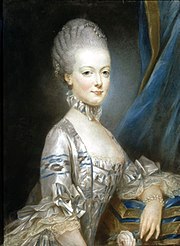
In order to prove to Louis what a beauty her youngest daughter had become since their negotiations began, in 1768 Maria Theresa commissioned the French portraitist Joseph Ducreux to immortalize the then-twelve-year-old Antonia in oils. Antonia (who years later would confess "I am terrified of being bored" ) was notoriously too impatient and exuberant; and after five sittings, the result was disastrous. So Ducreux literally went back to the drawing board.


The result was this portrait of the thirteen-year-old archduchess, not completed until 1769. It was then sent to Versailles.


In order to create this image of teenage perfection Antonia's hairline had been altered. The first step was the removal of a woolen band that her governess had used for years to keep her unruly strawberry blonde curls off her forehead. The band had been so tight and had been used for so many years that it had resulted in hair loss, with bald patches near Antonia's hairline. In addition, her high Hapsburg forehead was judged too unattractive for French tastes and a Parisian friseur, or hairdresser, named Monsieur Larsenneur was sent to Vienna to soften the hairline and create a flattering new hairdo that would disguise the problem. The style, named à la dauphine, became all the fashion for the young Viennese. In Ducreux's portrait Antonia's hair has been lightly powdered.


But the new hairstyle was nothing compared to what Antonia's mouth had to undergo. Her teeth were crooked and in the early months of 1768 a French dentist, Pierre Laveran, was summoned to the Hofburg Palace to straighten them. Evidently, he used an 18th century form of braces. However, none of Marie Antoinette's biographers could enlighten me on the details (one did mention a device called "the Pelican" but had misidentified what the "Pelican" actually was, so it's a good thing I didn't take their word for it). [Since someone is bound to ask, the "Pelican" was a set of pliers used to pull teeth. The pincers or forceps end of the pliers was shaped like a pelican's beak, hence the name.]


After letting my fingers do the walking in cyberspace, I not only came across the technique that would have been used at the time, but the name of the dentist who did the work! Finding the name of Pierre Laveran, who came from a family of respected dentists, was the "eureka" moment. It was enhanced by my discovery of the technique that would have been used at the time, a horseshoe shaped device made of precious metal with perforations at regular intervals through which gold wires were threaded. The device, called "Fauchard's Bandeau" was a revolutionary technique developed by Pierre Fauchard, widely considered to be the father of modern dentistry (and orthodontics). Fauchard's 1728 treatise, "The Surgeon Dentist" (or, in French Le Chirugien Dentiste) was the dental Bible of the age.


Pierre Fauchard (1678 [?] - 1761]

Discovering Fauchard and his method of applying braces to someone's crooked teeth was a golden research moment for me. Taking the process one step further to find the name of the dentist who actually applied the bandeaux to Marie Antoinette's teeth, took it platinum.


Have you ever gone searching for information and stumbled upon exactly what you were looking for -- the tiny detail or tidbit of arcana that added additional authenticity to your novel -- even though you might be the only geek who would ever know (or care) that you hadn't made up the information?


What was it?


P.S. The photo below is a postscript to a comment I made on Kathrynn's recent post about Dark Heroes. We were discussing Brian de Bois-Guilbert in Ivanhoe, and I mentioned that I had adapted the novel for the stage and played Rebecca. That's me, of course, in the dark wig. Ivanhoe was played by the incomparable Ian Rose, who was my co-writer on the script and who also staged the fights.