Showing posts with label romantic poets. Show all posts

Friday, August 21, 2009

Further Research Ramblings: Sense and Sensibility Asea

I think it's Shelley's 1822 death in a boating accident (not quite 30 years old! Why, oh why, didn't he let Lord Byron teach him to swim?) that lies at the root of my interest in Regency figures at the seaside. In any case, I began The Edge of Impropriety with a boating accident, and ended it with a happier trip by water.

But what did they wear during that period when sailing?

No point patterning anyone after Shelley: this radical, atheistical, vegetarian son of a baronet (who borrowed every penny he could against his expectations, with the aim of depleting the family holdings by the end of his life) wore threadbare shirts wherever he went and rarely bothered with neckware. The prototypical romantic poet would have been sadly out of place among the gentlemen of Regency romance -- and anyway, he seems to have mostly gone sailing with his guy friends and left Mary, Claire, Mrs. Leigh Hunt, and the rest of the ladies home with the babies.

In the prologue to Edge I mentioned that Lady Hedges is "dressed for boating," but I didn't go into detail. And the guilty secret (now it can be told!) is that while I was writing it I rather imagined she and her husband board their sailing vessel dressed like Edwardians -- white linen, white flannel, perhaps even "boater" hats.

Entirely off-period, but good enough to get me through writing a prologue and imagining a set of supporting characters.

But in my current work, whose 1813 hero and heroine also go sailing (in a scene that's central to the narrative) I'm not so comfortable finessing the question. (Side issues: why, in women's fiction, do we take such pleasure in having the clothes described to us? And why couldn't Jane Austen have given us a little more to go on?)

So I posted an inquiry on the Beaumonde discussion loop, and was guided (most clearly, of course, by our own Kalen) to various period fashion plates for ladies' seaside wear, and some terrific background information about water and watering places as well.

Somewhat shorter skirts, I thought -- hmm, good point. And note the half-boots. While as for the pantalettes in the print over to the right, I decided to pass on those, agreeing with an 1806 quote from The History of Underclothes that calls them "the ugliest things I ever saw" and swears that the writer "will never put them on again.")

Of course, a truth little acknowledged (by readers -- or writers) of Regency romance fiction is that the second decade of the 19th century wasn't the loveliest ladies' fashion decade, the gowns being increasingly plagued by those hellish ruffles. Looking at the fashion plates, it seemed to me that all the clothes in the fashion plates were chosen for a certain artistic, even romantic, beach effect -- aforementioned ruffles flutter in a gentle breeze as the lady gazed poetically out to sea.

And as I pondered this, I received another response to my query, a bracing email from the prolific and perennially award-winning Regency romance author Allison Lane (who's tutored me before in period matters and consoled me when it was too late to fix my errors -- and whose complete backlist is available at RegencyReads.com):

If your female character is going to sail, make sure she's wearing fabrics that are closely woven and sturdy, in styles that don't billow. Sailing ships, from the smallest to the largest, are loaded with ropes that love to grab anything loosely woven or flapping in the breeze. She will also need a pelisse, both to control the skirts of her dress and to keep her warm since it is nearly always cool to cold on the water. So the ruffles that started appearing on clothing in the latter Regency are awkward at best on board a yacht. She will also need sturdy shoes that won't skid easily.


Sometimes there can be no doubt that you're hearing the voice of reason, not to say wisdom. And after all, I thought, how seriously do "rational creatures" take the dictates of fashion? (The phrase, btw, referring to women, is of course Mary Wollstonecraft's, though I love that Mrs. Croft uses it in Persuasion, and Fiona Shaw speaks it gorgeously in the 1995 movie version...)

But as to "rational creatures" being rational about what they wear...?

Oh. Well.

Which was when I knew what's going to happen aboard my boat -- a war between the rational and the not-so, fashion-wise. A face-off between the wearers of pelisses, sturdy shoes, etc, and the true believers in fashion.

Except, for some reason, I didn't want to say "pelisse," a word that always sounds furry to me.

And so I began to wonder exactly how Jane Austen had described the scene in Emma where Jane Fairfax is almost knocked overboard, during a sailing party. Well, how Miss Bates describes it to Emma, anyway (in a novel where much is said but not everything must exactly be believed), in reference to Mr. Dixon, who, as Miss Bates has it,

...does not seem in the least backward in any attention. He is a most charming young man. Ever since the service he rendered Jane at Weymouth, when they were out in that party on the water, and she, by the sudden whirling round of something or other among the sails, would have been dashed into the sea at once, and actually was all but gone, if he had not, with the greatest presence of mind, caught hold of her habit -- (I can never think of it without trembling!) -- But ever since we had the history of that day, I have been so fond of Mr. Dixon!"

Of course, Miss Bates only has this from the very secretive Jane -- and Emma, as we know, will make of it what she will -- but one thing I'm sure we can believe is that what Jane was wearing is a... habit, quite, as Allison put it "to control the skirts of her dress and to keep her warm."

Except that I'd though that habits were only worn by riders and nuns.

At which point in the process I had to break a rule I've lately set so that I can achieve even a minimum daily word count -- which is wait until later to check the period accuracy of a word.

Nope, in this case we were going straight to my beloved OED (free online for all holders of San Francisco Public Library cards) to... to what, check Jane Austen's period accuracy? Well, to get more of a feel for how else the word was actually used at the time. By, as it turns out, Jane Austen again -- who has Catherine Moreland wearing a habit on the rainy day she's first driven to Northanger Abbey. While Walter Scott, in 1824, points out that riding-habit as a specific use of the word feels, at least to him, relatively recent, when he refers to "The elegant compromise betwixt male and female attire, which has now acquired, par excellence, the name of a habit."

Anyway, I love "habit" as something a Regency lady would wear to sail. Even, or especially, when her sensibility might favor the flutter of ruffles, "habit" sounds to my ear more like an imposition of sense and discipline than "pelisse" does.

Want to take bets as to whether some future editor will let me keep it?

Do you love using the OED as much as I do?

And what excellent research resources (textual or human) are you especially grateful for?

Friday, December 12, 2008

On Refilling my Bookshelves: the Romantics in their Time

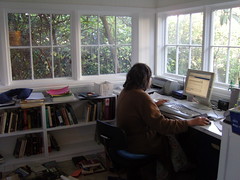
The room I write in is the nicest in our house. A do-it-yourself add-on built by a former owner, my study has an improvisatory, even a romantic, air to it. Resembling a screened porch at the back of the house, it's wainscoted up to its ceiling, with lots of fanciful if not awfully efficient cabinets and unexpected moldings that probably mask seams in the carpentry.

Best of all (especially for a room in a tiny San Francisco Victorian on a narrow little urban plot of ground) the paneled windows along the back and a side wall let in lots of light and other amusements from our backyard and the ones adjoining. Cats in the shrubbery keep watch on their territories even as they doze, while my glamorous actress/model neighbor modulates from singing torch songs to informing one or another of her little boys that he has to "share that with your brother."

When our visitors get the (necessarily very brief!) front-to-back house tour, this is the last room they see. And they usually breathe something like "ah," or "oh yes" -- windows and woodwork calling attention away from the 1950s crumbling asphalt tile on the floor, the white paint yellowed and threatening to flake off the walls and ceiling.

At least until recently. Though who knows how long we would have gone on that way if an architect friend hadn't murmured, "That tile is made of asbestos, you know."

We hadn't known. We raised our son here, after all. But as of last week, the tile is sealed off by a nice new floor and the walls and ceiling are wonderfully, beautifully repainted.

"Just white," I told Teresa, the housepainter. But Teresa's an artist at what she does and artists don't go for easy answers (they're also more curious -- she's read some of my books and came to my book party).

"There are an infinite number of whites," Teresa told me. "You need to think about this."

And so I did. I thought about the room's northern exposure, the cool blue light that pours in when I'm in the throes of a project and begin writing at dawn or before.

And so the white walls and ceiling now have a pearly sunrise glow; the lower wainscoting is a cool, pale blue-gray; moldings, window frames, cabinets, and bookshelves as pure and bright a clouds-of-glory white as Teresa could manage.

And now that I've seen the room empty for the first time since 1984, I can see where the bookshelves (here, in the hallway that Teresa also painted, even in the nearby kitchen) really should have been. Not to speak of beginning getting intimations of how they should have been arranged.

And so... inevitably (you writers and perhaps some of you readers as well know where this is going, don't you?) I, and Michael too, are undertaking a major rearrangement of our books and shelving all through the house.

As you can see from the books scattered about in the photograph waiting to be categorized, it's a slow process. I need to think about this, I tell myself. It's not wasted time, I insist, it's a shape of the space of my life.

Of the life I share with my husband/research partner/most astute reader. Perhaps it's a holiday gift to ourselves and each other. It's not our custom to exchange anything else this time of year. But I'm finding it delicious to realize a little better every day what I need to read and what I don't, not to speak of what I want to work on next -- together or maybe even with Michael.

But in preparation, we're gathering the books about the history of eros and romance -- even (or especially) in literature and philosophy -- in shared space, in a big mahogany bookcase I once got at an auction.

While as for my study -- luxuriously, I may devote one whole bookcase to to-be-read and check-this-out-again, though part of this may also be given over to indispensable-never-to-be-without.

All the books about Jane Austen go together. Lord Byron. Mary Wollstonecraft.

Fiction and poetry (except for novels directly relevant to what I might be working on) still go on the floor-to-ceiling shelves of our living room, though. Because it's a social space, I guess, for sharing with guests what we most love. And showing off (just a little) what we're made of.

But there will be one fiction shelf in my study devoted to a growing passion of mine: for those novels (some out of print) inspired by that moment in literary history when writers and lovers came together, not only to create the modern horror genres (Frankenstein and also Byron and Polidori's gentleman-vampire) but to live and die too fast, and hence to remain (in Keats' words) "for ever young," forever frustrated, angry, selfish, brave and beautiful...

So far I've got:

Passion, by Jude Morgan. A big, delicious, deeply affecting novel by a British romance writer -- who, btw, turns out to be a guy! In alternating sequences covering a decade or two, Morgan tells the stories of the younger romantic poets, Keats, Shelley, and Byron, by telling the stories of the women in their lives, Fanny Brawne, Mary Godwin Shelley, and (two for Byron) Lady Caroline Lamb and Augusta Byron Leigh, with a brilliant prologue about the literal mother of one of them and the figurative mother of them all (and maybe us as well), Mary Wollstonecraft. All of the stories are beautifully wrought, but if I had to pick a favorite, it would be of Augusta, Lord Byron's half sister and (according to some, though not -- I'm told -- the Byron Society), his lover and the true love of his life. (And thanks again to hoyden Janet Mullany for insisting I schlep this one back home from the 2007 Dallas RWA National conference).

Love's Children, by Judith Chernaik. Constructed in a manner similar to Passion, but on a miniature rather than an epic scale. This one comprises first-person narratives by four of the women in Shelley's life: Mary Shelley, her stepsister Claire Claremont, half-sister Fanny Imlay, and Shelley's first wife Harriet, during the year when Mary was revising Frankenstein. Delicate, perceptive, tragic, a story of erotic and amatory liberation in a time when the risks to women were immense (both Harriet and Fanny committed suicide). I read this one after I'd finished writing The Slightest Provocation, and was fascinated that Chernaik had Mary, Claire, and Percy Shelley angrily reading newspaper accounts of the Home Office provocateuring that constituted the political heart of my novel. And I was deeply amused by Chernaik's portrayal of the dalliance between Shelley and Claire: in The Slightest Provocation, my heroine Mary Penley rebuffs Shelley's advances and advises him to "leave aside the fantasies of communal love and for God’s sake get rid of the stepsister." (Love's Children is out of print, but worth the search)

The Year of December, by Lucy Gores. Lots of readers find Claire, "the stepsister," a shallow, bratty annoyance, but her life and letters tell a more interesting story. Yes, she threw herself at Lord Byron at seventeen and had a daughter, Allegra, by him. But she showed backbone and judgment when she protested his sending the child to an Italian convent school. And one can't help but grieve for her upon learning that five-year-old Allegra died there in a fever epidemic that swept the convent -- and to root for her when she pulled herself together to travel across Europe and work as a governess in Russia. Living a long, productive life and never marrying, Claire remained more faithful to Mary Wollstonecraft's passionate feminism than Mary Shelley did. Gores' fanciful novel (written in 1974 and long out of print) follows Claire to Russia and thrusts her into a radical political intrigue worthy of her, the 1825 Decembrist Uprising against the Tsar. I haven't read this yet, but I love its imagined premise -- and its reminder that the romantic era was bracketed by the French and American Revolutions on one end and the rebellions that swept across Europe for decades on the other.

Imposture, by Benjamin Markovits. I was hot to read this when I posted to this blog about the roots of Regency vampire fiction last September, and I loved Imposture when I read it soon after. Though I will have to admit that the story of John Polidori, who lived and died in Byron's shadow, is so sad that I had to switch off with Christopher Moore's hilarious vampire novel Bloodsucking Fiends. Still, in some ways Polidori survives with honor, as the author of The Vampyre, which originated the gentleman-vampire school of fiction, even if its source was a (less good) story by Byron.

I'm not entirely sure what draws me to the romantics and their little wrinkle in literary/historical time, but I suspect it has something to do with my coming to adulthood in another outrageous, risky era -- the 60s -- and that I feel myself to be part of a collective story that I want to hear from more angles than my own...

...if still in my own newly pearly and glorious writing space.

And so -- perhaps returning to thoughts prompted by Mary's lovely post earlier this week -- do you have a mythic, personal time period, either your own or one in history?

And how about your own space for getting in touch with it?