Thursday, February 26, 2009

Near misses in history


We spend a lot of time here debunking accepted historical myths and delving into what really happened. Maybe it's because we approach history as writers and want to improvise upon a set theme or just have an urge to dig deeper. And deeper.

I found out something really fascinating just the other day. I turned to my trusty resource at Historic-UK.com and found that today, February 26, was the date of the first issue of a British one pound note in 1797, a result of the panic caused by the French invasion of Fishguard a few days earlier. The what?! (The invasion, not the pound note. And I don't even want to get into why a pound note could do what a coin couldn't; it makes my head spin the same way a $1.75 trillion deficit does.)

Now popular British myth has it that the last time the country was invaded was in 1066. There were some home grown invasions--didn't the Scots cross the border a few times? How about the Duke of Monmouth in 1685?

Well, Fishguard is in Wales, not England proper; and given that the story has the trappings of a Gilbert and Sullivan operetta and has a woman of a certain age in a starring role, it's no wonder it's not the stuff of legend.

The previous year, the French, under the command of General Lazare Hoche, attempted an invasion of Ireland that, with the support of the Irish, was supposed to spread to the north of England, gaining support in the great industrial cities of the north and marching southwest to Bristol--in other words, taking the major ports. It was foiled by bad weather and poor organization.

In 1797, Bristol was targeted under the command of an Irish-American from South Carolina, William Tate, with four ships carrying over 1,200 soldiers wearing English uniforms, captured earlier--the cloth would only take a dark brown dye so they were known as "La Legion Noir." The weather was too bad to attack Bristol, so they sailed north, landed near Fishguard and unloaded soldiers and weapons. A farm was captured. Vive la France!

The Pembrokeshire Militia gathered, joined by reinforcements from the navy, but discovered the French had superior tactical positions and possibly outnumbered the English. But Tate's forces lost control of the situation, and here's where the G&S elements come in. It's thought that the French, seeing at a distance Welsh women in their traditional dress of red shawls and black hats, were English infantry; furthermore, Tate was having problems with his undisciplined troops becoming mutinous, and the local inhabitants, instead of flocking to support liberte, egalite and fraternite, were hostile.

Hundreds of civilians joined the English troops. As a further blow to French male pride, a local cobbler, 48-year-old Jemima Nicholas, supposedly captured twelve French soldiers singlehanded.

The French surrendered. There's a full account of the invasion at fishguardonline.com.

In a comic postscript, the captured French later escaped in the yacht of the English commander Lord Cawdor.

Over at the Riskies today, talking about the escape of the Corsican Monster from Elba... another legend in his own time.

Why do you think certain events live on in popular memory and others are forgotten?

Wednesday, February 25, 2009

The Privileged Class Enjoying Its Privileges


I claim to believe in liberty, equality, and fraternity. And I live here.

My heroine Mélanie says these words to her mentor and former lover Raoul in Secrets of a Lady, surrounded by the surrounded by the Siena marble, intricate fretwork, and Aubusson carpet of her elegant Berkeley Square library. Pam had a wonderful post a couple of weeks ago which got me thinking about Mélanie’s words. Pam wrote about the conundrum of being “deeply egalitarian in my attitudes toward social, political, and economic matters” and yet writing “in a genre that centers itself upon the pleasures and pursuits of the Regency ton.”

These days, it's difficult not to think about economic matters. And for those of us who write predominantly about aristocrats, the contrast is perhaps sharper than ever. The 1930s romantic comedies I loved as a child were a big influence on me as a writer. So many of those stories (Holiday, The Philadelphia Story, My Man Godfrey among others) take place in a rarefied world of cocktail parties and dinner dances, weekends in the country and engraved cards of invitation). In many ways it's a fairytale world of escapism with black tie and glamorous gowns and cocktails on the terrace. And yet the darker side of the Depression era is not out of sight. My Man Godfrey begins with the madcap society girl heroine on a scavenger hunt from which she brings back the "forgotten man" hero and makes him the family butler. The hero, Godfrey, turns out to have a more complicated past than meets the eye, one which brings the story back to the whole ever-present question of "forgotten men."

In Holiday, the hero, a young, self-made man, wants to take a holiday and "come back and work when he knows what he's working for" to the horror of his socialite fiancée and her Wall Street father (but the delight of his fiancée's sister). In The Philadelphia Story (which remains one of my all time favorite movies and plays), a left-wing reporter assigned (to his disgust) to cover a society wedding, goes to write about "the privileged class enjoying its privileges" (writing this post, it occurred to me that Bow Street Runner Jeremy Roth in my books probably owes something to Mike Connor; both view the privileged class with a jaundiced eye). In the course of a midsummer night both Mike and the heiress bride-to-be Tracy Lord re-evaluate their attitudes toward social class as well as the nature of love and morality.

My mom, who grew up during the Depression, introduced me to these movies (in the days before vcrs and dvds, we often went to old movie revival houses). My mom was also a lifelong liberal with a strong sense of social justice. As I wrote in response to Pam’s post, “I absorbed strongly egalitarian values from my mom, who also introduced me to Georgette Heyer [and Dorothy Sayers, Margery Allingham, Ngaio Marsh and other writers who's books are largely set in a rarefied and aristocratic world] and took me out for tea and with whom I started writing Regency romances. Even our first book, The Widow’s Gambit, which was very 'London Season,' had scenes set in the darker side of the Regency world. Exploring that darker side is something I’ve done more and more through the years. But there’s no denying my central characters live a very elite privileged existence.” And in my own life, though I certainly don’t live in Charles and Mélanie’s elite world, I confess I’m a political, social, and economic liberal who also enjoys the opera and nice restaurants and has a weakness for designer labels (usually purchased at 70% off :-).

In my books, Mélanie in a sense confronts the same paradox. She married her aristocratic husband Charles Fraser (diplomat, politician, duke's grandson) because she was working for a cause that opposed everything his world stands for. She realizes her marriage had catapulted her neatly over an artificial and quite unconscionable social divide. And yet she thinks in Secrets of a Lady that the longer one played a role, the more natural it became. She had grown all too comfortable with the privileges she had married into. It’s a conundrum she continues to wrestle with. In fact, I think she’ll confront it more in future books, when her past and ideals aren’t so buried.

Mélanie's conflict mirrors a number of my own conflicting feelings as an author who writes about a very privileged set of people. I love reading (and writing) about balls and gowns and country house parties and social intrigue. But I’m also fascinated by the contrast between the “Silver Fork” world and it’s darker, more Dickensian side. When I blogged about this topic on my own website, Stephanie commented, "It’s not an easy line to tread. Because I enjoy reading about 'the glitter and the gold' in historical romance, yet few things raise my hackles more quickly than a hero or heroine born at the top of the food chain and carrying around a whopping sense of entitlement....Maybe the difference between an obnoxious versus a sympathetic member of the elite has to do with how they 'wear' power. Do they wear it expecting lesser beings to tug their forelocks and kowtow? Or do they wear it more lightly, understanding that, as people born to wealth and station, they might have something of a duty to those less fortunate than themselves? I suspect that Regency–and for that matter, Victorian–society had plenty of people occupying both ends of the spectrum."

That range of attitudesgives writers a lot of leeway in how portray characters. Think of the difference between Anne Elliot’s self-absorbed father and elder sister in Persuasion versus Darcy who has a strong sense of the duty that comes with his position. Or the way Emma's attitudes change over the course of her namesake book. When my mom first introduced me to Emma, she compared Emma Woodhouse to Tracy Lord. Austen may not write about climbing boys and the stews of St Giles, but she does a brilliant job of showing the plight of women without a fortune without anyone lecturing about it.

And writing about the powerful, doesn't necessarily mean ignoring social realities. As Taryn commented on my blog, "power, well-used, is very attractive, and mis-used is intriguing as a force to be feared."

As writer Mike Connor says to Tracy Lord, "With the rich and mighty, always a little patience."

How do you feel about power and privilege in the novels you read? Do you prefer to read about characters living an elite and aristocratic life? Do you like to see the dark side of that life or escape in to the fairy tale? Does it make a difference whether the story is set in the past or the present day? Does the current economic situation make you yearn for escapism or make you want stories more grounded in economic reality? Or both?

Monday, February 23, 2009

Just what is sexy?


Pam’s last post got me thinking about what I find sexy (or exciting, or intriguing, or moving) as a writer, as a reader, as a woman. And further, about how I use my own predilections in my books without the book becoming a display of TMI (as has been the accusation for a certain paranormal writer), or worse IMO, ending up with a book with limited appeal (the equivalent of the magazine Bears in the gay community, which has a limited and very specific target audience).

On occasion I stumble across a book which, for whatever reason, turns me off, though I can tell that the author is describing something that she finds attractive. And it always leaves me shaking my head in wonder. Some details are entirely unnecessary, and by using them, you can lose readers, so why do it?

Years ago I heard an author give a workshop about designing/describing heroes and her advice is something that really rang true for me: Give just enough details that the reader can fill in the blanks to make the hero her own. The specific example she used, copious amounts of chest hair, rang especially true for me (TMI WARNING: I would never, under any circumstances, be a subscriber of the afore mentioned Bears magazine). She pointed out that by spending precious time lovingly describing the hero’s hirsute chest, you risk readers who find said expanse of chest pelt repulsive laying aside your book and never picking it back up (and worse, never buying another book by you, for fear for further paeans to something that she finds decidedly unsexy). I know that there are authors I avoid because of these sorts of issues, and I’m sure you all have them too.

To further complicate the issue, those of us who write historicals are also often working against what was considered attractive at the time (mustaches anyone?), or what was simply the predominant look (Prince Valiant bowl cut, mmmm, sexy), or aspects of fashion that simply don’t work for the women of today (wigs = toupee, don’t they, just admit it). Throw in a general lack of sanitation, fashion that may or may not float your readers boat (all that velvet and lace in the 18th century doesn’t work for a lot of people, though it clearly does for me, LOL). Some of this you can work around by simply glossing over it. Some of it gets done away with by having characters with unusual habits (there’s a lot of bathing in Medieval Romancelandia). And some stuff just gets made up entirely to better conform to modern tastes (here I’m thinking of a recent discussion on one of my loops of sexy silk nightgowns and sheets in Regency romances).

It’s such a balancing act. Is it any wonder that the occasional reader finds herself falling from the highwire of our creation? As a reader, does it bother you when the hero is “over described” or are you able to skim past it and keep your mental image of the hero as you’ve created him? As a writer, do you worry as much as I do about this stuff, or am I truly alone in the crazy, deep end of the pond?

Friday, February 20, 2009

"When I am dancing, I know who I really am."

Book review: Once a Dancer, An Autobiography, by Allegra Kent.

I’ve loved ballet since I was 8 years old and saw Alicia Markova and Jacques D’Amboise dance “Coppelia” at Stern Grove in San Francisco. That was in 1945. From then on I kept scrapbooks of magazine articles about ballet dancers, read everything I could find about dancing, and the summer I was 9, I even talked my grandmother into enrolling me in a beginning ballet class at the Ft. Bragg grange hall in northern California. During my first lesson, Grandma noticed that both my knee joints were swollen and swept me off to the doctor, who said I had rheumatic fever. End of my ballet dreams, but not of my interest.

Reading Allegra Kent’s autobiography (St. Martin’s Press, 1997) was a thrill. Born Iris Cohen, she started lessons relatively late (at age 9) but excelled in both athletic ability and imaginative gifts. Later she joined the New York City Ballet at 16, the youngest member of the company. George Balanchine choreographed some of his best-known dances especially for her.

Allegra was a choreographer’s dream. She was small (she weighed 100 pounds, and if she gained even 5 pound she worked it off at the barre). She was athletic, with a strict regimen of daily attendance at class (even after childbirth), muscle massages, and swimming exercises with water wings attached to her ankles (her own invention). Balanchine described her as “bendable.” She could do a perfect split standing up–one leg straight up over her head.

Kent had a distinctly unique gift as a dancer--an imagination that could transport her physical body into a character with sensitivity and exquisite nuance. And often an unexpected dash of humor, which enchanted Balanchine.

Outside of dancing, though, her life was a mess. Abandoned by her father, dominated by her mother, involved with first no men at all and then a real rake hooked on drugs, she was gun-shy for years. She reveled in motherhood, bore three children, all gifted in the arts, but all her life she scratched for money to raise them on her own. Her late-in-life love died young (at 60), after only four years together.

Like many talented artists, Allegra was her own worst enemy. She trusted the wrong people, struggled with stage fright all her performing life, and, inevitably, she grew older. Over the years he kept her body in shape for dance, had very few injuries and consistently substituted for other dancers who did, and sometimes ended up dancing eight ballets in a single weekend.

Allegra Kent was the oldest member of the ballet company, still performing at 50, when her mentor Balanchine died. New young talents (Suzanne Farrell, Gelsey Kirkland) were joining the company and Allegra was finally eased out of the troupe.

She was devasted. She had held onto dancing because “When I am dancing, I know who I really am.” In the following years she taught at ballet academies, coached other dancers in various ballet troupes, and performed in special “gala”concerts to which she was invited for a starring role.

What is most impressive to me is that she never gave up. She worked at dance; she sacrificed for her children; she loved unwisely and she suffered great losses. But each time she picked herself up, packed up her leotard and pointe shoes, and marched off to her daily regimen of classes.

Sound familiar?

Tuesday, February 17, 2009

A Few of My Favorite Dungeons

When I wrote my first book, The Secret History of the Pink Carnation, I blithely invented an extra-special torture chamber for my half-mad villain and his collection of the Inquisition’s Greatest Hits. I needn’t have bothered. If there was one thing revolutionary Paris didn’t lack, it was dungeons. In my current work in progress, my hero is employed directly by the Prefecture of Paris, and indirectly by Napoleon’s spymaster, Fouche, so I’ve been making up for lost time by taking full advantage of the dungeons of Paris.

In case you should care to visit the dungeons of revolutionary Paris, here’s my impromptu Lonely Planet guide on the subject:

The Temple Prison:

Definitely a must-stay for the discriminating aristo or would-be English spy. Located on the right bank of the Seine, in le Marais, the old aristocratic quarter of Paris. Former fortress of the Knights Templar, dating back to the 12th century. A very chi-chi place to be incarcerated: the royal family (Louis XVI, Marie Antoinette, the Dauphin, Princess Marie-Therese, and the King’s sister, Madame Elisabeth) were kept here while awaiting the fatal fall of the guillotine. It was at the Temple Prison that the Dauphin was last seen alive. Other notable inhabitants of the Temple Prison include Sir Sidney Smith, thought to be one of the prototypes of that demmed, elusive Pimpernel (although Sir Sidney was clearly not quite elusive enough, since he spent two years in the Temple prior to his belated daring escape).

Prison des Carmes:

The Temple might have been the prison for the old royalty, but les Carmes was the place for the new. Watch out—if you stay here, you may run across some of the key figures of the new political order to come. Rose de Beauharnais (later renamed Josephine by her enraptured second husband, a little man by the name of Bonaparte) was imprisoned here during the height of the Terror. Look closely and you may see her small pug dog Fortune running back and forth, carrying hidden messages to her two children, Eugene and Hortense. With her, you’ll find Therese Cabarrus (shortly to be Therese Tallien), who enjoyed a brief fame as Our Lady of Thermidor, hailed as the prime mover behind the fall of Robespierre and the end of the Terror, as well as being best of friends with the future Madame Bonaparte—until an increasingly stuffy Napoleon decided she was too flashy and he didn’t want her hanging around his court.

The Abbaye Prison:

A nice compromise for the discriminating prisoner who wants someplace with a known name, but less flashy than the Temple. Conveniently located in the fashionable district of St. Germain, on the left bank of the Seine, the Abbaye was made notorious in the September Massacres of 1792, when a bloodthirsty mob attacked the prisoners, killing over a hundred with a barbarity that shocked contemporary chroniclers. Notable prisoners included Mme Roland, as well as Sir Sidney Smith (yes, he got around). During the Consulate and Empire, the Abbaye was used for the interrogation of prisoners, with methods that included burning the soles of the prisoners’ feet and crushing their fingers in musket locks.

Also Available for Bread, Water, and a Little Light Torture: La Force (where indignities were perpetrated upon the Princess de Lamballe); Prison de la Bourbe, aka Prison de Port-Libre (the royal governess and Louis XVI’s lawyer were kept here); the Madelonnettes Prison (the Marquis de Sade stayed here); Saint Pelagie prison (more Marquis de Sade, as well as Mme Roland, although one hopes not at the same time); Le Coignard (um, yeah, the Marquis stayed here, too); Saint Lazarre (originally a leper hospital, but no Marquis de Sade); and many, many more….

Friday, February 13, 2009

Seeing Through Clothes: Milk, Mad Men, and Me

I finally saw Milk last night, and like Tracy, I left the theater in tears.

A lot of it was the memory of the events themselves – like the Briggs Initiative to rid California schools of gay and lesbian teachers (and their supporters) and the heroic, successful, hands-on campaign to defeat it.

I remember this particularly vividly because a friend of mine, activist Amber Hollibaugh, set off in a van and drove around rural California towns like the one she’d grown up in – an out lesbian taking on local fundamentalists in public debate, in 1978.

Could this have really happened, I ask myself? Could people really have been that brave?

It did happen. You can read Amber's account of it here.

But I know it's true because I remember how after the campaign, Amber showed me a lovely blousy overshirt (it was an era of big, filmy, voile-y sorts of things from India), and told me how she wore it to debate one Reverend Royal Blue of Redding, California. The shirt didn’t wrinkle, she said, and the metallic threads running through it gave it a sort of dressy look, good for being onstage in a local community center. Funny that amid all that astonishing, inspiring, take-on-the-world chutzpah, a big blue shirt with metallic threads running through it is what made Amber's bravery real for me.

Funny but true. There’s nothing like the clothing of an era to bring us back there. Milk has an uncanny, offhand realism about it – Sean Penn and other cast members wear the slouchy jeans of the late '70s just as I remember them being worn. And my husband Michael had that very same rust-colored jeans jacket – it would have been several years old in ’77 or ’78, which is accurate too (most of us don't throw our clothes away after a year).

In fact, the costumers the TV show, Mad Men talk somewhere in a DVD extra about the '50s clothes and objects they used for the show's 1960 first season.

Not that this favorite show of mine is anothing like Milk. Mad Men is about advertising rather than activism; it's cool rather than passionate, trading in desire and frustration rather than risk and triumph.

But what a sly, true take it has on an era's styles and surfaces, codes and constraints, as expressed through the world of objects its characters move through, sit on, wear, and (perhaps most especially) covet.

Sadly perhaps, since our cable contract is too "basic" for AMC, I'm a season behind and dependent on DVDs for my Mad Men fix. So I've only watched through end of Season One, the Thanksgiving 1960 episode (its ending credits scrolling against Bob Dylan's "Don't Think Twice," a song that wasn't written until 1962, the year Season Two begins – appropriately enough for this post, with a Valentine's Day episode).

But the enforced scarcity of a cheap cable contract makes me all the more obsessive consumer of the DVDs, plumbing the voiceovers and other extras for meaning – which in the case of Mad Men are the interviews with the costume designer and makeup people, along with snippets from the actors wearing the clothes and makeup:

- The women in their girdles and amazing torpedo bras: for all the lack of bodily freedom, many of the actresses admitted to enjoying feeling more "put-together" than we get to be these days)

- The men in their suits with the 13-inch fly zippers: the actors say the pants are too tight and rise too high; they complain of the discomfort. But watch them walk – watch John Hamm move across the frame (after the commercial – sorry! – about 1 minute, six seconds into this clip -- there, that wasn't so painful, was it?); I don’t know what it is about that walk, but I know that a part of me – a deeply desiring part of me from my early teens – remembers that walk and that look as a masculine ideal.

But as a writer I'm more interested in the clothes from the inside out. The way they make us feel when we wear them. Because our clothes may be our most consistent guides and goads to who we try to be in a world we didn’t create; our nakedness when we're alone an intermittent reminder that we aren't exactly those people; our nakedness with a lover a way of revealing this fact.

And the limnal moments of dressing and undressing, especially when shared with a lover (not to speak of a reader!)… well, in my writing, anyway, for me those are perhaps the sexiest, most complicated and challenging moments of all. Which is why, I guess, I care so much about what people really wore in the periods I write about – why, like Kalen Hughes, costume expert extraordinaire, I take seriously that Regency stays and shifts didn’t just fall off at the touch of a male finger.

(I’m indebted to Kalen, for example, for teaching me that in 1828 women’s stays began to have metal grommets around the holes for laces – can you think of a better way to show-not-tell the beginnings of an advent of radical physical unfreedom for women?)

And why I usually like to include a dressing as well as an undressing scene among the erotic parts of my books – because I love the pathos of people going back to their worlds, of eros and ego in a world of objects.

And why I’d love to know how the writers among you think about the clothes (period and otherwise) that you write about…

…and what you readers want when you read about them.

Oh, and an acknowledgment: The title of this post comes from Anne Hollander's deeply illuminating study of clothing in the western art tradition.

Wednesday, February 11, 2009

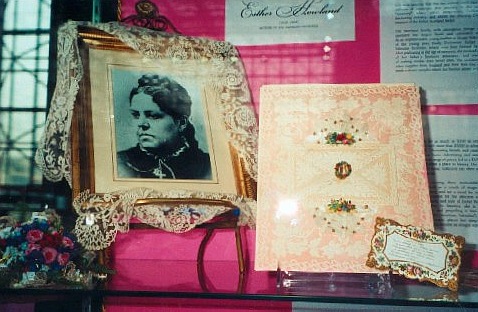
All Hail Queen (of Hearts) Esther Howland


Esther who?

With florists and jewelers doing a land-office business around February 14, sooner or later, someone was bound to see the commercial potential in romantic greeting cards. And who has the time to make each missive with their loving hands?

The visionary was Esther Howland (1828-1904), a Worcester Massachusetts native and Mount Holyoke graduate who never married. But of course Jane Austen never wed either, and one could never accuse her of not knowing a thing or two about romance.


A classmate of Emily Dickinson's, Howland graduated from Mount Holyoke in 1847 at the age of 19. When she received an ornate English Valentine from a business associate of her father’s, her heart skipped a beat—because she saw dollar signs.


Her family owned Worcester's largest stationery and book store, so she already had connections. Esther created a dozen prototypes of her Valentines and gave them to her brother to include in his sample book. When he returned from his business trip with more than $5,000 in orders, Esther realized she wasn't going to be able to process all those orders alone. So she started up her own greeting card business, importing machine-embossed paper lace (think doilies) and floral decorations from England, and employing her female friends to manufacture Valentines using the process and techniques of an assembly line (take that, Henry Ford!)


On February 5, 1850 she took out her first advertisement in a Worcester paper, The Daily Spy.

Soon, things were booming; in 1879, Howland's company was named the New England Valentine Company (her valentines usually have a NEV CO on a red sticker on the back); and the little cottage industry moved from Esther's family home to a building of its own. She published a thirty-one-page book of verses and allowed her clients to chose their own poem for their valentines.


Esther Howland became known as the "Mother of the American Valentine" and her company brought in annual revenues of $100,000. The decades between 1840 and 1860 were the golden age for sentimental Valentines. Even after they caught on in America, the perforated lace paper used for making them was still manufactured only in England, so Esther continued to import the lace-edged “blanks” for her company’s cards. But she introduced several innovations of her own to the Valentine-making industry: she is credited with the idea of placing a thin sheet of colored paper under the white paper lace, to produce a contrast, as well as with the concept of a three-dimensional “shadow box” card.

A recurrent knee knjury forced Esther to work from a wheelchair since 1866. And in 1881, Howland sold the business to the George C. Whitney Company so she could care for her ailing father.


As people who focus on love and romance nearly every day because it’s what you write about, does Valentines Day have any special place in your heart? Do you think of it as a “busman’s holiday?” Do you send Valentines? Do you make them yourself, or do you buy them? Are you one of those people who send a little valentine to many people in your life to remind them that you think they’re special, or do you save all your love for one recipient?