Sunday, May 31, 2009

A British Treasure

In the spring of 1986 I absorbed a museum exhibit that ranks as the best in my experience. "The Treasure Houses of Britain" was seen by almost one million people during its five months at Washington's National Gallery of Art. Like most of the visitors I was amazed, impressed, "gobsmacked" not only by the sheer opulence of the treasures but also by their artistic merit.

Whenever I haul out the 600page/7 pound catalog I lose myself for hours and today alone I came up with tree subjects for future blog posts.

Here are a few notes about the Treasure Houses exhibit. According to the National Gallery of Art website more than 700 objects were gathered from more than 200 homes in Great Britain representing collecting and domestic arts from the 15th to the 20th century. Gervase Jackson-Stops chose the art work and the exhibit was structured to showcase each period of collecting. Seventeen period rooms were built to display the objects. "The Treasure Houses of Britain" was obviously the most ambitious project ever undertaken by the NGA.

It was at this exhibit that I first saw the work of master woodcarver Grinling Gibbons. The piece on display was a a carving of fish and game, not my favorite subject matter, but the delicacy and detail amazed me. I do not know how Gibbons worked but plan to research that more. I do know that he created these masterpieces before dental implements and dremel tools made intricate carving more accessible. Gibbons work shows an attention to detail that defies the imagination of my contemporary “hurry up and get it done” approach to most projects.

Grinling Gibbons was born in Rotterdam in 1648. It’s possible his father was an Englishman who worked with British architect, Inigo Jones. Grinling obviously developed his talent in the nineteen years before he came to England in 1667 but his career as a craftsmen in wood began in earnest when he was discovered by diarist John Evelyn working “in a poor and solitary thatched hut in Kent." Evelyn introduced him to King Charles II through the intercession of Christopher Wren.

Gibbons work can be found in dozens of houses and public buildings throughout Britain, including Petworth, Blenheim, Kirtlington Park and also at Windsor, colleges at Oxford and Cambridge, and many of Wren’s London churches. Gibbons and his workshop added immense detail and beauty to St Paul’s, London. One of the choir stalls is pictured above.

Gibbons worked in other mediums, but wood best suited the detailed handiwork for which he is best remembered. The life-like cravat pictured at the left is on exhibit at Chatsworth and is a departure from his usual work with objects of nature. The panel on the right (from Trinity College at Oxford) is one of my favorites, the grapes look real enough to eat.

Are you familiar with Grinling Gibbons and his work? What exhibit ranks as the “BEST” in your experience?

Friday, May 29, 2009

Promissory Notes: Reading Theory on Vacation

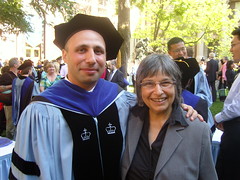
Amanda's not the only hoyden who's been on the road lately. I recently returned home to San Francisco after a fantastic three weeks doing my Northeast Family Corridor Circuit (New Haven-New York-Philadelphia) for many hugs, visits, and bigtime celebrations, including my sister's wedding (more soon at my own blog) and my son's PhD conferral from Columbia (next year the Corridor gets longer, when Jesse begins teaching English at Johns Hopkins in Baltimore; I'm delighted that the cheap and comfortable Bolt Bus goes there too).

Unusually for me, I didn't make a lot of plans, except to get to the celebrations on time. With more people to visit than I had time for, and my husband, sadly, only able to get off work for the wedding and the degree ceremony (the last long weekend of the trip) I decided to take the solo part of it slow, to follow my nose and my luck: as when my friend Barbara Garson introduced me to an artist friend of hers in the locker room of the Chelsea Piers gym -- who sent me to the glorious Picasso:Mosqueteros show at the Gagosian Gallery on 21st Street (still showing until June 6: run, don't walk, if you're in New York) -- after which, strolling down 23rd Street on the way to the subway, I stopped at a movie theater to see what time Star Trek was starting.

In five minutes? Sure, I said, I'll take a ticket, even as I wondered if there'd be a decent seat left (which is no small concern for someone measuring five foot one on a good day). How nice that I wound up in the best seat in the house, a single in the nicely-banked last row of the theater.

Because it was that kind of a trip. The best, the luckiest kind, that makes a high-and-low culture vulture like me eager to live long and prosper (not to speak of go all soft and happy inside over the absolutely right and absolutely Obama-era Spock-and-Uhura pairing).

The kind of trip where the next thing to do is obviously also the right thing.

And the next thing to read is the right thing as well -- as I sat in this or that New York cafe, w.i.p. on my laptop; pens and notebook, books and drink on the table; with a lovely, leafy late spring just outside, and myself only mildly, occasionally pricked by the exquisite guilt of being in this most wonderful of cities at the wonderful moment when spring rain stirs dull roots even if I hadn't earned it through suffering through an East Coast winter.

East Coasters may understand the guilt thing (I was born in Brooklyn); Californians probably won't.

But between the pricks and twinges I took the season as a gift, even as I took my reading seriously. I've already listed what I was into during those weeks, in my response to Kathrynn's What-Are-You-Reading Hoyden post, but what made it particularly great was checking in with my awesomely erudite son, who knows oodles about the history of the European novel throughout the nineteenth century.

Like when I asked him what he knew about D.A. Miller's lit crit study The Novel and the Police, that Lisa Fletcher makes sound so interesting, in her lit crit study Historical Romance Fiction?

Jesse went to his bookshelf. "Miller's book is very interesting," he said, "and it's important too." Important enough, it seemed, that he had two copies, and graciously handed me one of them.

So I read The Novel and the Police, and began to think about what Miller has to say about novels and "open secrets," and how that works out in romance novels where the hero and heroine are always the last to know.

And which led me to think more about what Lisa Fletcher has to say about historical romance -- popular and literary -- and more particularly about historical cross-dressing romance, which she says occupies a place of some importance for understanding historical romance as a whole. She even makes a few small observations about my cross-dressing historical romance, Almost a Gentleman (that was interesting to read!) among many other texts on her way to an extensive and thought-provoking discussion of Georgette Heyer's cross-dressing romances.

So I also read These Old Shades, and am queuing up The Masqueraders. And then a reread of Possession (A. S. Byatt, I learn from Fletcher, being an outspoken fan of Heyer and doubtless an instructive one), and then perhaps what sounds like a fascinating study by Alison Light, called Forever England: Femininity, Literature, and Conservatism between the Wars, which I hope will help me understand the Tory aspects of the romance genre (as I've groused about it on this blog from time to time, even as I've indulged my early passion for the great popular/literary English between-the-wars writer Dorothy Sayers, of the Lord Peter Wimsey mysteries).

While back in San Francisco...

"You're so intellectually hungry these days," my husband told me yesterday, and I suppose I am. Not only because I take a wonky lit-crit interest in literary history and in what (still and always a bit mysteriously to me) is called "theory," but because I can't help but think that at least some of that weighty stuff does have something to do with the lighter-than-air stuff I write, and with whatever instinct or memory or desire caused me (not much of a romance reader, in truth) to become a reluctant yet enthralled romance writer.

Also because I write my own stuff better if once in a while I evoke the old shades and stir up the roots with a little spring rain of research, self-understanding and reminiscence. (Leading me to give thanks for the spadework the romance scholars of IASPR are doing, and to encourage anybody else who's interested in this stuff to join the newborn International Association for the Study of Popular Romance. And to thank Dr. Eric Selinger, one of the organization's blithest guiding spirits, for turning me on to the Fletcher book).

And because I think this stuff -- or at least the best of it -- works.

Which is why (drawing upon hoyden Lauren Willig's endlessly helpful Theory of Productive Procrastination) I hope, in some future post, as a break from my own w.i.p. (yes, there is one, I promise!), to give some account of the critical commentary that most helps and interests me, both as reader of popular and literary fiction, historical and erotic romance writer, theory groupie, and even (swear to god, Jess, I'll never be this embarrassing again) proud parent of the smartest, most erudite literary scholar I know.

Wednesday, May 27, 2009

WHO Slept Here? I Did! Staying at Places with a Past


My husband and I just returned from about ten days down South.


In New Orleans we stayed at the Lamothe House on Esplanade Avenue, bordering both the Vieux Carré and the Marigny district. Built in the 1830s for a sugar baron, it was one of the first double-wide (so to speak) mansions in the French Quarter, and was completely renovated in 1860.


What you see in the photo below is the dining room where guests have their complimentary, though disappointing, breakfast, consisting primarily of packets labeled Quaker or Kellogg. But that's not the point of my post.


Lamothe House dining room


The wide planked floors slope; the treads of the winding double staircase buckle under your feet as you mount them; the Victorian-era furniture is scratched, the upholstery tatty, and the underpinnings barely there because thousands of butts have sat there over the last three centuries, counting our own (butts and centuries).

Frankly my dears, it's those bygone butts that fascinate me.

Lamothe House foyer


Who slept here before I did? What was this house like in its heyday? Was the poky room we were first assigned, located in a low, one-story building flanking the courtyard and its opposite number, where the slaves slept? Were the rooms we were switched to a combination of front and rear parlors? Did the sugar mogul himself sleep there?


Room 214, Lamothe House. We slept here.

I love staying in places with a past. And if I'm only there for a few days, it doesn't much matter to me that the upholstery is worn or that the floors slant or that the plumbing is erratic. I'm surely not alone in imagining if these walls could talk...


Here, from the Lamothe House Hotel's web site is the history of the house.


The first Lamothe to own the property was Miss Marie Virginie Lamothe, who purchased two parcels of land fronting on Esplanade Avenue in 1829. She sold the same property to her 33-year-old brother, Jean Lamothe, in 1833.

The house was built circa 1839 as one of the first double townhouses to be built in New Orleans. Jean Lamothe was a wealthy sugar planter of French descent originally from the West Indies. He sought refuge in New Orleans for his family at the turn of the century, after the insurrection in Santo Domingo.


In 1859, the Lamothe family sold the property to Henry Parlange and Paul Rivera, two Parisians. At this time, Rivera contracted builder Louis Folliet (E. G. Gottschalk) to make considerable renovations. Rivera's contract included changing all the shutters and doors, and converting the porte-cochere (carriage entrance) into a main entrance and hallway. This is the reason for the unusual façade opening arrangement.


In 1860, the four hand-carved Corinthian columns were added to the double entrance. Also added were the twin winding stairways with hand-turned mahogany rails that sweep up to the second floor reception area and third floor suites. The house's great cypress floor boards and ceiling timbers were hand-hewn and many of the hand-wrought iron fastenings for doors and windows, as well as most of the original rolled glass window panes, have been preserved.

The double service wings were rebuilt of brick, and the courtyard was paved with flat stones originally imported as ship ballast. The original flagstones remain today.The Rivera contract also specified that the parlors were to be richly decorated to the taste of the owner. This is reflected in the rich interior millwork, moldings, and plasterwork installed by Folliet in 1860.

Interior openings retain the original Greek key arches and door frames surmounted by handsome molded cornices and transoms with sophisticated muntin arrangements.


I could not stop imagining what life was like here in the 1830s as well as in the 1860s, and how it changed over the decades.


In Savannah we rented a condo apartment in the Bird Baldwin House on Liberty Street, at the edge of the historic district. The house was built in 1839 as an inn. During the Civil War it served as quarters for some of General Sherman's troops. As a Yankee myself I admit it felt good to stay in a place that housed Union soldiers. Did they tromp all over the hard pine floors in their muddy boots? What did they discuss in front of the fireplaces? What did they do for recreation? How many other weary travelers stayed in these rooms? Where were they going and where had they been?


Do you enjoy staying in houses with a past? Have you ever done so? Do you tend to seek them out when you book a vacation and do you mind if the venue is a bit down at heel, if it's a trade-off to become part of the house's lore?

Monday, May 25, 2009

Medals and Ribbons

In the US, the last Monday in May is celebrated as a national holiday, Memorial Day. It is a day of official recognition of men and women who have died in military service to their country. In its early days this holiday was called Decoration Day and was originally instituted after the Civil War to honor soldiers who fought for the Union.

General Order #11 states that “The 30th day of May, 1868, is designated for the purpose of strewing with flowers, or otherwise decorating the graves of comrades who died in defense of their country during the late rebellion, and whose bodies now lie in almost every city, village, and hamlet churchyard in the land. In this observance no form or ceremony is prescribed, but Posts and comrades will, in their own way, arrange such fitting services and testimonials of respect as circumstances may permit.”

Since World War I Memorial Day has been recognized as a day to reflect on the loss of life in any military action or war. Memorial Day is often confused with Veterans Day, November 11th which recognizes all who have served in the Armed Forces. But I don’t know any vet who, when thanked for service on Memorial Day, makes the distinction clear.

Medals are another more personal form of recognition for service. The two US medals that are best known are The Congressional Medal of Honor and The Purple Heart. Both of these medals were instituted by George Washington. In 1782 Washington “directed that whenever any singularly meritorious action is performed” the soldier was authorized to wear the “figure of a heart in purple cloth or silk, edged with narrow lace or binding.”

The Purple Heart was one of the first medals to be made available to the enlisted as well as offices. In fact only three Purple Hearts were issued at that time, all
three to non-commissioned officers. Awarding of the Purple Heart (then called the Badge of Military Merit) fell out of use and was not re-instituted until the 200th anniversary of Washington’s birth when the more familiar medal (at right) was designed and formalized.

Since it reintroduction in 1932 over 800,000 Purple Heart medals have been awarded, From 1932 until World War II, it was given not only for being wounded in action but also for meritorious service. The qualifications for the medal have changed since then and the criteria now focus on injury in action.

George Washington authorized the Congressional Medal of Honor in 1792 after the Revolution but it was not a popular award as many thought that such “decorations” were too royal a concept for the new democracy to accept. The medal came into use during the Civil War and is the highest military decoration awarded to this day.

While we are all familiar with the Congressional Medal of Honor and the Purple Heart there are ten medals that precede the Purple Heart in importance with the Medal of Honor at the top, always at the top.

If you are interested in the medals and the criteria for awarding them this website does a nice job of presenting the details http://www.gruntsmilitary.com/army2.shtml.

The actual medals are worn on formal uniforms in order of importance. Ribbons that represent the owner’s medals are worn on a day-to-day basis.

The last picture shows the ribbon representing the medals of a typical senior officer of the late twentieth century. On meeting him anyone could tell a great deal about his career by “reading the ribbons.” The when and where of each ribbon is almost always a story worth hearing. The two most distinctive on this set are the Bronze Star earned in Vietnam as a Lieutenant and the Meritorious Service Medal which is a one inch representation of an amazing experience known as Hurricane Hugo.

I have always wanted to write about ribbons and medals and it seemed that Memorial Day was the perfect opportunity. I promise to return to Kedleston Hall and the Regency in my next blog post.

How did you celebrate this weekend? We had a grand time with our son and daughter-in-law. I hope you had as much fun as we did.

Friday, May 22, 2009

The 10 Most Important Kisses in History

I saw this article on CNN yesterday and it was just too good to pass up. So I am posting in its entirety, with my comments at the bottom.


“Pucker up as we explore 10 smooches that changed religion, art, culture, and history. "


1. The Kiss of Judas: A betrayal or just misunderstood?
Nothing ends a good "bromance" quite like flagrant, murderous betrayal. A long time ago, a wandering preacher named Jesus was doing pretty well for himself -- building up a following and promoting religious teachings -- until one of his buddies sold him out to the authorities. In exchange for 30 pieces of silver, Judas Iscariot kissed Jesus on the cheek and, by doing so, identified him to Roman soldiers. Although Judas double-crossed his best friend for a paltry sum, some scholars argue that Judas is the secret hero of Christianity. The claim is based on a recent translation of The Gospel of Judas, a text written by Jesus' followers a couple hundred years after his death.


In 1978, a farmer discovered the mysterious text in Egypt and sold it to an antiques dealer. Years later, a National Geographic Society team got hold of it. They restored and analyzed the document, and in 2006, they announced that the text painted Judas as a man of valor. According to their interpretation, he was actually Jesus' most trusted friend, because he agreed to fake a betrayal so that Jesus could die a martyr and then be resurrected.


Soon after the National Geographic Society released its findings, other scholars started picking the interpretation apart. Chief among them was April D. DeConick, a Rice University biblical studies professor, who claimed the team made some critical errors, including translating several passages to mean the exact opposite of what they were intended to communicate.
DeConick contends that the Gospel says Judas was a "demon" rather than a "spirit," as interpreted by National Geographic, and that he was set apart "from the holy generation" rather than "for the holy generation." With just a few tweaks in translation, Judas has gone right back to playing the bad guy.


2. The kisses you can share with a Quaker
The Religious Society of Friends, or Quakers, is a small Christian sect best known for rejecting all forms of violence, embracing progressive politics, and dedicating themselves to simple, restrained living. They've promoted a more harmonious world by founding causes such as Amnesty International, not to mention lending their name to oatmeal.


So we were surprised to learn that when teenage Quakers get together, their favorite activity is a free-for-all kissing game that often ends in bruising and rug burn. Alternately known as Ratchet Screwdriver, Bloody Winkum, or Wink, the game dates back to the early 1900s.
To play, participants divide themselves into girl/boy pairs with one boy left over to be the "Winker." The pairs sit on the floor, with each boy hugging a girl from behind. When the Winker winks at a girl, she tries to scramble across the room to kiss him, while her male partner does his best to hold her back. Hilarity (and release of pent-up sexual frustration) ensues. But not everyone finds this game so hilarious. In 2002, the Children & Young People's Committee of the Quakers in Britain issued a statement discouraging the game at official functions. And while that may not seem surprising, the reasoning is. The committee frowns upon the game because younger children and adults don't get to play, thus making it ageist. Due to their egalitarian values, Quakers seldom segregate by age at get-togethers, and the committee didn't want the very young or the very old to feel left out.


3. The kiss that proved no means no
Gentlemen, a word: When a lady rejects your advances, you'd do best to listen. Take, for example, the story of Thomas Saverland, an English gentleman who was at a party in 1837 and, as a joke, kissed Miss Caroline Newton by force. In response, she bit off a chunk of his nose.
Saverland took her to court, where the judge found his case more hilarious than harrowing. The judge ruled, "When a man kisses a woman against her will, she is fully entitled to bite off his nose, if she so pleases." A smart-mouthed barrister then added, "and eat it up, if she has a fancy that way."


4. The kiss that said "welcome to America!"
At the turn of the 20th century, immigration processing at Ellis Island was quite an ordeal. Immigrants had to prove they weren't carrying any of a long list of illnesses, mental impairments, or moral defects. If you were sick (and it was curable), then you'd be detained in the hospital until you got better. The whole process could take hours, days, or months. And even then, you could be turned back. Also, ladies traveling alone and anyone with less than $20 in their pockets had to wait for a sponsor or family member to meet them. If no one was there to greet you, you were sent back. Of course, all of this was further complicated by the fact that immigrants couldn't go down to the pay phone and call Aunt Bertha when they landed. Instead, when relatives heard that the right ship had docked, they trucked over to Ellis Island and waited desperately by the Kissing Post -- a giant wooden column just outside the room where the final stages of immigration took place. Ellis Island staffers gave the Kissing Post its name because families and lovers were generally swept up in emotion as they reconnected with their long losts.


Today, the Kissing Post continues to be a symbol of hope and togetherness as the pillar that supports the American Family Immigration History Center. If you're one of the 100 million Americans descended from immigrants who passed through Ellis Island, there's a good chance the History Center there can help you find a picture of the ship that carried your ancestors.


5. The Eskimo kiss: A tale taller than the abominable snowman
Popular wisdom claims that Eskimos rub noses because kissing on the lips would cause their mouths to freeze together. Not only is this completely untrue, but Eskimos don't rub noses at all.
The myth of the Eskimo kiss was created by Hollywood in an early "documentary" called Nanook of the North, which took America by storm in 1922. To film it, director Robert J. Flaherty recorded real Inuits in the Arctic. However, in order to accommodate the huge, awkward cameras of the day, he staged all the scenes and built a three-sided igloo for interior shots. Nanook, the main character, wasn't really named Nanook, and the women playing his wives weren't really his wives.


As for the term "Eskimo kiss," that too was constructed by Flaherty to explain how one of the wives was nuzzling her baby. In actuality, the woman was giving her baby a kunik, an expression of affection in Inuit culture. Typically in kuniks, adults press the sides of their noses against the cheeks of their babies and breathe in their scent. Who kuniks whom differs from culture to culture, but it's never a romantic gesture. Inuits kiss on the lips, just like everyone else.


6. The first guy-on-guy kiss to hit the big screen
Movie experts often credit Sunday Bloody Sunday, a 1971 film about a love triangle among two guys and a girl, with being the first mainstream feature film to depict two gay men kissing. That's true, but it wasn't the first time two guys kissed on screen. Apparently, straight men had been doing it for decades. In 1927, two soldiers kissed tenderly in the silent movie "Wings", which won Best Picture at the first Academy Awards. When the film was released, no one raised an eyebrow about the scene, partially because kissing in the trenches was remarkably common during World War I. According to British Academy Postdoctoral Fellow Dr. Santanu Das, letters and accounts of the war are peppered with stories of soldiers kissing, embracing, and giving each other pet names like "my Palestine Wife."


Das believes the war succeeded in breaking down the traditional limits on emotional and physical intimacy between men, allowing soldiers to form relationships that went beyond what was permissible at home. While it's surprising to us today, that Wings scene didn't even cause a stir in 1920s America.


7. The kiss that gave artists their 15 minutes
If it weren't for kissing, Andy Warhol might never have become The King of Pop Art. In 1963, Warhol was still a little-known commercial illustrator. But that all changed when he bought a silent-film camera and started shooting his friends and acquaintances kissing in unbroken, four-minute-long shots. The result was a series called Kiss, which took the art world by storm. In fact, New York's Gramercy Arts Theater played a new "kiss" each week. The series helped cement Warhol's place in the artsy underground, and it also launched the careers of several kissers.


8. The prepubescent kiss that changed the law
When first-grader Johnathan Prevette pecked his classmate on the cheek in Lexington, North Carolina, he quickly became a poster boy for everything that was wrong with America in 1996.
After Johnathan's classmate complained to a teacher, the 6-year-old was taken out of class for the day, missing an ice cream party. When the school told Johnathan's parents that he'd violated the sexual harassment rules, a media circus followed. Critics pointed to the Prevette case as a sign that political correctness had gone too far, adding that innocent play didn't deserve such harsh punishments. After all, pundits asked, is a child really capable of sexual harassment?


But while Johnathan was making headlines, another legal battle was raging. A 10-year-old Georgia girl named LaShonda Davis had been repeatedly groped by a bully in her class, to the point where she contemplated suicide. She told several of the teachers at her school, but no one did anything. LaShonda's parents had to call the police -- and sue the school --before the abuse stopped.


Both Johnathan and LaShonda deserved protection under the law, and both cases played a role in molding the current standards. In response to the Johnathan Prevette case, the Department of Education's Office for Civil Rights issued new guidelines for identifying sexual harassment by putting the emphasis on common sense and telling schools to take age and maturity into account.
But there was still a big question about whether schools should be accountable for students harassing each other. When LaShonda's case went to the Supreme Court in 1999, their answer was yes, sort of. The Court decided that schools can be blamed, but only if they learn of the abuse and do nothing to stop it.


9. The kiss that could send you to jail
In the city of Guanajuato, Mexico, there's a smooching spot called el Callejón del Beso, or the Alley of the Kiss. According to local legend, the alley was once the final scene of a tragic love affair. A young woman and her lover were meeting there to run away together, but when her father discovered them, he stabbed his daughter in the heart. As she lay dying, her lover kissed her hand for the last time, and the alley got its name. Today, it's said that anyone who kisses there will have seven years of happiness. Thanks to its romantic history, the alley has become a popular tourist attraction, although that's starting to change. On January 20, 2009, the ultra-conservative mayor of Guanajuato authorized a new municipal ordinance cracking down on public displays of affection. If he has his way, lip-locking in the open will carry with it a fine of $100 and up to 36 hours in jail.


10. The most Iconic kiss in history
On August 14, 1945, thousands of men and women embraced one another in New York City's Times Square to celebrate victory over Japan. But two people -- a sailor and a nurse -- locked lips at just the right moment and became larger than life. More than a dozen men and at least three women claim to be the kissers in Alfred Eisenstaedt's photograph. Of the men, our favorite is George Mendonça, a Rhode Island fisherman and World War II navy recruit, who claims he grabbed the strange nurse and kissed her right in front of his girlfriend. In fact, Mendonça says his girlfriend, now his wife, is in the background of the photo.


While the mystery will probably never be solved, Alfred Eisenstaedt has left us with a juicy back story. In his autobiography, the famed photographer writes that he followed around a sailor who moved through the crowd, kissing anything wearing a skirt. When the sailor hit on a nurse whose white dress contrasted nicely with his dark suit, Eisenstaedt snapped the shot. But he failed to get their names.


Coincidentally, another photographer, Victor Jorgensen, took the same shot from a slightly different angle and also forgot to get the subjects' names. Jorgensen's version ran in the next day's New York Times, but as a working military photographer at the time, he didn't own the rights to his work. So while Eisenstaedt received glory and royalty checks for his image, Jorgensen simply got a nice clipping to hang on his fridge.”


So there they are….some of the most memorable kisses in history. If I had to make a list of the best kisses in all the romance books I’ve read, I just couldn’t do it. Too much good material. But I’m a sucker for a good historical kiss. Same for movies and plays… I will always hold the Romeo and Juliet’s first kiss close to my heart.
What about you? What kisses rank amongst your 10 most important in a movie, a romance book…or otherwise?


Wednesday, May 20, 2009

A Different Kind of History - Damaged Characters


No, I’m not talking about the damage an author can inflict with one too many rounds of revising (though that would make an interesting blog topic in and of itself). I’m thinking of characters who are damaged by their past experiences, whether it’s a painful childhood, battlefield trauma, the morally ambiguous life of a spy, or a love affair gone tragically wrong. Which comes down to the focus of this blog--history. Whether it's real historical events, such as the brutal aftermath of the Siege of Badajoz, or fictional history, such as a lover's betrayal or parental neglect, the scars of the past create damaged characters. To explore and heal that damage, a writer has to delve into the character's history.

As a reader and writer, I've always been fascinated by history, both real historical events and the history of fictional characters (I love sequels and prequels, seeing characters at differnet points in their lives, part of what I so enjoyed about the new Star Trek movie). So perhaps it isn't surprising that a lot of my favorite characters are defined by their pasts. Francis Crawford of Lymond begins his adventures in Dorothy Dunnett’s Lymond Chronicles already an outlaw and an attainted traitor, estranged from his family and guilty over his sister’s death. Damerel, the hero of one of my favorite Georgette Heyer novels, Venetia, is a social outcast thanks to the scandals in his past. He’s convinced he’ll make Venetia miserable by dragging her into social ruin if he marries her. Venetia has to go to great (and very entertaining) lengths to convince him otherwise.

Lymond's past scars, while they involve fictional plot twists, are rooted in the real historical event of the Scottish defeat at the Battle of Solway Moss. Damerel's damage on the other hand is more personal--a love affair with a married woman, subsequent estrangement from his family, his father's death in the midst of it. Both Lymond and Damerel are wonderful examples of the classic tortured hero. Both have a complex backstory, which I think is one of the keys to doing tortured characters well (there’s nothing more annoying than a character who’s tortured over a deep dark secret that seems common place when revealed). But while traditionally it’s the hero who’s suffered the most emotional damage, I’ve always liked heroines with emotional baggage. Barbara Childe, the edgy, self-destructive heroine from Heyer’s An Infamous Army, is a wonderful example of the type. So is Dorothy Sayers's Harriet Vane. I know some readers find Harriet too prickly to be sympathetic, but she's one of my favorite heroines, struggling to come to terms with the past (her lover's murder, her own trial on charges of killing him) yet refusing to let herself be defined or defeated by it. Of course Peter Wimsey has scars of his own, rooted in historical events--shell shock from World War I. In one of my favorite scenes from Busman's Honeymoon, it's Harriet (who begins the series "sick of myself, body and soul") who comforts Peter. That scene shows the hard-won balance they've achieved in their relationship.

It can be particularly interesting when both the hero and heroine have emotional scars. I just finished Laurie King’s latest (quite wonderful) Mary Russell & Sherlock Holmes book, The Language of Bees. In this series King (who talks about Sayers as an influence and has some wonderful Sayers parallels in books) took Holmes, who has suffered plenty of damage (some shown, some hinted at) in the original Arthur Conan Doyle stories, and paired him with the much younger but equally scarred Russell. One of the delights of the series is watching these two people, who both guard themselves carefully, reveal bits of their scarred pasts to each other and to the reader. There’s something particularly heartening about two damaged people being able to form a bond (the declaration scene in A Monstrous Regiment of Women is one of the most wonderful I have ever read, right among there among my favorites with the Harriet and Peter scene at the end of Gaudy Night). And of course, the bond doesn’t heal all the damage, which makes for interesting developments over a series. The previous book in the series, Locked Rooms, dealt with Russell coming to terms with the events surrounding her family’s death. In The Language of Bees, Holmes comes face to face with the “lovely, lost son” King referred to in a previous book and with a painful past that goes back to Irene Adler. King creates a Holmes who moves believably into the 20th century, yet he is still coming to terms with his past.

It’s perhaps no wonder that as a writer I can be quite merciless in creating histories for my characters that leave them weighed down with emotional baggage. When I first began sketching out Charles & Mélanie Fraser, I knew that the secrets of Mélanie’s past would create plenty of angst for both of them. But it never occurred to me to stop there. Before I even had the plot of Secrets of a Lady (formerly Daughter of the Game) worked out, I had given Charles a tragic love past affair, an emotionally neglectful childhood, a strained relationship with his brother, and questions about his legitimacy. While Mélanie had suffered the horrors of the Peninsular War (specifically the carnage inflicted by the British Army during Sir John Moore's retreat) and lost both her parents and her younger sister. Quite a bit of that is mentioned or at least alluded to in the first scene between them in Secrets/Daughter. I wanted to show the damage these two people had suffered and the stable marriage they’d managed to build in spite it. To me, that made it all the worse when the very foundations of that marriage are threatened. All of that past damage also provides rich fodder for subsequent books in the series. Charles’s relationship with his family, particularly his father, was the starting place for Beneath a Silent Moon. And there’s lots more to deal with in Mélanie’s past…

Do you like stories about damaged characters? Do you prefer it to be the hero or the heroine or both to have the emotional scars? Any favorite examples to suggest? Writers, when you create characters do you think about how their past history has defined them? Do you try to work real historical events into their past history?

Monday, May 18, 2009

A Pin & A Prayer

On a previous post I commented that often women’s clothing was held together by little more than “pins and a prayer”. Janet Mullany responded by asking if this was true of the clothing of the upperclass, and the answer is yes. Actually, it’s far more likely to be true of the clothing of the moneyed than of the poor (pins were expensive!).

As far back as Ancient Greece (and probably even further), gowns were little more than lengths of fabric held together at the shoulder by pins of some sort (fibula to the Romans). During the Tudor and Elizabethan periods, gowns frequently fastened with pins (generally either up the side-front of the bodice or where the gown joined the stomacher). If you look closely at portraiture of the day, you can even see these pins portrayed (usually as a series of small dots along a seam, as in this detail of a Holbein painting of Jane Seymour).

In the 18th century, it was extremely common for gowns to be held together by nothing more than pins (they were used along jacket fronts as well as in the same gown/stomacher fashion as in the 15th-17th centuries). If pins were not used, women were often sewn into their gowns by their maids (which I swear can be faster than pinning, which would also have to be done by a maid, as the angle is nearly impossible for the person wearing the gown). In the sketch of the 16th century gown shown here, the gown is laced and then the stomacher pinned in, but I have not seen similar lace holes on 18th century gowns (but I have seen evidence that the stomacher was first pinned to the stays with tabs, meaning that the gown couldn’t have been laced beneath it).

In the Regency, pins start to fall out of fashion, but you do still see gowns closed with them. In particular, the so-called “apron front” gowns had the underbodice held together with pins, and often the bib was held up with them as well. Pins were also used to close the gap between ties at the back of gowns, and to hold up trains for dancing.

All this leads me to wonder if our heroes’ historical counterparts didn’t pay a bloody price for a hasty grope . . .