Showing posts with label Star Trek. Show all posts

Wednesday, January 27, 2010

Star Trek, Lost, and Characters that Fascinate

My book,Vienna Waltz, is due February 1st. So since I'm currently in the throes of going through the book through for the last time, layering in more texture, double-checking research facts, making sure my timeline is consistent, and a zillion other things that always seem to be part of the last week of working on a book, I went through old posts on my own blog to see if I could find something to post today. I came across a post I wrote last May on series and characters that fascinate. Which seems particularly apropos, because one of the series I talk about is Lost. When I first wrote this post, the season finale had just aired. Now, the final season is about to premiere (Tuesday, February 2nd, a treat for me after I turn my book in :-).


My musing on series started when my friend Penny Williamson and I spent the afternoon of my birthday last May at a matinee of the Star Trek movie. We both loved it. It manages to simultaneously be fresh and innovative and yet true to the original. The actors do a fabulous job of capturing the characters we know so well, in mannerism and vocal patterns (and the way the writers wrote their dialogue). You can really believe these characters will grow into the characters from the original tv series. And yet the new actors never seem to be mimicking, they make the characters their own. Since I love to move back and forth in time in my own writing and examine my characters at different points in their history, I particularly enjoyed the prequel aspect (the prequel and alternate universe were very timely since I was then in the early stages of writing Vienna Waltz, which is both a prequel and something of an alternate universe take on my own series).

Penny and I both love to talk about favorite series. When we first became friends, we spent endless lunches analyzing and speculating over Dorothy Dunnett’s books (this was in the years when the House of Niccolò series was still being written and published). More recently, we could be found picking apart Alias over lattes in our favorite cafĂ©. Waiting for Star Trek to start, we were discussing the season finale of Lost. Penny and I’ve been discussing Lost a lot lately. In fact, we talked about it for the entire five hour plus drive from the San Francisco Bay Area to Ashland, Oregon, on our spring trip to the Oregon Shakespeare Festival. Lost fascinates and baffles both of us. Usually we can come up with a theory about where we think a story arc is headed (wrong perhaps to varying degrees but at least a theory that works with the information at hand). With Lost, every time we think we have something figured out, the next episode pulls the rug out from under us.

Part of the delight of speculating over a series of course is trying to unravel the plot. When I was a teenager, my mom and I had numerous discussions about Star Wars in the years between The Empire Strikes Back and Return of the Jedi. I still remember the moment when, thinking about Arthurian mythology, I said “oh, I know, Luke and Leia are brother and sister.” Of course, I was thrilled to be proved right when we saw Return of the Jedi (the day it opened, my mom stood in line and got tickets and then picked me up at school). But mostly, I was relieved to see the characters I cared about get the happy ending I so wanted them to have. Thinking about Star Trek and Lost, I realized how much of the allure of an ongoing series is the characters. Characters you care about and root for. Characters who seem to have a rich inner life off the screen/page. Characters you want to learn more about. Characters whose fates seem very real and a matter of great concern (I confess to having tears in my eyes at one point in the Star Trek movie, and the Lost season finale definitely left me choked up).

I returned to the world of another favorite series last spring when I read Laurie King's The Language of Bees. It was a delight to step back into Russell & Holmes’s world. When I finished the book, I didn’t want to leave that world (partly because of the questions left to be answered in the next installment, but mostly because I wanted to spend more time with these characters). For quite a while afterwards I reread earlier books in the series, unable to move on to something new.

I'm currently immersed in yet another beloved series, reading Lauren's Betrayal of the Blood Lily. Having this book to read while I'm finishing up my own book is both a delight and very dangerous. It's great to have a treat for breaks from revisions, but I'm have to firmly resist the temptation to dive into the world of the Pink Carnation characters and not come up for air until I've finished the book. When I saw Lauren in New York last fall, one of the very fun things about our conversations was talking about our respective series and asking what was next for various characters. It's almost like talking about mutual friends. In a way it's more intimate, because we know so many details about the characters.

What makes you bond with the characters in a particular series? Have you seen the Star Trek movie? Do you watch Lost? If so, do you have the faintest idea of where the show is headed? :-).

Friday, May 29, 2009

Promissory Notes: Reading Theory on Vacation

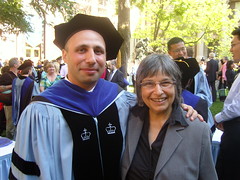
Amanda's not the only hoyden who's been on the road lately. I recently returned home to San Francisco after a fantastic three weeks doing my Northeast Family Corridor Circuit (New Haven-New York-Philadelphia) for many hugs, visits, and bigtime celebrations, including my sister's wedding (more soon at my own blog) and my son's PhD conferral from Columbia (next year the Corridor gets longer, when Jesse begins teaching English at Johns Hopkins in Baltimore; I'm delighted that the cheap and comfortable Bolt Bus goes there too).

Unusually for me, I didn't make a lot of plans, except to get to the celebrations on time. With more people to visit than I had time for, and my husband, sadly, only able to get off work for the wedding and the degree ceremony (the last long weekend of the trip) I decided to take the solo part of it slow, to follow my nose and my luck: as when my friend Barbara Garson introduced me to an artist friend of hers in the locker room of the Chelsea Piers gym -- who sent me to the glorious Picasso:Mosqueteros show at the Gagosian Gallery on 21st Street (still showing until June 6: run, don't walk, if you're in New York) -- after which, strolling down 23rd Street on the way to the subway, I stopped at a movie theater to see what time Star Trek was starting.

In five minutes? Sure, I said, I'll take a ticket, even as I wondered if there'd be a decent seat left (which is no small concern for someone measuring five foot one on a good day). How nice that I wound up in the best seat in the house, a single in the nicely-banked last row of the theater.

Because it was that kind of a trip. The best, the luckiest kind, that makes a high-and-low culture vulture like me eager to live long and prosper (not to speak of go all soft and happy inside over the absolutely right and absolutely Obama-era Spock-and-Uhura pairing).

The kind of trip where the next thing to do is obviously also the right thing.

And the next thing to read is the right thing as well -- as I sat in this or that New York cafe, w.i.p. on my laptop; pens and notebook, books and drink on the table; with a lovely, leafy late spring just outside, and myself only mildly, occasionally pricked by the exquisite guilt of being in this most wonderful of cities at the wonderful moment when spring rain stirs dull roots even if I hadn't earned it through suffering through an East Coast winter.

East Coasters may understand the guilt thing (I was born in Brooklyn); Californians probably won't.

But between the pricks and twinges I took the season as a gift, even as I took my reading seriously. I've already listed what I was into during those weeks, in my response to Kathrynn's What-Are-You-Reading Hoyden post, but what made it particularly great was checking in with my awesomely erudite son, who knows oodles about the history of the European novel throughout the nineteenth century.

Like when I asked him what he knew about D.A. Miller's lit crit study The Novel and the Police, that Lisa Fletcher makes sound so interesting, in her lit crit study Historical Romance Fiction?

Jesse went to his bookshelf. "Miller's book is very interesting," he said, "and it's important too." Important enough, it seemed, that he had two copies, and graciously handed me one of them.

So I read The Novel and the Police, and began to think about what Miller has to say about novels and "open secrets," and how that works out in romance novels where the hero and heroine are always the last to know.

And which led me to think more about what Lisa Fletcher has to say about historical romance -- popular and literary -- and more particularly about historical cross-dressing romance, which she says occupies a place of some importance for understanding historical romance as a whole. She even makes a few small observations about my cross-dressing historical romance, Almost a Gentleman (that was interesting to read!) among many other texts on her way to an extensive and thought-provoking discussion of Georgette Heyer's cross-dressing romances.

So I also read These Old Shades, and am queuing up The Masqueraders. And then a reread of Possession (A. S. Byatt, I learn from Fletcher, being an outspoken fan of Heyer and doubtless an instructive one), and then perhaps what sounds like a fascinating study by Alison Light, called Forever England: Femininity, Literature, and Conservatism between the Wars, which I hope will help me understand the Tory aspects of the romance genre (as I've groused about it on this blog from time to time, even as I've indulged my early passion for the great popular/literary English between-the-wars writer Dorothy Sayers, of the Lord Peter Wimsey mysteries).

While back in San Francisco...

"You're so intellectually hungry these days," my husband told me yesterday, and I suppose I am. Not only because I take a wonky lit-crit interest in literary history and in what (still and always a bit mysteriously to me) is called "theory," but because I can't help but think that at least some of that weighty stuff does have something to do with the lighter-than-air stuff I write, and with whatever instinct or memory or desire caused me (not much of a romance reader, in truth) to become a reluctant yet enthralled romance writer.

Also because I write my own stuff better if once in a while I evoke the old shades and stir up the roots with a little spring rain of research, self-understanding and reminiscence. (Leading me to give thanks for the spadework the romance scholars of IASPR are doing, and to encourage anybody else who's interested in this stuff to join the newborn International Association for the Study of Popular Romance. And to thank Dr. Eric Selinger, one of the organization's blithest guiding spirits, for turning me on to the Fletcher book).

And because I think this stuff -- or at least the best of it -- works.

Which is why (drawing upon hoyden Lauren Willig's endlessly helpful Theory of Productive Procrastination) I hope, in some future post, as a break from my own w.i.p. (yes, there is one, I promise!), to give some account of the critical commentary that most helps and interests me, both as reader of popular and literary fiction, historical and erotic romance writer, theory groupie, and even (swear to god, Jess, I'll never be this embarrassing again) proud parent of the smartest, most erudite literary scholar I know.