In the beginning… Wait a moment, what is the start of a historical novel? Of course, it’s when things get interesting for the characters but when and how much should the novelist start feeding the historical backdrop into the story? How do you hook modern readers on the story without losing them in dry details about an era that ended before their grandparents were born?
I admit I’m pondering this as I write the proposal for a new historical fantasy. Writing any story’s beginning is brutally hard for me – don’t even get me started on penning opening lines! – and I usually go through five or six tries before I get a scene that I like. While I was tearing out my hair, it occurred to me that historical authors might have to consider a few more tricks when starting a book. After all, we have to sneak in backstory for our setting – things like war (Waterloo, anyone?), legal principles like women’s rights, wildly different styles of clothing and shelter, and so on – all while rapidly sucking the reader into the book. Contemporary authors can at least hope that somebody else will have told their reader about these basics. (Not that their job isn’t hard, too; some critics argue that the reader knows so much they’ll be picking holes in every detail and the author must get them Right. But I’m here to talk about the extra Big Stuff a historical author needs to sneak in early.)
So what is history as backstory? How soon does it need to hit a book’s pages?
A story is always about conflict, or trouble. That’s not going to change, no matter how recently it occurred. But what about how it’s told? Les Edgerton’s HOOKED gives several elements to consider. The Setup “sets up the opening scene by giving a snapshot that allows what will take place in the following scene to be clear to the reader.” Backstory is “anything and everything that’s happened up to the time of the inciting incident.” It’s easy to see how history fits into Setup and Backstory. Some description of a castle or ballroom in the Setup, perhaps a long-departed political event or maybe a key cultural change to fuel the Backstory…
But they’re not the important stuff. That comes with what I think of as the Starting Three: The Inciting Incident is what kicks off the story, “the crucial event – the trouble – that sets the whole story in motion.” The Initial Surface Problem “propels the protagonist to take action and assists in eventual revelation of” the Story-Worthy Problem, which “is the real problem that the protagonist must reconcile by the story’s end.” (As you might guess, a large array of Surface Problems usually accompany a solid Story-Worthy Problem.)
Where does history fit into these? It’ll obviously affect Setup and Backstory. For my westerns, I usually handled Setup by a single line at the beginning of each chapter giving the date and place. I used this to very quickly frame THE IRISH DEVIL’s opening scene, where my frustrated hero wakes up in a brothel during Arizona’s Apache Wars. But Backstory? Okay, that will definitely include stuff no contemporary character would think normal. When should it be introduced?
Now, Jane Austen wrote contemporaries but that was centuries ago. Today’s readers consider them historical novels. A male coworker told me he hated Jane Austen because her movies are all about balls and dances and “where’s the danger in that?” I blinked, then asked if he’d ever seen SENSE AND SENSIBILITY, the tale which exposes the dirty historical reasons for women’s fixation on Catching the Right Man.
In her SENSE AND SENSIBILITY, the Inciting Incident is Mr. Dashwood’s death. The Initial Story Problem is will John Dashwood take care of his stepmother and half-sisters? No, he doesn’t, which triggers the rest of the book. The Story-Worthy Problem is will impoverished Elinor and Marianne marry and be happy, despite society’s strict insistence on marrying only for money? Honestly, do we need to know exactly what year Mr. Dashwood’s death takes place? Not in my opinion, at least not when the book opens. However, the tension humming behind Mr. Dashwood’s request that John look after the ladies? Frankly, that’s not very twenty-first century when women usually have other financial options than depending on male relatives’ charity. Hmm, starting to feel the need for some historical backstory here. As for the Story-Worthy Problem? Why do our heroines wind up in that tiny cottage after living at that truly gorgeous estate? Why did the Colonel’s lost love descend from impoverished respectability into prostitution when he didn’t marry her – and is that fate truly possible for our young heroine? All this conflict makes me very sure historical backstory will come in very handy to understand all the dangers to my heroines.
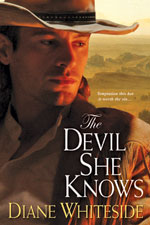
Now I admit I throw history into my westerns a lot faster than that. For example, THE DEVIL SHE KNOWS’ Inciting Incident is teenaged Portia Townsend’s unwelcome arrival at a stagecoach depot deep in Arizona, during a series of Apache raids. Initial Story Problem is how can Gareth Lowell get Portia to Tucson alive and well so she can help succor her foster family? (Alive, yes – but in the process, he totally destroys her hunger for him.) Story-Worthy Problem is will Portia grow up and convince Gareth her home is with him – no matter where that is – in time to save their lives and an empire? Yup, I stuffed the history straight into the Inciting Incident and emphasized it in the Initial Story Problem and Story-Worthy Problem. (Hopefully, it was emotional and fully understandable!)
What about the new book? Mercifully, my historical fantasy is – so far – being fairly well behaved as to when it wants history spoon fed. The first chapter takes place in a setting so iconic that I only need to identify it within a century and a thousand square miles or so. (Yes!) However, the second chapter becomes very specific as to time and place, zeroing in on a single city in a single month and year. I’m keeping my fingers crossed.
What about you? How early to you like to smooth your history into your story and how do you do it? What about your favorite historical novel?