Showing posts with label Rose Lerner. Show all posts

Monday, October 22, 2012

Perfect freedom of action

Lively St. Lemeston, the small Sussex market town at the heart of my next two (at least) books, is the first town I've written about. In for a Penny takes place on a country estate, and A Lily Among Thorns is set in London. But towns were becoming more and more important in England during the Regency as the balance of the economy shifted, with more jobs being created in industries and jobs in agriculture being lost. Of course there were the great factory towns (most of them in the North of England) like Manchester, and London itself increased greatly in size in the period, but even small towns saw growth and change.

One thing I learned was that "town" covered a huge range of sizes. ("City" had a pretty specific meaning in period: a town with a cathedral, that is, the center of a Church of England see, and didn't really denote anything in terms of size.) I imagine Lively St. Lemeston having a population of about 1500. But what I have to remember is that that sounds a lot smaller to me (my high school was bigger than that) than it would have to a Regency English person. Because there were many fewer urban areas and long-distance travel was fairly impractical for most people, even a town of that size could have a very well-developed social and political life, with its own Assembly Rooms, clubs, theatres, libraries, workhouses, jails, newspapers, &c. &c.

But one thing a lot of towns lacked was effective infrastructure. Most towns had very low taxation, in some cases only enough to pay for an annual feast for the town councilmen. The primary taxes were the poor rates, which paid for whatever form of welfare the town provided and which were administered through individual parishes (of which some towns had several, and some towns had too few to actually service the potential congregation, since the parish boundaries were usually hundreds of years old). There was no income tax, and even though a national one was briefly passed during the Napoleonic Wars to fund the army, it was immediately repealed when peace came. Any new expenses, such as streetlights or improving the roads, often had to be provided for in an Act of Parliament, and they could be difficult to get passed if the measure was controversial in the town.

One measure that was almost always contoversial in England at this period was an expanded police force. It's hard for me to wrap my head around how people in the eighteenth century thought about government. Growing up in the United States of the present day, I take it for granted that I pay taxes to the government and in return, they maintain the roads, provide public schools, have fire and police departments, run community centers, fund social programs like Medicaid, SSI, and welfare, and make laws that regulate my day-to-day life.

In eighteenth century England, that simply wasn't the case. Furthermore, crime was very different. Before mass production and the relative cheapness of consumer goods that industrialization brought about, all personal property was extremely valuable. It was possible to make a living only stealing handkerchiefs. (Sorry, I've mentioned that before, but it really blew my mind.) The most common form of crime was non-violent property theft. (Compare pickpocketing, relatively rare now, to mugging, relatively rare then.) In rural areas, where people knew their neighbors, anonymous crime was so difficult as to be almost non-existent. People just didn't see the need for any larger police force than the parish constable. And huge numbers of people financially benefitted from the constant organized theft, poaching, and smuggling going on all around them, so it was hard to muster public support for stopping it.

(I know I'm ignoring sexual assault and child abuse, probably a form of crime that was as endemic then as it is now. But it's hard to talk about that in this context because the laws and attitudes around it were so different that I'm not sure how much it would have entered people's minds when thinking about the advantages or disadvantages of policing.)

In 1822, a Parliamentary Select Committee on Policing the Metropolis concluded that, "It is difficult to reconcile an effective system of policing with that perfect freedom of action and exemption from interference, which are the great blessings and privileges of this country."

Perfect freedom of action and exemption from interference. Definitely not something most modern people expect.

Of course, it didn't help that the police forces that did exist were either ineffectual or corrupt or both. This was largely due to the extremely low pay of the officers (parish constables were not paid at all), who were generally obliged to personally pay the costs of prosecuting any criminal they brought charges against, and received a monetary reward on a successful conviction. This led to a situation where the police forces were as notoriously corrupt as the Gotham Police Department.  Whether the average citizen knew it, I can't say, but criminals certainly did. Bribery was common, streetwalkers paid night watchmen for protection, police swore under oath to Parliamentary Committees that "flash houses" (basically headquarters for London criminal activity, sort of combination brothel/fence/boarding house/gaming dens/you name it)  did not exist even though it was public knowledge that they did.

You can see something of the public attitude toward night watchmen in this Cruikshank illustration for Life in London, entitled "Tom Getting the best of a Charley." ("Charley" was a nickname for the night watchman.)


Image copyright The Museum of London. (Of course, rich young men being rude to cops continues to be a popular subject for fiction, but they don't get away with it much anymore. I still fondly remember that time on Smallville that Lex Luthor had to attend anger management seminars after smashing up a traffic cop's car with the golf clubs he was planning to donate to a charity auction. And didn't Logan Echolls do something similar on Veronica Mars?)

Here is another entry from James Hardy Vaux's Dictionary:
WEIGH FORTY: term used by the police, who are as well versed in flash as the thieves themselves. It is often customary for the traps, to wink at depredations of a petty nature, and for which no reward would attach, and to let a thief reign unmolested till he commits a capital crime. They then grab him, and, on conviction, share (in many cases) a reward of 40l., or upwards; therefore these gentry will say, Let him alone at present, we don't want him till he weighs his weight, meaning, of course, forty pounds.
And don't even get me started on some of the really shocking cases of entrapment I've read about--that's another whole post!

But crime got worse and worse, and public opinion was turning against capital punishment, the traditional deterrent of crime (partly, of course, because it was fairly ineffective as a deterrent, and made juries reluctant to convict anyway). Clearly something had to be done, and many towns did pass Policing Acts. One alternative that great numbers of towns tried were prosecution associations, which raised money through member subscriptions to pay for the prosecution of criminals.

A Policing Act is one of the biggest local political issues in Lively St. Lemeston, and most of my characters have an opinion of one kind or another (my Sweet Disorder heroine's mother will bore you for hours with hers). But for now, they just have a constable and a paid night watchman. This makes it an interesting place for the hero of my next book, Crimson Joy, since he's a con artist with a London background...

I'll probably be posting more about this, but in the meantime, a few links to further reading if you're interested:

"The Origins of Policing and Law Enforcement in England," by Stevie Woods at The Macaronis historical romance blog.

"Night Watchmen Through the Ages (with a little help from Richard Armitage)," by Cheryl Leigh at Historical Hearts.

An extended quote from Government and Community in the English Provinces, 1700-1870 by David Eastwood at my tumblr; it was too long to include here but it has some great insights into the whole context of how people were thinking about crime, private property, and public spaces in this period and how that was shifting.

A couple of other great sources on the topic are The English Town, 1680-1840: Government, Society and Culture by Rosemary Sweet and The Regency Underworld by Donald A. Low (although that one mostly deals with London).


Monday, October 1, 2012

Oliver is in town

This is part two of my favorite entries in James Hardy Vaux's 1812 Dictionary of the Flash Language. Part one is here.

(I'm rereading the dictionary, and reading Vaux's memoirs, because my next book has changed direction. After a conversation with my agent at the RWA conference about the marketability of ghosts at the moment, I've temporarily shelved The Ghost and Miss Moore and have started another book about a con man and the daughter of the Tory patron of my little market town from Sweet Disorder. Its working title is Crimson Joy and so far I'm still in that new-book first-flush-of-love stage with it!)

LETTER Q: the mace, or billiard-slum, is sometimes called going upon the Q, or the letter Q, alluding to an instrument used in playing billiards. [BILLIARD SLUM: The mace is sometimes called giving it to 'em on the billiard slum. See MACE.

MACE: to mace a shopkeeper, or give it to him upon the mace, is to obtain goods on credit, which you never mean to pay for; to run up a score with the same intention, or spunge upon your acquaintance, by continually begging or borrowing from them, is termed maceing, or striking the mace.]

LETTER-RACKET: going about to respectable houses with a letter or statement, detailing some case of extreme distress, as ship-wreck, sufferings by fire, &c.; by which benevolent, but credulous, persons, are induced to relieve the fictitious wants of the imposters, who are generally men, or women, of genteel address, and unfold a plausible tale of affliction. [I think my hero and his brother have done this one a fair number of times in their careers.]

LUSH: to drink; speaking of a person who is drunk, they say, Alderman Lushington is concerned, or, he has been voting for the Alderman.

[Some scholars believe that this term derived from an actors' fraternal organization, "The City of Lushington." According to the Encyclopedia of Word and Phrase Origins by Robert Hendrickson (as quoted here), "Near Drury Lane Theatre in London was the Harp Tavern, where a club of hard drinkers called The City of Lushington had been founded in 1750. Lushington's had a chairman, the 'Lord Mayor,' and four 'aldermen,' who presided over the wards [a type of urban administrative district] of Poverty, Lunacy, Suicide, and Jupiter (the supreme Roman god who presided over all human affairs).[...]'Lush,' at least as a generic term for beer or drink, first appeared in about 1790, long after The City of Lushington's formation, and it could very well be a contraction of the club's name."

By the way, when the club stopped allowing stage hands and other crew members to attend meetings as guests, it spun off a theatre technicians' organization called the Royal Antediluvian Order of Buffaloes which has lasted as a fraternal organization to the present day (although it is no longer affiliated with the theatre).]

MONKERY: the country parts of England are called The Monkery.

NUT: to please a person by any little act of assiduity, by a present, or by flattering words, is called nutting him; as the present, &c., by which you have gratified them, is termed a nut.

NUTS UPON IT: to be very much pleased or gratified with any object, adventure, or overture; so a person who conceives a strong inclination for another of the opposite sex, is said to be quite nutty, or nuts upon him or her. [Wow, is that where that comes from?]

OLIVER: the moon.

OLIVER IS IN TOWN: a phrase signifying that the nights are moonlight, and consequently unfavorable to depredation.

PEAR-MAKING: inlisting [sic] in various regiments, taking the bounty, and then deserting.

PIGS, or GRUNTERS: police runners. [Wow, some things never change.]

RINGING CASTORS: signifies frequenting churches and other public assemblies, for the purpose of changing hats, by taking away a good, and leaving a shabby one in its place; a petty game now seldom practised.

SPANK: to spank a glaze, is to break a pane of glass in a shop window, and make a sudden snatch at some article of value within your reach, having previously tied the shop-door with a strong cord on the outside, so as to prevent the shopman from getting out, till you have had full time to escape with your booty; to spank a place, is to rob it upon the spank; a spank is a robbery effected by the above means.

STAR: The star is a game chiefly practised by young boys, often under ten years of age, although the offense is capital. It consists of cutting a pane in a shop-window, by a peculiar operation calling starring the glaze, which is performed very effectually by a commen penknife; the depredators then take out such articles of value as lie within reach of their arm, which if they are not interrupted, sometimes includes have the contents of the window. A person convicted of this offense is said to have been done for a star.

TURN UP: to desist from, or relinquish, any particular habit or mode of life, or the further pursuit of any object you had in view, is called turning it up. To turn up a mistress, or a male acquaintance, is to drop all intercourse, or correspondence, with them. To turn up a particular house, or shop, you have been accustomed to use, or deal at, signifies to withdraw your patronage, or custom, and visit it no more. To quit a person suddenly in the street, whether secretly or openly, is called turning him up. To turn a man up sweet, is to get rid of him effectually, but yet to leave him in perfect good humour, and free from any suspicion or discontent; this piece of finesse often affords a field for the exercise of consummate address, as in the case of turning up a flat, after having stripped him of all his money at play, or a shopkeeper, whom you have just robbed before his face of something valuable, upon the pinch, or the hoist.

TURNIPS: to give any body turnips signifies to turn him or her up, and the party so turned up, is said to have knap'd turnips.


While writing this post, I discovered that almost all of these entries appeared word-for-word in Pierce Egan's 1823 expanded edition of Francis Grose's Classical Dictionary of the Vulgar Tongue (subtitle: "Revised and Corrected with the Addition of Numerous Slang Phrases Collected from Tried Authorities")! I don't know enough about nineteenth-century copyright law to know whether that would be considered plagiarism. (I guess it's possible that he paid Vaux's publisher for the rights...does anyone know?) If it was, I can't decide whether James Hardy Vaux would be annoyed and want his share of the cash, or appreciate Egan's sharp practice.

One of the things I consistently try to remember while writing is how valuable every piece of personal property was before consumer goods became mass-produced and semi-disposable. I remember researching a few years ago what a Regency house would have in its rooms in place of a trashcan and realizing they wouldn't have had anything because nothing was thrown away. Absolutely nothing. It's hard for me to imagine a world where handkerchiefs cost enough that you could make a good living just from stealing those, but it must have really informed how people thought about their surroundings, and it definitely informed how professional crime and the underworld functioned.

And with that I must leave you! Here, have some of these:

photo of turnips

Monday, August 20, 2012

Getting your money at the best

While researching A Lily Among Thorns, I came across James Hardy Vaux's Dictionary of the Flash Language (included as an appendix in his Memoirs) (the first autobiography AND the first dictionary written in Australia!). It's a great resource for criminal vocabulary because Vaux is a dedicated author--he includes really detailed usage notes. The footnote on the original dedication of the book (dated 1812, although it looks like the book wasn't published until 1819):

"The Author (a prisoner under sentence of transportation for life) having, by an alleged act of impropriety, incurred the Governor's displeasure, was at this period banished to Newcastle, a place of punishment for offenders: these sheets were there compiled during his solitary hours of cessation from hard labour; and the Commandant was accordingly presented by the Author with the first copy of his production."

This is a two-part post because there are too many great entries I want to share with you, but here's part one:

ARM-PITS: To work under the arm-pits, is to practise only such kinds of depradation, as will amount, upon conviction, to what the law terms single, or petty larceny; the extent of punishment for which is transportation for seven years. By following this system, a thief avoids the halter, which certainly is applied above the arm-pits.

BEST: to get your money at the best, signifies to live by dishonest or fraudulent practices, without labour or industry, according to the general acceptation of the latter word; but, certainly, no persons have more occasion to be industrious, and in a state of perpetual action than cross-coves [criminals, as opposed to square-coves, honest men]; and experience has proved, when too late, to many of them, that honesty is the best policy; and consequently, that the above phrase is by no means à-propos.

BOUNCE: to bully, threaten, talk loud, or affect great consequence; to bounce  a person out of any thing, is to use threatening or high words, in order to intimidate him, and attain the object you are intent upon; or to obtain goods of a tradesman, by assuming the appearance of great respectability and importance, so as to remove any suspicious he might at first entertain. A thief, detected in the commission of a robbery, has been known by this sort of finesse, aided by a genteel appearance and polite manners, to persuade his accusers of his innocence, and not only to get off with a good grace, but induce them to apologize for their supposed mistake, and the affront put upon him. This masterstroke of effrontery is called giving it to 'em upon the bounce.

CAT and KITTEN RIG: the petty game of stealing pewter quart and pint pots from public-houses.

CHRISTEN: obliterating the name and number on the movement of a stolen watch; or the crest, cipher, &c., on articles of plate, and getting others engraved, so as to prevent their being identified, is termed having them bishop'd or christen'd.

COME TO THE HEATH: a phrase signifying to pay or give money, and synonymous with Tipping, from which word it takes its rise, there being a place called Tiptree Heath, I believe, in the County of Essex.

CRAB: to prevent the perfection or execution of any intended matter or business, by saying any thing offensive or unpleasant, is called crabbing it, or throwing a crab; to crab a person, is to use such offensive language or behaviour as will highly displease, or put him in an ill humour.

DINGABLE: any thing considered worthless, or which you can well spare, having no further occasion for it, is declared to be dingable. This phrase is often applied by sharps to a flat whom they have cleaned out; and by abandoned women to a keeper, who having spent his all upon them, must be discarded, or ding'd as soon as possible.

DRUMMOND: any scheme or project considered to be infallible, or any event which is deemed inevitably certain, is declared to be a a Drummond; meaning, it is as sure as the credit of that respectable banking-house, Drummond and Co.

FLESH-BAG: a shirt.

(Let's just look at that one again:

FLESH-BAG: a shirt.

Beautiful.)

FLAT: [I'm really happy about this one because I was so upset that "mark," meaning the target of a con man, is out of period, but then I realized "flat" can be used almost exactly the same way!] In a general sense, any honest man, or square cove, in opposition to a sharp or cross-cove; when used particularly, it means the person whom you have a design to rob or defraud, who is termed the flat, or the flatty-gory. A man who does any foolish or imprudent act, is called a flat; any person who is found an easy dupe to the designs of the family, is said to be a prime flat. It's a good flat that's never down, is a proverb among flash people; meaning, that though a man may be repeatedly duped or taken in, he must in the end have his eyes opened to his folly.

GO-ALONGER: a simple easy person, who suffers himself to be made a tool of, and is readily persuaded to any act or undertaking by his associates, who inwardly laugh at his folly, and ridicule him behind his back.

GO OUT: to follow the profession of thieving; two or more persons who usually rob in company, are said to go out together.

KIDDY: a thief of the lower order, who, when he is breeched [in funds], by a course of successful depradation, dresses in the extreme of vulgar gentility, and affects a knowingness in his air and conversation, which renders him in reality an object of ridicule; such a one is pronounced by his associates of the same class, a flash-kiddy or a rolling-kiddy. My kiddy is a familiar term used by these gentry in addressing each other.

KID-RIG: meeting a child in the streets who is going on some errand, and by a false, but well fabricated story, obtaining any parcel or goods it may be carrying; this game is practised by two persons, who have each their respective parts to play, and even porters and other grown persons are sometimes defrauded of their load by this artifice. To kid a person out of any thing, is to obtain from him by means of a false pretence, as that you were sent by a third person, &c.; such impositions are all generally termed the kid-rig.

KNAPPING A JACOB FROM A DANNA-DRAG. This is a curious species of robbery, or rather borrowing without leave, for the purpose of robbery; it signifies taking away the short ladder from a nightman's cart, while the men are gone into a house, the privy of which they employed emptying, in order to effect an ascent to a one-pair-of-stairs window, to scale a garden-wall, &c., after which the ladder, of course, is left to rejoin its master as it can.

Do you have a favorite bit of old slang? A favorite language reference book?

Monday, July 30, 2012

The House of Commons opera hat

Rose here! My next book, Sweet Disorder, is set during a Parliamentary election in a small town. The Regency political system is so different from the modern one that I wanted to do plenty of research to make sure I didn't mess it up (for example, one thing that consistently confused my beta readers was that each voter got two votes!). Luckily I'd already done a little research on Parliament for a book proposal that didn't go anywhere (although I haven't given up hope for the future).

One book I read was The Great Palace, by Christopher Jones, about the Houses of Parliament themselves. It was published in 1985 so not up to date, but that didn't matter for my purposes! Some things I learned:

"The Mace, the symbol of Royal authority, must always be present when the House is sitting. Without it, the House is totally powerless."

The Lord Speaker, accompanied by the mace and doorkeepers, makes her way to Sovereign's Entrance to await the arrival of the Queen
"The Lord Speaker, accompanied by the mace and doorkeepers, makes her way to Sovereign’s Entrance to await the arrival of the Queen." Image: Parliamentary copyright/ Catherine Bebbington.

More on the Mace from Wikipedia.

23. Serjeant at Arms places the Mace on the Table
"The Serjeant at Arms, Jill Pay, places the mace on the Table to signal that the House is sitting. May 18 2010." Image: Catherine Bebbington. Parliamentary Copyright.

On the next page:

"The Serjeant-at-Arms[...]is the only person in the Chamber allowed to wear a sword." This doesn't make clear to me whether s/he actually wears a sword--I can't see one in the above picture. (But is that a change since 1985?)

Two pages later:

"The House of Commons snuffbox. It is kept by the Principal Doorkeeper. Any Member may ask for a pinch of snuff before going into the Chamber."

According to Wikipedia, "A floral-scented snuff called 'English Rose' is provided for members of the British House of Commons at public expense due to smoking in the House being banned since 1693. A famous silver communal snuff box kept at the entrance of the House was destroyed in an air raid during World War II with a replacement being subsequently presented to the House by Winston Churchill." (The new box was made from the timber recovered from the damaged Chamber.) Nicholas Fairbairn, an MP until 1995, was known during his tenure for being the only person to actually use the snuff.

I'm not sure the snuff is English Rose anymore, though, because check out this 2010 Freedom of Information request I found! The respondent states, among other things, that "The cost of the snuff is approx £6 per tin and the House has purchased 4 tins in 8 years, the cost is paid from Serjeant at Arms' petty cash. There is no specific company make and the House just purchases it from a local tobacconist," and that "Members who have taken snuff in the past year numbered perhaps less than five, Members taking snuff in the present Parliament has yet to occur."

And guess what: it turns out the US Senate has ceremonial snuffboxes too!

But my very, very favorite is this:

"The House of Commons opera hat. The collapsible top hat which Members must wear if they want to raise a point of order during a division [their word for a vote]."

And there's a little picture of an old top hat sitting on a bench.

I was desperately sad to discover that this custom had been discontinued following a recommendation of the Select Committee on the Modernization of the House of Commons:

"64. At present, if a Member seeks to raise a point of order during a division, he or she must speak 'seated and covered'. In practice this means that an opera hat which is kept at each end of the Chamber has to be produced and passed to the Member concerned. This inevitably takes some time, during which the Member frequently seeks to use some other form of covering such as an Order Paper. This particular practice has almost certainly brought the House into greater ridicule than almost any other, particularly since the advent of television. We do not believe that it can be allowed to continue."

Another beautiful image was provided by Hansard's record of the discussion on the issue:

"We recommend a new procedure for raising points of order during a Division. At present, we have the opera hat, and, although some Members may feel that they look particularly fetching in it, it makes the House of Commons look ridiculous when someone wearing the hat is trying to raise a point of order from a seated position while everyone else is milling around and going to vote."

(Sidenote: If anyone writing historical romance with a political dimension doesn't already know about the online Hansard's, here it is! It is saving my life with things like dates of parliamentary recesses, when bills were proposed, &c.)

Can anyone find a picture of the opera hat? Preferably being worn. My Google-fu is failing me.

Monday, July 9, 2012

"Not with their property, but with their lives"

While researching smuggling for The Ghost and Miss Moore, there's one problem I run into again and again: the bulk of the records of the customs service were lost in the 1814 London Customs House fire. To me the greatest loss is that every revenue officer was required to keep notebooks detailing his daily activities and submit them to his superior officer. There are almost none extent from before 1814 because of this fire.

"The fatal Conflagration of the Custom House, on the Morning of the 12th February 1814"
(British Museum)

The fire was discovered by the porter at 6AM. By 7 the fire engines had arrived, and by 8 the flames were so high they had given up on saving the Customs House and began trying to save the surrounding buildings.
[A] report was circulated that many barrels of gunpowder were deposited in the vaults, and that consequently an explosion might soon be expected. This report had nearly a magical effect. All withdrew to a distance, both firemen and spectators. At half-past nine the report which had been circulated was confirmed not to have been an idle one. The explosion of about two barrels and a half of gunpowder was tremendous. The shock was distinctly felt on the Royal Exchange, and by persons who came to London by the Whitechapel Road; it was felt four miles in that direction. Many of the buckets were carried as far as Billingsgate; and one man was hurt or killed by two bricks falling on his head. The concussion spread devastation around the neighbourhood breaking many windows in Cannon Street, East Cheap and the adjoining streets, and exciting in the breasts of the inhabitants apprehensions of the complete destruction of that quarter of the City.
[...]The explosion of the gunpowder carried the burnt papers, ships registers, and a variety of matter, as far as Dalston, Shacklewell, Homerton, Hackney, and all the adjoining villages in the direction of the wind. A bundle of signed debentures is said to have been picked up by a gentleman at as great a distance from the scene of destruction as Spital Square.
(From the British Fire Service's contemporary accounts on their website, which are definitely worth reading all the way through. I couldn't find any citations of whose accounts they are, though, and they are clearly a composite of several authors' work since there are two different stories about Colonel Kelly's "(late of the Guards)" actions. He was the housekeeper's brother and one writer claims he "hurried to his sister and found her in such a senseless state from the fright, that it was with extreme difficulty he could drag her out almost naked."  In the other, he was paralyzed with fear in his burning room when the porter found him, and then ran to a window from which he was "saved by a ladder with the greatest difficulty and shockingly burnt in the face and hands," while the porter went and got his sister and the servants. While I am not by any means criticizing the guy for freaking out while his room was on fire, if I were the porter I might be annoyed by that face-saving story, although I'd feel guilty about being annoyed since Colonel Kelly died a few days later of his injuries.)

It later turned out that there were only about 10 or 12 pounds of gunpowder stored in that nearby building, for use by the volunteers, but rumors that there were barrels and barrels spread quickly and kept many of the firemen from wanting to get very near the fire, with the result that it spread fast and far.
The flames soon communicated to the houses in Thames Street opposite the Custom House, and embraced, in a short time, warehouses in Globe Yard, and the whole of the tenements extending from Beer Street to Water Lane from which it required the utmost activity of the inmates to escape, not with their property but with their lives.
The flames didn't get under control until around 3PM, by which time the Customs House was ashes.

The Customs House before the fire, by Rowlandson, 1808. (Wikimedia Commons)

Some of the amazing non-archival things lost in the fire:
The actual loss to government by the sudden destruction of the Custom House cannot be calculated; books, bonds, debentures, pearls, coral, valuable property of every description and securities of all kinds have been consumed.[...]The private property lost within the buildings is very considerable: several gentlemen had left large sums of money in their desks, ready to make payments on the following day. One individual has lost upwards of six thousand pounds in bank notes, which will be irrecoverable, as the memorandum of the numbers was in the desk with the notes and met the same fate. 
A very fine collection of pictures was also lost, which the Commissioners had permitted a gentleman to leave in deposit till it would be convenient for him to pay the duties, amounting to one thousand five hundred pounds. A genteel young man, in appearance, was stopped by some police officers, in Thames Street and, on searching him, his pockets and breeches were found to be stuffed with coral beads, silk handkerchiefs, and other valuables of small bulk. It appeared that his boldness in venturing nearer than even the firemen dared to do, had enabled him to obtain this booty.
Fortunately a new Customs House was already being built, the Napoleonic Wars (and resulting embargoes) and increased trade having vastly increased the work of the Customs. The new building was completed in haste...which may or may not have led to the design flaws that caused a huge part of the floor of the Long Room to collapse and fall into the King's Warehouse below in 1825, leading to major repairs, a new, much more classically Neoclassical facade, and the ruin of David Laing's career as an architect. But that's another story! (Which you can read a bit more about here, along with looking at many more engravings and drawings of the Custom House through the years.)

Do you have a favorite disaster, natural or otherwise? Tell me about it!

Monday, June 18, 2012

The eye was of the size of the Seal's

In September 1808, a local man was fishing off the coast of Orkney when he spotted a bunch of birds feasting on an animal corpse on the rocks. He saw what looked like a giant sea serpent, but couldn't get close enough to be sure.

Ten days later, a gale washed the corpse onto the Stronsay beach, where it was closely examined and measured by local men. The beast quickly gained notoriety--but it also quickly decomposed. The four men who examined it closely were taken to Kirkwall (Orkney's main city) to give sworn testimony to the magistrate about what they'd seen. The 1860 Naturalist's Library sums up the testimony as follows:

It measured fifty-six feet in length and twelve in circumference. The head was small, not being a foot in length, from the snout to the first vertebre; the neck was slender, extending to the length of fifteen feet. All the accounts agree in assigning it blow holes, though they differ as to their precise situation. On the shoulders something like a bristly mane commenced, which extended to near the extremity of the tail. It had three pairs of fins or paws connected with the body; the anterior were the largest, measuring more than four feet in length, and their extremities were some what like toes, partially webbed.[...]The skin was smooth, without scales, and of a greyish colour; and the flesh appeared like coarse ill-coloured beef. The eye was of the size of the Seal's; the throat was too narrow to admit the hand.
I just want to say I respect whichever of the observers (described by the Library as "respectable individuals," in case we were worried) stuck his hand down this thing's throat.

If you're interested, the full eyewitness testimony can be accessed from Yvonne Beale's dead geocities page via the Wayback Machine, here. And it is fascinating! The bristles glowed in the dark when wet! George Sherar, tacksman (meaning, I believe, that he paid a fixed annual sum to the government in exchange for the right to collect certain traditional taxes in a designated area of Orkney, whatever he collected over the amount he paid in "rent" being his own profit), clearly had a scientific mind. He did several experiments, including putting a small piece of the animal in his lamp to see how it burned: "it neither flamed nor melted, but burned away like a gristly substance." He says "that he was the more attentive to its shape, dimensions and figure, in order to be able to give an accurate account of it to any travellers that might come to Rothiesholm," and I hope he dined out on the story for the rest of his life!


The November 1808 meeting of a Natural History Society in Edinburgh gave the creature the Latin name Halsydrus Pontoppidani ("Pontoppidan's Water Snake of the Sea") in honor of an 18th century Norwegian bishop with a sea-serpent hobby. But a leading ichthyologist of the day, Sir Everard Home, a member of the London Royal Society, examined the remains and believed the creature to simply be a basking shark, a large fish common in the Orkney waters. Several scientists since then have supported his conclusions.

Basking shark.
"How the heck could that look like that sketch up there?" you may be wondering. The answer is that basking sharks take on a "pseudo plesiosaur" appearance while decomposing! Their jaw drops off, giving the appearance of a long neck and tiny head, and then,

[...]as only the upper half of the animal's tail fin carries the spine, the lower half rots away and provides a convincing serpentine tail. When the dorsal fin begins to decompose, the remaining rays can have the appearance of a hairlike mane. The monster's six legs can simply be explained away as the remains of the shark's lower fins.
(from this site.) 

The thing is, the largest recorded basking shark is only 40 feet in the length, and the Stronsay Beast was carefully measured by more than one person as being in the 55 foot range (and part of the tail seemed to be missing, so it might have been longer!). Sir Everard Home got around this issue by insisting that the three eyewitnesses who measured the corpse were not educated men, and must have measured wrong. Never mind that one of them was a carpenter! (The other two were farmers, but since farming in Orkney at the time involved a complicated division-of-land system that relied on a lot of measuring, I'm guessing they knew what they were doing.) He blithely announced that the creature was really only about 35 feet long.

The Royal Museum of Scotland in Edinburgh has the vertebrae and bristles (although I don't remember seeing them when I was there, which makes me very sad!), the skull and a "paw" were sent down to London and destroyed in the Blitz, and some other pieces ended up in the hands of Lord Byron. I've googled and googled and I can't figure out how! He doesn't seem to have been in Northern Scotland at the time. Anyone? Those pieces are still around and now in the John Murray Collection at the National Library of Scotland.

An Orcadian scientist named Yvonne Beale (who has a degree in evolutionary, environmental and biomedical genetics from St. Andrews and a doctorate in DNA damage repair from Edinburgh's pathology department) has said she can use those pieces to determine the creature's species. But her current website is still under construction, and the archived geocities page from 2008 doesn't come to a definitive conclusion.  She questions the "basking shark" theory on the ground that basking sharks only resemble plesiosaurs when pretty decayed, and nothing about the eyewitness testimony suggests that the Beast was too badly rotted. But she does say that since the Beast is cartilagenous, it couldn't be a whale or real plesiosaur, and must be a type of shark. Every other story I can find just says she's going to make an announcement, and they're all dated three or four years ago. I can't even find confirmation she was ever given permission to take samples from the remains in the National Library's possession.

And so the cryptozoology debate continues...

If you were going to use this story in a romance, who would your hero and heroine be? And seriously, how do you think Byron got those Beast pieces?

Monday, June 4, 2012

Brigands calling themselves workers

I had a post all planned about the Stronsay Beast (the corpse of a mysterious sea monster that washed ashore in Orkney in 1808), but yesterday I was wandering through the Fremont market where I work and came across this:

A cheaply framed colored 18th century engraving of a building on fire

The text reads "Barrière de la Conférence Incendiée, le 12 Juillet 1789." (The Conference Gate Burned, July 12 1789). Here's a less blurry one that doesn't show the frame, if you click on it, you can see it up close.


In the right-hand corner it says "No. 10," and small text along the bottom edge reads "Prieur inv. & del." and "Berthault sculp." Prieur inventeur et delineateur (creater and artist), and Berthault sculpteur (engraver), I assume? 

The engraving was originally published in Collection complete des Tableaux historiques de la Révolution française.


The engravings were based on drawings created through the Revolution by Prieur and other artists, first published in 1798 (or, as it said itself, "Year 7") and reprinted several times. Pierre-Gabriel Berthault engraved over 100 of the 144 images (he later directed Napoleon's Description of Egypt). Jean-Louis Prieur, who did many of the drawings, had already been guillotined back in 1795, but Berthault lived to the ripe old age of 94! (He retired in 1816, already nearly 70, and two years later wrote to the Minister of the Interior asking for a complimentary copy of his last book, signing himself "Uncle Berthault." He didn't get it.)

To see a nice high-res version of the engraving in black and white, go here, and to see more engravings in the series, go here. I have no idea how old my copy of the engraving is or if it was made from the original plates, but it does look hand-colored! If I'm right, that suggests to me that it's fairly old. 

July 12, 1789 is widely considered the first day of the French Revolution. Among other things, citizens sacked and burned 40 of the 55 hated new Customs Houses built into the wall around Paris (a 1785 pamphlet called them "a monument of slavery and despotism"). While the engraving, to me, seems pretty celebratory of the riot, the commentary by Chamfort which accompanied the engraving in Tableaux was extremely critical, calling the crowd "brigands calling themselves workers" and including a lengthy diatribe on the loss of the Customs House:

We have chosen [...]the Barrière de la Conférence; it was the one whose destruction left the most regrets, when public terror was calmed, and when calm had led to reflection. Art lovers still regret the colossal figures[...]which particularly decorated this barrier: they were allegorical figures of Brittany and Normandy, who seemed to point out the route which led from the capital to these two provinces. The fire barely altered them, but the rage of the arsonists, determined to destroy all, led them to use iron, which cruelly supplemented the impotence of the fire, and erased the form when the substance could not be consumed.

(Go here for the full commentary in the original French.)

Buy anything cool lately? Tell me about it!

Monday, May 7, 2012

Wilt thou yet confess?

Hi, Rose here! As I mentioned in my last post, I'm doing research for my next book, about a revenue officer, a governess, and a ghost in Orkney (tentatively titled The Ghost and Miss Moore). I've always liked stories with ghost characters, but real-life ghost sightings have never been much of an interest of mine, so I'm reading The Haunted: a Social History of Ghosts by Owen Davies. It's a fascinating book and it's been giving me lots of ideas for how I want my ghost character to work!

He's a murder victim seeking justice (or maybe vengeance...he's not entirely a nice ghost), which has been a popular kind of ghost over the centuries--so popular, in fact, that murder investigations have been opened because of ghost sightings, up through the early part of the eighteenth century. In one case in 1660, a Westmoreland magistrate investigated the death of Robert Parkin because of a report that Robert's ghost had appeared to a man in the parish church crying "I am murdered I am murdered I am murdered."

In 1728, a Dorset coroner exhumed a body because of several sightings of the boy's ghost. In this case the ghost didn't even speak--its appearance was enough to indicated foul play, despite no previous suspicion about his death. Upon examining the body, the coroner decided he had really been murdered.

A painting of Macbeth seeing Banquo's ghost
"Never shake thy gory locks at me!"

Murder victims sometimes haunted their killers: a servant who had killed his master and gotten clean away  to Ireland was driven to turn himself in by a headless ghost who appeared to him every night demanding "Wilt thou yet confess?" Sometimes they haunted other acquaintances.

David Garrick in his iconic just-caught-sight-of-the-Ghost pose.

One of the most upsetting incidents described in the book is this one:

The astrologer and occultist John Heydon (1629-c.1670) recounted how one of his mother's maids was pulled out of her bed one night by the ghost of a lover named John Stringer, who had recently been murdered by a jealous admirer. Despite three doors leading to her bedroom being locked, the maid 'had the right side of her haire and headclothes clean shaved or cut away' by Stringer's ghost.
That poor woman! Whether you believe in ghosts, or whether you think she imagined the ghost out of guilt and shaved her own hair, it's an awful story. I hope the "jealous admirer" was prosecuted, and didn't get to continue stalking and attacking her and her loved ones.

Sometimes ghosts appeared to strangers at the site of their hidden graves. This tied in with another ghost tradition, that souls who didn't receive Christian burial would walk until their bodies were found and interred in consecrated ground. In 1806, in a town near Manchester, the townsfolk drained a deep pool after a recently missing man's ghost repeatedly appeared over it at midnight, leading to suspicion he had been murdered. His body was actually found at the bottom, although the evidence indicated he had drowned accidentally.

Francis Grose [in his 1787 A Provincial Glossary, with a Collection of Local Proverbs, and Popular Superstitions] wondered why the ghosts of those murdered did not go straight to the nearest justice of the peace, rather than hang about their burial place frightening passers-by. 'Ghosts have undoubtedly forms and customs peculiar to themselves,' he concluded.

Ghosts historically have not talked much, although apparently they talked more in the past!

Brutus and the Ghost of Caesar 1802
Great Caesar's ghost! "Aye, at Philippi."

Completely silent ghosts became the norm to a much greater extent over the course of the nineteenth century. Generally ghosts who did speak were wrong-righting ghosts. (Although there were exceptions! In 1706 Mr. Shaw, a fellow of St John's College, Oxford, chatted with the ghost of a dead colleague for two hours before receiving his warning of untimely death.) Murder victims were the most common. (Conflicts over inheritance were also a big one: "Mother's ghost appeared to me and she says I get the antique dining set!") Ebenezer Sibly, eighteenth century writer on astrology and the occult (and huge racist), insisted that only murder victims could speak (and possibly only those who had been killed in "circumstances uncommonly horrid and execrable), because the traumatizing memory did "more powerfully operate upon the faculties of the apparition, so as to enable it to frame the similitude of a voice, so as to discover the fact, and give some leading clue to detect and punish the wicked perpetrator."

My ghost is going to be a bit more talkative, since he's a prominent character in the book, but this research is giving me ideas for how to make him more distinctly ghostly and disturbing.

What's your favorite ghost story? (Either a famous one, or one that happened to you or someone you know...)

Monday, April 16, 2012

The de'il's awa wi' the Exciseman

I've been researching smuggling for my soon-to-be-started WIP (a revenue officer, a governess, and a ghost in Orkney!). Mostly what I'm discovering is how incredibly widespread and shameless smuggling was. It operated in many ways like our modern-day Mafia--but before the 80s mob trials. Revenue officers knew who the smugglers were. Often they even had advance knowledge of smuggling runs. But they were so badly outnumbered that in many cases, the officer or two (even if he was backed by half-a-dozen dragoons) had to simply watch as sixty or a hundred armed men rode by escorting huge cargoes.

There were cases of small fleets of smuggling ships coming into an inlet where a Revenue cutter lay at anchor and saying, "Cut your anchor and take off or we'll sink you!" (But with worse language, my book made sure to clarify!) And the ship had really no choice but to do it.

Even if smugglers could be arrested, it was rare to find a jury that would convict them. This was both because of genuine local support for the smugglers (who kept local economies going and stood up to the Man) and because of fear. Smugglers set fire to the stables and ricks of farmers who refused to allow their horses to be used, and tortured and/or murdered informers.

Here's a story that shows how truly out of control the situation was:

One of the most famous smuggling organizations was the Hawkhurst Gang (like Adrian!) in Kent. This gang operated quite openly and violently. In one instance, they beat, interrogated, and flogged some revenue officers who tried to challenge them, then carried them across the Channel and dumped them on enemy French soil in their King's uniforms.


Rye, the Mermaid Inn - geograph.org.uk - 170715

The Mermaid Inn was a popular hangout for the gang, who would carouse there with their weapons out on the table.


In 1747 the town of Goudhurst decided they were tired of the Hawkhurst Gang's reign of terror. They formed the Goudhurst Militia, to be trained and let by a former sergeant in a foot regiment of the line. When the gang heard, they were furious and attacked the town's new defenses, pushing the militia into the town. They managed to capture one of the militiamen and tortured him for information. Once they had gotten out of him all the militia's preparations, they sent him home ("mangled," my book says) to tell the town that the gang would attack on April 20th, kill every person found in the town including women and children, and then burn it down.

The town didn't back down. The women and children were sent away for safety and Goudhurst was speedily fortified, with the church as the final line of defense.


St.Mary's church, Goudhurst - geograph.org.uk - 188877


"Kingsmill [the leader of the Hawkhurst Gang] formally called on Stuart [the sergeant] to surrender, in correct military procedure." (Geoffrey Morley's The Smuggling War.) An intense battle ensued, in which Kingsmill's brother was shot down and died beside him. Startlingly (to me) the villagers got the upper hand, wounding most of the smugglers and eventually pursuing the retreating smugglers back to Hawkhurst.

And the government did nothing while all this was going on! Of course, there was no organized police force at the time and bringing the army out against their own citizens...I'm sure no one wanted another Civil War. But it's mind-boggling, isn't it?

Here's what the government did do: they cut the import duty on tea. Smuggling was profitable because import duties on their products were so high: smugglers could sell their tea, brandy, lace and so on for much more than they had paid for it and still be far below the price set by legal merchants. It was estimated at one point that smugglers would still make a profit even if only one in three of their cargoes made it into England. So the smugglers were actually angry at the government for lowering the tea tax, which tells you exactly how seriously to take their "We only smuggle because the taxes are unfairly high" argument.

So a few months later (September 1747), a Revenue cutter captured a Hawkhurst ship and took her to the nearest port: Poole in Dorset. Her enormous cargo of tea and some alcohol and other things was unloaded into the Customs House.

What did Kingsmill do? He got together a group of local smugglers (who had to sign a statement of their intentions as a guard against them informing later) headed by him and six of his men heavily armed thirty of his men and went to storm the Customs warehouse. They were undeterred even by the presence of a warship in the harbor, calculating that if they waited until low tide, the ship's guns would be out of range of the warehouse doors. So they broke into the warehouse, taking only their own contraband (only the tea: they didn't have the horses or carts to take the brandy and other stuff), and went home. (This is actually not the only instance of this happening.)


When someone finally informed on the gang, the Hawkhurst Gang abducted him and the officer (Charles Galley, an elderly man) escorting him, torturing and whipping them as they carried them back to Hawkhurst. The officer finally fell off his horse, and the smugglers buried him alive in a fox earth (some sites say "possibly" still alive).


Galley Grove, Rogate, West Sussex - geograph.org.uk - 54126

Galley Grove, site of the officer's grave and now named after him.


They then took the informer, keeping him chained in a shed for a few days while they decided what to do with him. They eventually tried to hang him from the windlass of a well, but the rope was too short so they just dumped him down the shaft and dropped stones on him until the shaft was full. (You can see a series of contemporary illustrations of these events at this site.)

Seven of the men responsible were finally caught and tried for their part in the raid on the Customs House, but only because one of their own turned Crown's evidence!  They were tried in London rather than in their home turf. Kingsmill and three of his men were given the death penalty, and right up until their execution they insisted they were innocent since the contraband they had stolen back was their property which they had bought and paid for.

Like pirates, smugglers are a group of people that are fun to romanticize, but the truth is pretty ugly.  On the other hand, they never would have become so powerful or violent without unreasonable taxes on common items (just enact an income tax already, for realz!), without the death penalty which made smugglers desperate not to be caught, or without widespread desperate poverty to create the large workforce.

Do you have a favorite romance about smuggling? Do you think smugglers make good heroes?

Monday, March 26, 2012

No more, no more Greenland for you, brave boys

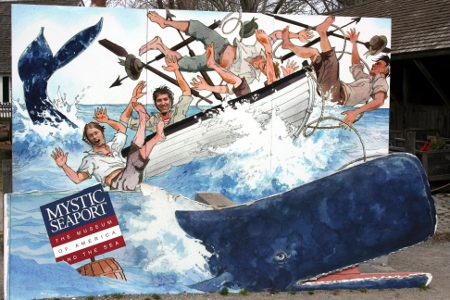
This Saturday I went to Mystic, Connecticut, a small recreation of a shipbuilding and whaling town (like Williamsburg, but for mid- to late-19th century shipping).  I could have easily spent another full day there and not seen everything!


A photo opportunity! On the left is my friend Matti (who I dedicated A Lily Among Thorns  to--she met me in Mystic with her fiancé, which was wonderful because I haven't seen them in forever) and on the right is me. All pictures, by the way, are taken by my uncle, David Lerner.


I really, really love tall ships.


In case you can't read this sign, it says: "1876 Witness to History: Meet a Person from the 19th Century!" And then written in chalk is "Saturday March 24, 1876. Miss Marsh is enjoying a day of respite from her work in the Mill."  And then to clarify, there was this sign:


"The Staff in this exhibit are ROLEPLAYERS portraying people living in 1876. Please come in and converse with them about Life and the Sea in the 19th Century."  I was a little disappointed as I was expecting time travelers!


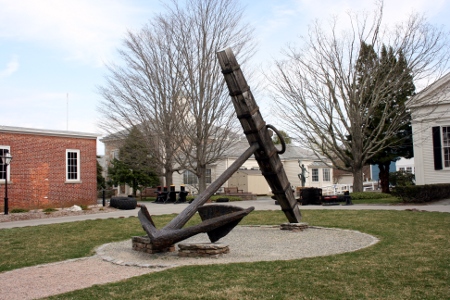
This ginormous anchor was salvaged near Mystic and is believed to belong to a British 74-gun ship (my uncle says that was the standard size for a ship of the line) from the Revolutionary War or the War of 1812.  Pretty cool, no?


I'm not sure why I found it so funny that they shrink-wrapped the boats and ships. My uncle says it's not at all unusual.


Original iron shutters on the bank! It also had an impressive iron door and a granite vault (although that was to prevent the contents being hurt in a fire, not to prevent burglaries).  One thing I forgot to ask for a picture of was the partner desk in the shipping agents' office, but I really liked it.  It was like two of those great sloping desks you see bankers or accountants using in costume dramas, put back to back, so that the partners could work facing each other. It's not, I guess, an unusual design, and it conserves space, but it just looked like such a cozy way to work with a friend.


The ropes had to be stretched full-length to be twisted, so to make rope for a large ship required an incredibly long building. This one, I think, wasn't even the original full length (I think they said the real one was twice as large and four times as long, or something amazing like that).  The spinning wheels to make the twine was upstairs in a loft, and then as you can see, the twine went on this giant spool machine from which you could thread it into this:


(Sadly it came out a little blurry, but you get the idea).  Then this machines on tracks were used to twist first the individual strands of rope, and then to twist the strands of rope together into the complete rope--but it all had to be manually told what to do by people who had to know exactly how fast to roll the machine and to rotate its parts in order to get an evenly twisted rope. Something that really struck me at all the trades was the incredible precision of every single artisan's knowledge, from the cooper who had to cut staves and form them into perfectly water-tight barrels to the ship's architects who used a wooden model of a ship to create actual full-size pieces of ships, tracing patterns for ship-parts onto the floors of giant lofts and the carpenters just carved the parts right there! 


Everybody had to know exactly what they were doing or the whole thing fell apart.

This is a Life-Saving Station. Isn't the design cute? I got the impression it was the standard design. Men lived here whose job was to help out the crew of wrecked or floundering boats. They were set at intervals along the coast and the men walked a beat from their own station to the halfway point, looking out for ships in trouble.  Then they could rest briefly in a small shed-like building called a halfway house. There they had to meet the guy from the next station over and exchange brass shields, to prove they had really walked the whole beat.


I was fascinated by the druggist's because of course my last hero, Solomon, was a chemist.  So much neat glass equipment and mysterious jars everywhere! (All the jars in one cabinet were labeled in Latin, so the various herb-seeds were labeled "Semen" much to the amusement of some 12-year-old boys...) The druggist also equipped ships with standard medicine chests (which I think they were legally required to carry). I liked these convenient leech-jars.

The shipsmith's shop is the "only manufactory of ironwork for the whaling industry known to have survived from the 19th century." The guy working there told us the story of how it was saved: an eccentric millionaire bought it and displayed it on his estate! The man in question was Edward Green, son of Hetty Green (the "Witch of Wall Street," so called because I guess ladies can't be successful Wall Street moguls without resorting to congress with the devil). Both of their Wikipedia pages are well worth reading!

Anyway, the important part is that she was a notorious miser and he was a lavish spender, with famous stamp and coin collections and a fleet of nice cars in addition to his "giant historical stuff" collection. His other big purchase was the Charles W. Morgan, the last whaling ship still extant, also now at Mystic and currently in dry-dock being restored. (It was HUGE! We had to walk up about four flights of stairs to get onto the deck. I think most of the space was reserved for barrels of whale oil though, because my uncle, who's 6'4", was hunched over and getting severely claustrophobic in the crew deck and honestly I wasn't doing much better even though I'm only 5'8".)

The guy in the shipsmith's shop said he spent every penny of his inheritance and ended bankrupt! It's not true though. He was a talented businessman and Wikipedia says his estate was valued at over 44 million dollars and his wife and sister fought a major probate court battle over it. (His wife, by the way, was a former sex worker! He waited until after his mother died to marry her.)  The bankruptcy story is a better narrative though, isn't it?

We concluded the day in the shop, where I demonstrated my restraint and frugality by only buying three new books--and one was a gift! The two for me are Black Jacks: African American Seamen in the Age of Sail by W. Jeffrey Bolster and The Trafalgar Captains: Their Lives and Memorials by Colin White and The 1805 Club. I dithered over that last book but in the end I couldn't resist--it consists of brief biographies of each officer who captained a ship at the Battle of Trafalgar and (what the back cover copy describes as "perhaps the most intriguing aspect of the work") locations, descriptions, and photographs of each of their graves. If I decide to take a Trafalgar Captains' Graves Tour of England, I am prepared!

I managed to resist Trying Leviathan, about a court case in 1818 to decide whether whales were fish or not (if they were, they were subject to New York State fish oil tax) but I'm regretting it a little now...

What large historical thing would you buy if you were an eccentric billionaire?

Monday, March 5, 2012

The golden age of modern literature

The Oscar decision that most disappointed me last week was that Jane Eyre didn't win for Best Costume Design.

Michael Fassbender and Mia Wasikowska from Jane Eyre 2011. Both laugh as they tussle for something in Jane's hand.

I thought the costumes were beautiful, and complemented the vibe of the story and the personality of each character perfectly.

The interesting thing is that I noticed for the first time a few years ago (on about my fifteenth re-read, but my first since college) that Jane Eyre is actually set during the (long) Regency. I was wondering, because of some details in how clothing and hair is described in the book, but this weird passage clinched it:

"[H]e laid on the table a new publication—a poem: one of those genuine productions so often vouchsafed to the fortunate public of those days—the golden age of modern literature.  Alas! the readers of our era are less favoured.  But courage!  I will not pause either to accuse or repine.  I know poetry is not dead, nor genius lost; nor has Mammon gained power over either, to bind or slay: they will both assert their existence, their presence, their liberty and strength again one day.  Powerful angels, safe in heaven! they smile when sordid souls triumph, and feeble ones weep over their destruction.  Poetry destroyed?  Genius banished?  No!  Mediocrity, no: do not let envy prompt you to the thought.  No; they not only live, but reign and redeem: and without their divine influence spread everywhere, you would be in hell—the hell of your own meanness.
While I was eagerly glancing at the bright pages of 'Marmion' (for 'Marmion' it was), St. John stooped to examine my drawing."
Marmion was published in 1808. (I don't know whether this tirade applies to all poetry after the Romantics, or just the poetry published between 1808 and "ten years later" when Jane is supposedly writing. Charlotte Brontë: genius and a bit of a weirdo, am I right?)
"But it's cool that they always make the clothes Victorian in movie adaptations," I thought, "because it's such a Victorian book. Putting Jane and Rochester in Regency clothes would be as weird as that Pride and Prejudice where everyone has leg-of-mutton sleeves."
Elizabeth and Darcy and Jane and Bingley from the black-and-white Pride and Prejudice with Greer Garson and Laurence Olivier. All wear very Victorian clothes.


But trying to pick apart why I feel that way is a little harder. What exactly is so quintessentially Victorian about Jane Eyre? Is it the deep POV? One could argue Jane Austen did deep POV in her books, especially Emma and Persuasion. Is it the dark seriousness? Thackeray is as light and funny as JA. Gothic horror is even a Regency genre! Is it just the style of the prose? In A Room of One's Own, Virginia Woolf said,
"The sentence that was current at the beginning of the nineteenth century ran something like this perhaps: 'The grandeur of their works was an argument with them, not to stop short, but to proceed. They could have no higher excitement or satisfaction than in the exercise of their art and endless generations of truth and beauty. Success prompts to exertion; and habit facilitates success.' That is a man's sentence; behind it one can see Johnson, Gibbon and the rest. It was a sentence that was unsuited for a woman's use. Charlotte Brontë, with all her splendid gift for prose, stumbled and fell with that clumsy weapon in her hands. George Eliot committed atrocities with it that beggar description. Jane Austen looked at it and laughed at it and devised a perfectly natural, shapely sentence proper for her own use and never departed from it."

Joan Fontaine and Orson Welles in the 1943 Jane Eyre

But it's not a very rigorous argument, apart from whatever opinions on the idea of a "woman's sentence" one might have. I don't think Jane Austen invented a new sentence, although there's no doubt she's a great writer who did some new and brilliant things with dialogue. Victorian prose was generally more ornate and formal than what was stylish in the Regency, and googling the quote Woolf used turns up "The New Monthly Magazine" of 1823, when that shift was already happening.


The one thing I can come up with that I feel pretty sure about is that the way Brontë uses the Regency is very Victorian.  While doing some research on Byron and his fans last year, I read an essay about silver fork novels, a style of popular novel that, according to Wikipedia, "dominated the English literature market from the mid-1820s to the mid-1840s" (Jane Eyre was published in 1847). Many silver fork novels, as far as I can tell, were a precursor to our Regency romances.  They depicted the lives of the British aristocracy in detail, hence their name, and according to the essay I read ("Silver-Fork Byron and the Image of Regency England" by Andrew Elfenbein in Byromania), many of them took place in the Regency period and were love stories where a rake reformed and married the virtuous heroine at the end.

But to Victorian readers, that had a much different significance than I think it does to us. The Regency represented a period of decadence and immoderation in English history, and the Regency aristocracy especially so: the "middle-class" values of chastity and thrift became so much more important at all levels of society during the Victorian era.  The Regency rake's reform also symbolized the Regency Era's reform, and his shift to responsible landowner represented England's shift into the morally upright Victorian Era.

Jane and Rochester from the 1996 version

Jane Eyre certainly fits that paradigm: Rochester's aristocratic moral degeneracy is transformed by Jane's rigid sexual morality (and the class differences between them don't hurt either!).

What do you think? What makes Jane Eyre feel so Victorian? Are we just stereotyping the period's literatures based on their most famous female writers?

Could you see Jane in high-waisted dresses and poke bonnets?