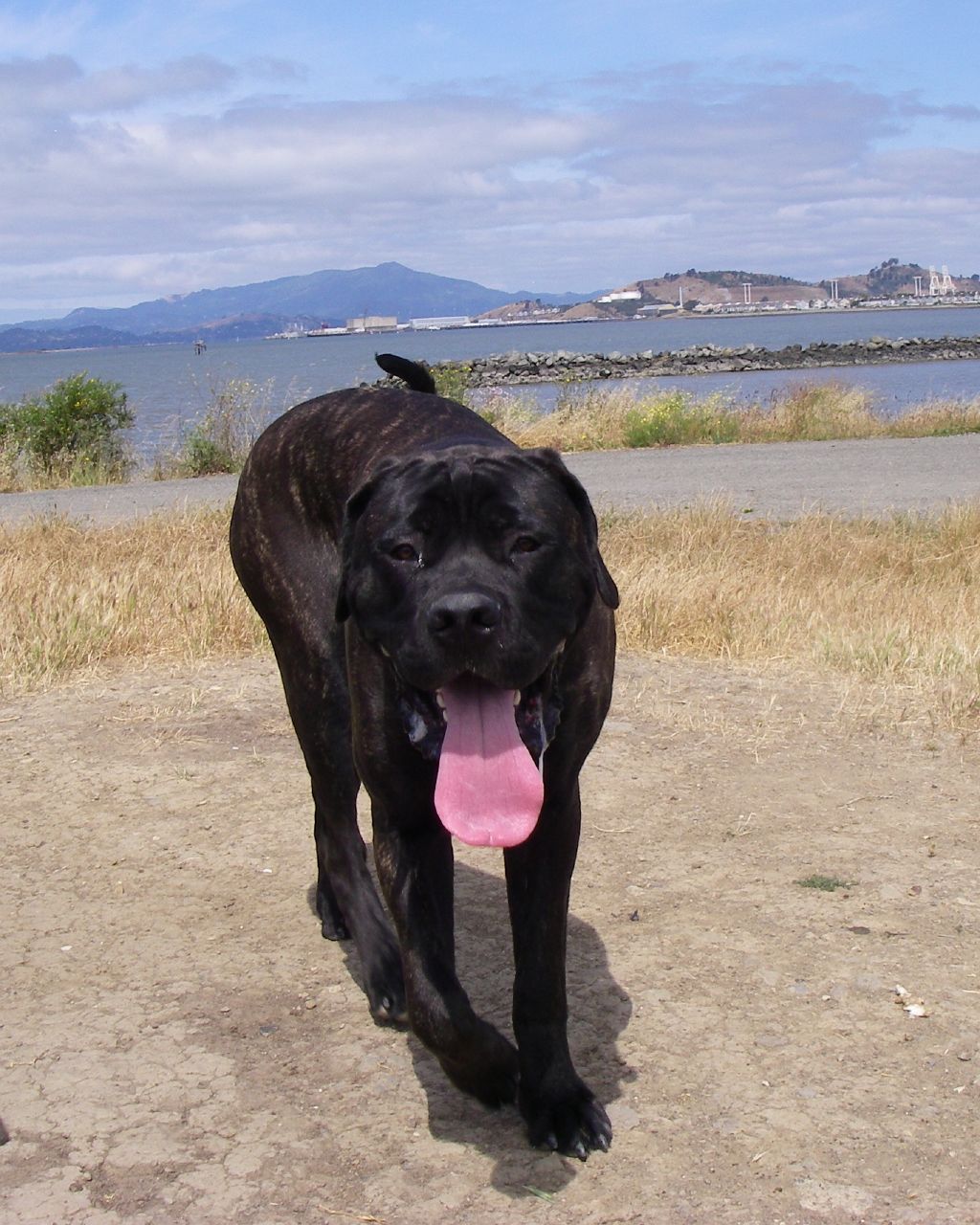
Leslie’s post about Spaniels inspired me to talk a little about my own dog: Clancy. He’s a Mastiff (a reverse brindle, very beautiful and very sweet). I grew up with Newfoundlands, Great Danes (aka Boar Hounds) and Irish Wolfhounds (all period breeds for my Georgian characters, though Wolfhounds and their cousins the Scottish Deerhounds were exceedingly rare during this period).
I lucked into a copy of The Complete Dog-Fancier’s Companion; describing the Nature, Habits, Properties &c. of Sporting, Fancy, and other Dogs from 1819 a few years ago. It talks about various breeds, instructions for rearing, training, and basic care (the veterinary advice is quite frightening), and has an amazing rant about the evils of blood sports that ends with: For the sake of humanity, it is to be hoped, that the cruelty exercised on the animal, had- been repented of by his master, the greater brute of the two [emphasis in original], and that there are none at present who could be guilty of a similar outrage.
One of the breeds featured is the Mastiff. Now, you know I’m prejudiced, as I own one, but they truly are magnificent dogs. My first book, Lord Sin, featured an Italian mastiff (a Neapolitan in modern terms) named Caesar. My next book, Ripe for Pleasure (coming out next year under my new pen name, Isobel Carr), features a mongrel mastiff or butcher’s dog (basically a Bullmastiff) that was inspired by my sister’s dog, Slag (a littermate of my Clancy).
Here is what the magazine has to say about Mastiffs:
The mastiff is much larger than the bull-dog, and every way formed for the important trust of guarding and securing the valuable property committed to his care. Houses, gardens, yards &c. are safe from depredations whilst in his keeping. Contained during the day, as soon as the gates are locked, he is left to range at full liberty: he then goes round the premises, examines every part of the them, and by loud barkings, gives notice that he is ready to defend his charge.
Well, my boy sleeps all night (ok, he sleeps most of the day too, LOL), but he does snap-to at the slightest hint of intrusion or danger and I’ve no doubt that he’d defend me and his “turf” if there was ever a need to do so (and let me tell you, the UPS man and the occasional religious evangelists are in no doubt of this either; though now that Jorge the UPS man has been introduced he no longer gets anything more than a tail-wagging hello through the window).
Much of what the author of my little magazine says elsewhere is surprising either for its prescience or its enduing common sense. At one point he notes that people commonly suppose dogs to be the civilized descendants of wolves! Remember this is 1819, before Darwin’s Origin of the Species. Under the training section the author advises: When you correct him to keep him in awe, do it rather with words than blows . . . When he hath done any thing to your mind and pleasure, you must reward him with a piece of bread. Sounds just like puppy training class to me, LOL!
Another book published in 1800, the Cynographia Britannica, said about the breed:
What the Lion is to the Cat the Mastiff is to the Dog, the noblest of the family; he stands alone, and all others sink before him. His courage does not exceed his temper and generosity, and in attachment he equals the kindest of his race.
I’m simply drawn to these giant dogs like no other I’ve ever encountered, and after owning one of my own, I can’t imagine ever owning anything else (ok, I can imagine owning most giant breeds, but they’re basically a type of mastiff or a mastiff spin off). I certainly find my love for them popping up in my books. I need to branch out and give the people in my next book something else . . . I can see some kind of coach dog for them maybe (aka a Dalmation).
Pictures, top to bottom: My boy, Clancy (and yes, that's one massive head and huge tongue); the illustration of the the Mastiff included in the magazine; Pluto, c. 1830, one of the foundation sires of the modern breed and another inspiration for the mastiff in my upcoming book.
BLYTHE GIFFORD is the author of five medieval romances, known for their “superb” mixture of history and romance. She specializes in characters born on the wrong side of the royal blanket. With HIS BORDER BRIDE, she crosses the border and sets a story in Scotland for the first time, where the rules of chivalry don’t always apply.
Here’s a brief description:
Royal Rogue: He is the bastard son of an English prince and a Scotswoman. A rebel without a country, he has darkness in his soul.
Innocent Lady: Daughter of a Scottish border lord, she can recite the laws of chivalry, and knows this man has broken every one. But she’s gripped by desire for him—could he be the one to unleash the dangerous urges she’s hidden until now?
Welcome Blythe! HIS BORDER BRIDE is your fifth book set in the fourteenth century, but the first you’ve set in Scotland. What caused you to cross the border?
A combination of creative and marketing reasons. Confession time: Scotland has never captured my imagination the way it does for so many, yet I know it is an auto-buy for many readers. Reason enough for an author to think seriously about a Scots story, but I refused to choose a setting strictly for mercenary reasons. But my hero in my last book, IN The MASTER’S BED, was from the Borders of northern England. As I learned his history, I became increasingly intrigued by this “third country,” where the Scots on one side of the line and the “Inglis” on the other had more in common with each other than either did with the rest of their countrymen. This was a Scotland that called to me, so I followed the muse across the border.
What sparked this specific story? Was it a character? An historical event? A scene you just couldn’t get out of your head?
I wanted to write a real “bad boy” hero. Since all my books have featured a character born on the wrong side of the [English] royal blanket, I wanted him to be the son of a really hated member of the royal family. I discovered that John of Eltham, a younger brother of Edward III, spent several months commanding the English troops in a Scottish invasion. He was rumored to have burned a church filled with people who had sought sanctuary there. I thought his son would be well and truly hated on the Scots side of the border, so that was my hero’s origin.
Did you have to do any major research for this book? Was it an easy transition?
Yes to the research. Not at all to the easy! It was much more difficult than I anticipated. Not the dates and places, but to learn the Scots mindset. I compare it to learning to write left-handed. I’m a life-long Anglophile, so I was very comfortable with that world view. I didn’t know what I didn’t know until I got into the story and had to learn the “back story,” if you will, of a whole country! During this period, and for several hundred years to follow, Scotland was more closely allied with France than with England. That made a difference in their court, their culture, their law – and that’s not to mention the Celtic echoes. I’m very grateful to the “Write Scottish Romance” yahoo group of writers who walked me through so much of it. So how do you feel about Scotland now? Did you learn to love it?
Actually, yes, I did. The Scots, particularly on the Border, are a stubborn, independent, hard-headed, ornery, freedom loving lot. My kind of folks! In fact, my next book will be set on the Scottish border, too.
What do you like least about this period?
I’m very familiar with the 14th century by now, so again it was the location, not the era that challenged me. In my last few books, I’d incorporated various trappings of educated royalty: art, music, dance, university studies. Life was rough on the Scots Borders. Art and “culture” were scarce. But that actually lead me to some character development, as my heroine longed for the kind of culture and comfort that she would find, she thought, by marrying a French knight. (Not the hero!)
Did you stumble across anything really interesting that you didn’t already know?
I had no idea how pervasive falconry was until I started studying it. Falconry, or hawking, is the sport of hunting with trained birds of prey. Its origins are ancient and despite having written four medieval romances, I had not realized that between the 12th and the 17th centuries, virtually every noble and even some non-noblemen would have hunted as a matter of course. The sport and the birds became a strong theme in the book, symbolic both of her emotional state and of the developing relationship. And while I began by feeling quite clever for using it as a simile for the love story, I quickly discovered I was not the first to think of it. Much of the art of the period uses the falcon in just this contest. Several centuries later, Shakespeare, in “The Taming of the Shrew” uses the falconer/falcon analogy for Petruchio and Kate’s battle of wills. My story is not a “taming of the shrew” premise, but it made me feel better to know I had chosen a metaphor that indeed applied to love, as well as sport.
Anything that constrained you or that you had to plot carefully around?
The life cycle of the falcon! Because it was such a thematic arc for the story, I had to know when falcons mated, how long it took for the eggs to hatch, when the chicks first flew and how they were trained to hunt with humans---that cycle set the framework for the story. (The illustration of hawking here dates from the same era as my story.)
Any gaffs or mea culpas you want to fess up to before readers get their hands on the book? I know I always seem to find one after the book has gone to press. *sigh*
Somehow, my idea of Scotland included sprinkling nay and nae randomly throughout the text. (Well, not randomly. I thought I knew what I was doing.) But when the copy editor questioned my usage and my editor pointed out the confusion, I had an eleventh hour fire drill to go through the manuscript and correct or change my various and inconsistent usage. (Please don’t email to tell me I missed one!)
Thanks for being with us.
Thanks for having me back. I’d love to hear comments on the appeal of Scotland and what it represents to writers and readers. Any thoughts?
HIS BORDER BRIDE is a May release from the Harlequin Historical line. Blythe loves to have visitors at www.blythegifford.com or www.facebook.com/BlytheGifford. Cover Art used by arrangement with Harlequin Enterprises Limited. All rights reserved. ®and T are trademarks of Harlequin Enterprises Limited and/or its affiliated companies, used under license. Copyright 2010
As historical authors we pride ourselves on the accuracy of our research from clothes to carriages and everything in between. And not only should our characters walk, talk, dress, ride, and converse as they might have done in our chosen era, but we like their furry companions to be period-accurate as well.
For those who’ve known me for a while, or who have visited my web site, it’s no secret that I have a passion for Cavalier King Charles spaniels—although the way the breed looks today is not exactly the way it did back in the 17th century.
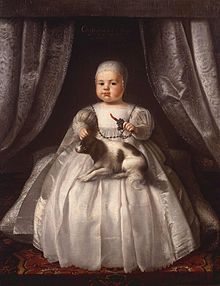
Charles II as a pre-breeched toddler; with Tricolor Cavalier
Cavaliers were named for England’s Charles I and II; the first half of the 17th century was sometimes known as the Cavalier era in England and France (think the Three Musketeers in thigh-high boots, wide collars, and lage-edged turned back cuffs).
Cavaliers were companion dogs, and at the time were also known as flea-catchers—attracting the icky critters themselves to spare their owners (and their bed linens, bolsters, testers, etc.) Over the ensuing centuries they became one of the breeds favored by royals as a lapdog. The aspiring classes as well were fond of Cavaliers.
In the first portrait George Romney ever painted of the teenage Emma Hamilton, she is posing as “Nature” with a Blenheim (maple brown and white markings) Cavalier. The original hangs in the Frick Museum in New York City; and for many people is their first encounter with Emma—who had a Cavalier sort of personality herself: utterly devoted, warm, cuddly, and prepared to stick like glue to her “master.”
If you've read TOO GREAT A LADY, my historical novel about Emma, you might sense that I’m as much of an Emma Hamilton devotée as I am of Cavaliers.
I even have a fairly good copy of that painting in my home office. And on my web site, I sought to recreate Romney’s “Nature” in one of the photographs. Austin, the Blenheim Cavalier in the photograph was borrowed for the photo shoot, though it remained my dream to own my very own Cavalier King Charles Spaniel. I knew exactly what I’d name her, too.
During my research for ROYAL AFFAIRS, which covers several of Charles II’s dalliances, I came to admire Nell Gwyn even more than I had before I began writing about her relationship with King Charles.
Perhaps the fact that she was petite, if bosomy, redheaded actress with a huge heart and a bawdy sense of humor had something to do with it. So of course my Cavalier would be called Nell. Here’s my Nell herself, a Tricolor Cavalier puppy. We’ll be picking her up from the breeder at the end of May. She has the same coloring as a famous royal Tricolor—the young Queen Victoria’s “Dash.” If you’ve seen the recent movie “The Young Victoria,” the dog trots away with every scene.
And in another month or so, sweet Nell will be sitting at my feet as I write.
Do any of your characters have dogs, and did you research their breed and temperament while you were writing (or already have that information) so you could suit your four-legged character (or not) to its fictional owner?
Do you like reading about, or writing about, dog-owning characters? And what depth or nuance, or even perspective, do you think it adds to a character to make them a pet owner?
I ran across this interesting article and thought it was post-worthy here...a story about Clelia Mosher, a Victorian-era Stanford Professor who conducted a sort of Kinsey report before Kinsey...She surveyed educated married women about sex and interestingly, had her results been published the study would have upended the long- held wisdom of the time-- that women didn't like sex and shouldn't rightly enjoy. You can read the whole article here: http://www.stanfordalumni.org/news/magazine/2010/marapr/features/mosher.html. I'ts nicely written and reports first-hand accounts of how Victorian women felt about sex. Apparently, they found great pleasure in it and thought it natural...although one who didn't like it faulted her poorly-trained husband.
From the article by Platoni: "One woman, born in 1867, wrote that before marriage she believed sex to be only for reproduction, but later changed her mind: "In my experience the habitual bodily expression of love has a deep psychological effect in making possible complete mental sympathy & perfecting the spiritual union that must be the lasting 'marriage' after the passion of love has passed away with the years." Wrote another, born in 1863, "It seems to me to be a natural and physical sign of a spiritual union, a renewal of the marriage vows."
Dr. Mosher herself is an interesting character---a mannish, lonely academic who wrote in her journals to an imaginary friend. She never married and probably never experienced that to which she dedicated so much of her life's research. But she was a trail-blazer for her time---disproving myths about menstruation, women's perceived frailties and raging against corsets and the heavy skirts.
The article: The Sex Scholar, written by author Kara Platoni is well worth the read and has gotten AP attention in the media. Posted here is an image of Dr. Clelia Mosher, born in the 1860s, a woman who served as a nurse in WWI and achieved the rank of full professor for her work on "women's hygiene" at Stanford in 1928. She is as interesting as her research.
I bet this study is no revelation to the romance writer, or reader...or even to women today in general. So why did we think Victorian women were prudish? history scholars tell us it's because sex education came to the Victorian woman via published so-called "health-books" written by men of the time and were treatises intended to discourage sexual interest--- and because disdain for the act was one of the rare ways women of the Victorian upper and middle class could set themselves apart from the lower classes and "earn respectability."
Dr. Mosh's report is worth a read just for the insights a historical writer could gain from hearing the voices of Victorian women convey their thoughts on sex.
Has anybody ever read other first hand accounts from Victorian women that reflects their attitude on sex?
My wonderful friend Veronica Wolff (with whom I often share very productive writing dates) has recently discovered the novels of Georgette Heyer. Lately our writing get-togethers often begin with a discussion of whatever Heyer book she's currently reading. It's so fun to be see Heyer's novels through the eyes of someone who is reading them for the first time.
If my fascination with the Regency era began with Jane Austen’s novels, novels which were actually written in the Regency, it was further cemented by reading Georgette Heyer’s Regency and eighteenth century-set historical novels. I still remember my first introduction to Heyer’s books. I was nine-years-old, and though I was reading to myself, my mom still read outloud to me as well. One evening we were at a bookstore, and I asked what we were going to read next. She held out a book with a cover showing a dark-haired young woman with side curls in a high-waisted pale green dress and said “let’s try this and see if you like it.” “This” was Heyer’s The Grand Sophy one of my favorite novels to this day (interestingly it was also the first Heyer book Veronica read). From the first chapter where Sir Horace Stanton-Lacey calls on his sister Lady Ombersley, I was entranced by this vividly created world. Over the next few years, I went on to read most of Heyer’s historical romances and several of her contemporary mysteries, some outloud with my mom, some to myself.
I reread her books frequently. Rereading the books as an adult, I'm more aware of Heyer's politics, which are wildly different from my own. Her take on the Regency is also somewhat different from my own. But I still marvel at her craftsmanship and think of her characters as old friends. I’m hard-pressed to pick favorites among the books, though I do have a fairly consistent top three:
The Grand Sophy which has a wonderfully tough, independent heroine, a nicely understated love story, a sharply-detailed cast of secondary characters, laugh-outloud humor, and an hysterically funny ending in which all the characters and plotlines converge (the inspiration for the finales of several of my mom and my Anthea Malcolm Regencies and also for the denouements of several of my historical novels).
Venetia, which beautifully captures the wonder of finding a friend and lover and manages at once to be deeply romantic and yet have a keen edge of reality (I also realized writing this that Venetia and Damerel toss quotations back and forth, which is probably yet another reason why Mélanie and Charles do the same).
And An Infamous Army, set in Brussels in the weeks before and then during the Battle of Waterloo. An Infamous Army started my interest in the Napoleonic Wars (definitely another influence on my Charles and Mélanie stories) and introduced me to a collection of real historical people who figure in the book and who I’ve gone on to use in my own books (Wellington, Fitzroy Somerset, the Prince of Orange, the Duchess of Devonshire, Georgiana Lennox). And its rebellious heroine and quietly honorable hero are a fascinating pair. I recently reread An Infamous Army because my WIP takes place round Waterloo. I was struck by how brilliantly Heyer integrates real events and people with fictional ones, so that one can scarcely tell where the history leaves off and the fiction begins. And the way she pulls back and lets us see the hero and heroine through the eyes of other characters (notably the hero's brother and his wife, the hero and heroine from a previous book) is masterful.
Those are my favorite three, but they leave out so many others I love–Sylvester, Arabella (after whom I named my Madame Alexander doll when I was ten), Frederica, These Old Shades, Devil’s Cub, Friday’s Child…
There's no explicit sex in Heyer's books, though I sometimes think they're the more romantic for it. Venetia in particular is a filled with sexual tension, perhaps all the stronger for being held in check. In The Grand Sophy, we don't event get the hero's and heroine's feelings in inner monologue. Perhaps the closest we get to a window into Charles (the hero)'s feelings is the moment when he looks at Sophy across his young sister’s sickbed as though a thought, blinding in its novelty, had occurred to him. Charles does ask Sophy to marry him but even then either says “I love you” in so many words. In fact his proposal is Will you marry me, vile and abominable girl that you are? and her reply is Yes, but, mind, it is only to save my neck from being wrung! I remember reading the scenes between Sophy and Charles over and over as a pre-teen, trying to tease out who felt what when, trying to decipher clues to their emotions.
Have you read Georgette Heyer? Any particular favorites? What makes those books stand out for you (or not as the case may be)?
Simon St. James, fifth Earl of Trask, knows he could do worse in the marriage of convenience department. Sophie Stanton may be a bit of a social liability, with her ungovernable ways and flighty nature, but Simon has responsibilities as an earl that far outweigh happiness in the household. As for happiness in the bedroom...he has to admit he sees Sophie’s potential in that arena...
Their passion was not!
But Sophie isn’t some bargaining chip to be traded, and she’s not about to let Simon St. James tell her how to live her life—even though she has nurtured a crush on the handsome young earl for as long as she can remember. If his idea of courtship is telling her what to do, then she is not interested, or at least she is trying not to be. But when his scolding words turn to scorching kisses, suddenly Sophie starts paying attention...
Sex And The Single Earl is set in the Regency period, specifically 1815. Is there a particular reason you chose that year?
The short answer is that it’s a follow-up to my first book Mastering The Marquess, which is also set in 1815.The events in Sex And The Single Earl take place about three months later.The long answer is that I wanted to write about the time period following Waterloo, and the end of the Napoleonic Wars.My hero is something of a proto-industrialist who is intent on building an empire in the textile trade.Now that the war is over, he wants to expand his commercial holdings to the Continent.The economic and social dislocation that occurred in those months following the war is a factor in the plot, as well.
How did you become interested in this time period? What do you love about it?
I became interested in the Regency period in the same way many historical romance writers did – through the novels of Georgette Heyer.From there I moved on to Jane Austen, which pretty much sealed my fate as far determining my favorite period of history.In graduate school, I studied British women writers of the Georgian and Regency era, especially Fanny Burney.Her diaries are a detailed and riveting account of life in artistic circles and at the court of George III.
I guess what I love most about the period is that fascinating combination of glamour, glitter, and wit exemplified by London’s elite society, co-existing alongside a truly gritty and flourishing underworld.The beauty and culture of the Mayfair mansions were only a few blocks away from the worst stews of London.But those worlds so often intersected in a strangely democratic way in places like Covent Garden and Vauxhall.
Throw in the danger and intrigue of the Napoleonic Wars and you have a killer combination.
What do you like least about this period? Anything that constrained you or that you had to plot carefully around?
There really isn’t much I dislike about this period.I just find it endlessly fascinating.There are always problems to plot around, though, and it can often be the little things that trip you up.Matters of social etiquette are probably the most common.Or details such as when certain dances or customs were first introduced into England.In my first book, I had a major plot point revolve around a breach of etiquette involving the waltz.I had to double and triple-check that the waltz was, in fact, being commonly danced in the year that my book was set.I think I might have even bumped the book up a year in order to accommodate that.
Anything you flat-out altered or “fudged”? If so, why?
In Sex And The Single Earl, which takes place in Bath, I needed to set an important scene in the workhouse, in a specific part of town.I was never able to nail down exactly where the workhouse was located in that period, so I picked the street I wanted it to be in and put it there.It fit the existing neighborhood at the time perfectly.
Any gaffs or mea culpas you want to fess up to before readers get their hands on the book? I know I always seem to find one after the book has gone to press. *sigh*
My hero is the ninth Earl of Trask, but the back cover copy of the book refers to him as the fifth Earl of Trask.I don’t know how I managed to let that one slip by!I’m hoping it’s corrected in the final version, but I may have noticed it too late.I’m sure there will be other slip-ups that someone else will point out to me.
Tell us a little about your hero. Something fun, like his favorite childhood pet, or his first kiss.
Simon is an uber-alpha tough guy, but when he was young he liked to play the piano and sing.He also wanted to teach mathematics at university, but things didn’t work out that way.
What sparked this book? Was it a character? An historical event? A scene you just couldn’t get out of your head?
As I mentioned earlier, Simon and Sophie were secondary characters in my first book.They took over every scene they were in and had really strong chemistry.I loved them right from the start, and knew they would be the hero and heroine of my second book.
Did you have to do any major research for this book? Did you stumble across anything really interesting that you didn’t already know?
Since the book is set in Bath, I had to do a ton of research on what the city was like in 1815.I have a sub-plot involving child prostitution, so I also had to research what the criminal underworld was like.Surprisingly, it was pretty extensive given the size of the town, because Bath was a resort that attracted rich people.There was a lot of poverty, too, which doesn’t really fit with our image of Bath in the time of Jane Austen.
What/Who do you like to read?
I enjoy reading histories and biographies of the period.In my grad school days, I loved both Fanny Burney and Jane Austen, and I was pretty partial to Samuel Richardson, too.As far as historical romance writers that I read, Loretta Chase, Eloisa James, Joanna Bourne, Madeline Hunter, and Anna Campbell are among my favorites.There are, however, too many great historical romance writers to list.I also read romantic suspense, and right now I’m devouring the back list of Karen Rose, who I think is monstrously talented.
Care to share a bit about your writing process? Are you a pantser or a plotter? Do you write multiple drafts or clean up as you go?
I’m a mad plotter, and do tons of pre-work before I start writing.In addition to my historical research, I do character biographies, GMC charts, a plot board, and usually a full synopsis before I commit words to the page.That results in a pretty clean draft.I do two revisions, which usually don’t take me very long.
What are you planning to work on next?
My third book is also in this connected series, and I’m really excited about it.The heroine is actually the villainess of Sex And The Single Earl.I’ve reformed her and hooked her up with a hero who drives her crazy.
I also write contemporary romance with my husband, under the penname of V.K. Sykes.Our first book, Caddygirls, is being published this summer by Carina Press.
I’m not a “big-name” writer by any stretch of anyone’s imagination. I’m a tiny fish in a very large pond, but of late I am discovering that even small fish have sensitive psyches.
Sometimes, when I am struggling with a book, I wonder whether other mid-list writers are sweating as I am. Are they questioning their ability to write their book the way they envision it? Running out of synonyms for “said” and “walked”? Waking up at 3 a.m. with the deflating realization that the love scene will never work? Wondering they have lost their “touch” or their “voice?”
Or (gulp) their next contract?
I agonize over whether my editor will like my last scene. My hero. My character arc. But then I have to ask, “Why am I doing this?” Am I writing this story for my editor, or for me? Is it my creative vision that’s important here, or the marketing department’s estimate of potential sales? Should I change to a more currently sellable genre such as paranormal? Urban fantasy? Young adult thriller?
I have days when I wonder if I really do have some talent for writing or just a workaholic daily routine. I wonder if my brain is slowing down as my body is? Then I wonder (philosophically [physiologically?]) if it’s really one’s brain that comes up with a great idea for a book or some ineffable force called The Muse.
I wonder if my Muse ever gets fed up and flies off to a greener pasture. Does my pasture need a shot of fertilizer, or am I just having a blue period which will pass when it stops raining?
Some days I think I’m doing okay. I write consistently; I research diligently; I plan my turning-point scenes, character growth, and emotional through-lines intelligently.
Other days I’m not so sure. I get a 4-page single-spaced revision letter from my editor; I get kindly nudges from my agent. I believe the editor just wants a good, marketable book rather than my ego on a platter. I believe my agent is on my side.
And I try to be on my side. But you know what? There’s a bunch of stuff I don’t know, like whether high sales numbers mean that I’ve written a “good” book. And what is a “good” book in the popular fiction category, anyway?
Maybe this is “artist angst.” Maybe it’s hormonal droop or Prozac poopout. But I wonder if I’m the only writer who sometimes feels uncertain and un-selfconfident and a bunch of other “un” things?
I hope I am preaching to the choir here; otherwise it’s just a struggling writer’s whine.