Friday, February 26, 2010

Confessions of an Unjustified Ignoramus: The Pleasures of WOLF HALL

If I could give it six or seven stars out of the allowable five, I'd do so, is what I recently wrote on Goodreads.com about this splendid historical novel that kept me reeling and squealing with pure reading pleasure last week while the rest of my life ground to a halt around it.

Not that I'm exactly alone in my appreciation. The reviews have been rapturous, the accolades universal. Wolf Hall didn't only receive Britain's prestigious Man Booker Prize this year; it was the oddsmakers' favorite since the short list of (spectacular) finalists was announced.

But I'm probably relatively alone -- if not in my pristine ignorance of its subject, then in my complete lack of prior interest in it.

Because before I read this book, not only did I know absolutely zip about Thomas Cromwell, Wolf Hall's towering, tough, surprisingly sympathetic, and entirely absorbing subject (who was King Henry VIII's chief minister and active fixer during the period of his divorce from Catherine of Aragon and marriage to Anne Boleyn).

But I had very little curiosity about his period, having learneed barely enough to get through high school European history: Henry leaving the Catholic Church and seizing the monasteries was about all you needed, though the lonely heroism of Thomas More might be worked into an essay question, while "one died, one survived, two divorced, two beheaded" might get you some extra credit. And I continued not to care much, even amidst all the Philippa Gregory hoopla of the last few years. I didn't bother about the Scarlett Johansson movie or the Tudors on TV -- though I will cop to always feeling slightly smug, knowing why Donwell Abbey is Donwell Abbey.

Of course, there was the high school pilgrimage to see A Man for All Seasons on Broadway, obligatory during a certain era for honor students from Long Island. But if there were any surprises to be found there, any ironies or complications of the mid-twentieth century liberal chronicle of Thomas More's resistance of conscience in the face of Henry's cynical operatives (Thomas Cromwell being chief among them), I've got to say they quite eluded my impatient adolescent imagination. While the King himself, bigger than life in the famous portrait, has, I confess, always seemed to me somewhat less than alive, so meticulously outlined by Hans Holbein the Younger's brush, so easily and too readily understood as a creature of outsized will and appetites.

Lusty -- isn't that the word that comes to mind, and much too quickly, imo. Odd how sometimes a word can obscure so much more than it reveals.
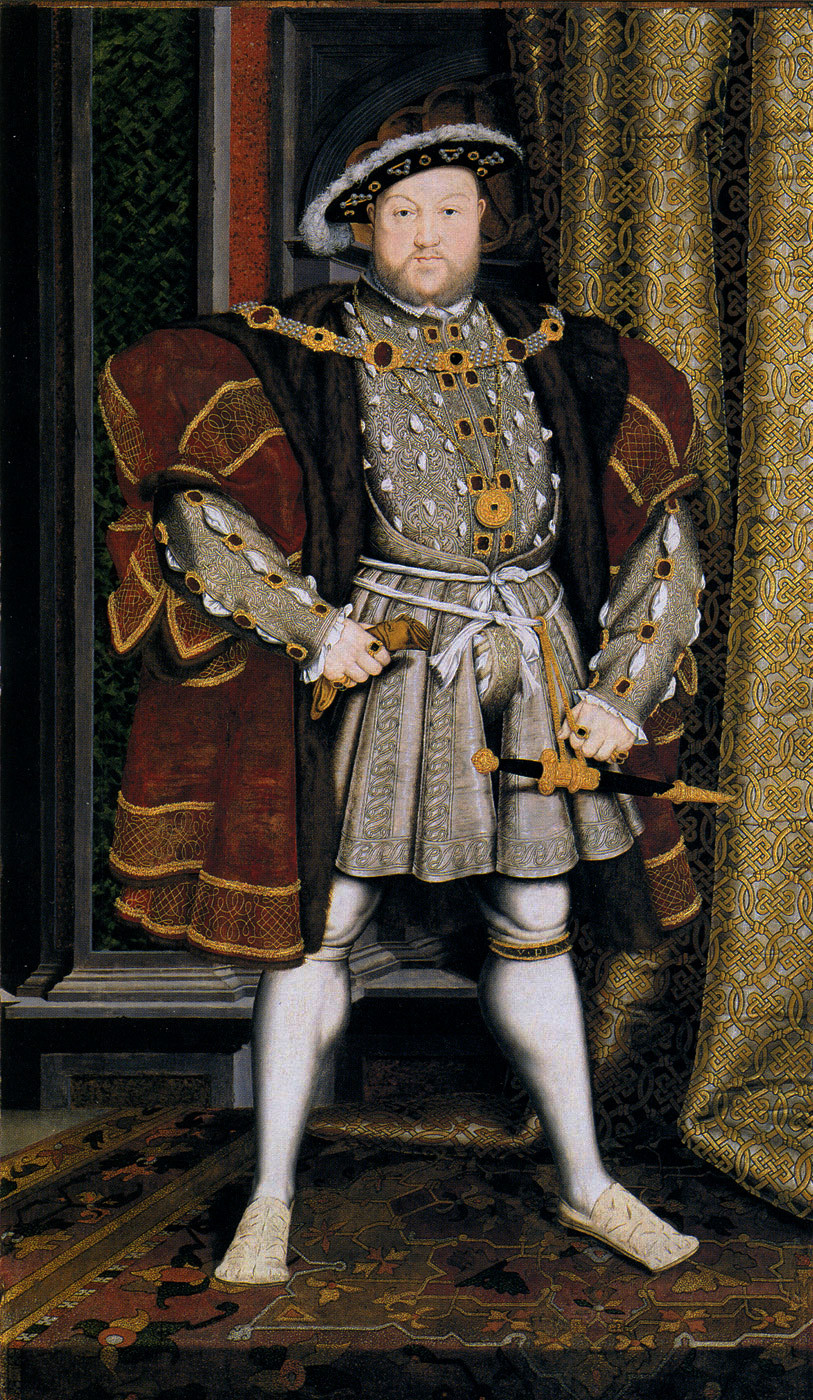
Which is not, necessarily, to fault Robert Bolt for what I might have missed in his play. While as for Holbein's painting: certainly the nuanced subtleties of his portrait of Henry -- the massiveness of the shoulders surrounding (as Mantel's text points out) the pampered daintiness of the mouth -- are there to see for anyone who really looks. It's clearly nobody's fault but my own that I wasn't understanding much.

But what I have to marvel at is, that thanks to Wolf Hall, my ignorance and inattention have been quite deliciously, almost unfairly rewarded, by allowing me such a fullness of latter-day discovery of this past world and its events though Mantel's rendering of Thomas Cromwell, son of a blacksmith, who rose to the heights of power amid the intrigues of the Tudor court. As Mantel tells it, the story of the man who managed Henry's divorce and marriage (avoiding war with the Pope while expropriating vast church properties) is an ongoing astonishment, a brilliant use of what historians do know and what they can't -- to build a credible human being, who just (we think and think and think again as the story unfolds) might have been something like that; a Thomas Cromwell who might have seen, thought, experienced things in just that way.

Credible and yet astonishing. As real people in the real world sometimes emerge from the background when we manage to see the world through their eyes for a brief empathic instant.

I don't think it would have worked without its brief, brilliant, brutal opening scene.

"So now get up."

Felled, dazed, silent, he has fallen; knocked full length on the cobbles of the yard. His head turns sideways; his eyes are turned toward the gate, as if someone might arrive to help him out. One blow, properly placed, could kill him now.

Another blow -- from the then-fifteen-year-old Thomas Cromwell's insanely, inexplicably violent father -- does come, but it's not properly placed and doesn't kill him. Nor does the boy get up. Not yet, anyway; he's got the remainder of the book in which to rise to the fabulous fullness of his political power. Now he simply absorbs the violence, plays for time, profits from a momentary lucky distraction to creep away, pass out, and survive the blows of a world he didn't make. Coming to consciousness the next day, he escapes his father's rages by leaving England, spending his young manhood on the continent as a soldier, a trader, a secretary and translator -- picking up the ways of the world as he goes, not only in courts, but in kitchens and counting houses.

Look again at that portrait of Henry, and at Holbein's portrait of Thomas Cromwell, here. Look only only at the men, though, but at the richness of the fabrics, the furs, the textiles and carpets, the stuffs that were being measured and traded out of Antwerp, the metals and minerals coming in on ships from the New World. Mantel's Thomas Cromwell is a man who's learned at first hand about the ways of wealth. When we meet him again -- after he's returned from his young man's education in the world -- we meet a man whose fingers know the weave of a carpet, the weight of a bag of coins.

But we know from that first scene that he's also a man whose body knows the ways of blunt, stupid, arbitrary power. The writing continues unfailingly, densely immediate as Cromwell measures, evaluates, acts, judges, and also desires and loves, mourns and endures. He loses a beloved wife and daughter in an afternoon of summer plague. It's a world where things are both bigger and smaller than we're accustomed to, wherein a man of Cromwell's competence can gather the tools of power, hear the hums and feel the stirrings of new religious and philosophical knowledges as though mastering the fine points of forging horseshoes in his father's smithy.

Written in a continuing present tense and an unremitting Cromwell-centered point of view (one of the few examples of that p.o.v. technology I've encountered that justifies the word deep), I read it as a kind of manna from historical fiction heaven, the best example of what I want from that kind of writing: the marvelous plenitude of detail and evidence and the daring, wide-ranging speculation that creates a world and a person within it. oneThe felt knowledge, as I've written more than once on this blog, that our now-familiar past was someone else's challenging, don't-know-how-it'll-end present.

Can one accomplish that in historical romance? Ultimately no, I think, though I do try for momentary effects, flashes of understanding, and challenges to the genre's received wisdom (surprise! the British Home Office wasn't all wisdom and gentlemanly rectitude post-Waterloo, devoted only to the good of its citizens and the defense of the Prince Regent's substantial person).

But in the main, historical romance has other virtues, other structuring characteristics. As I've written about before and as I'll try to write about again in the light of Wolf Hall.

What a book.

Have you read it? Do you intend to? And if you have, what did you think of it?

Wednesday, February 24, 2010

What a story! Real-life personals as literary inspiration


Pvt. George S. Gaines, First New York Mounted Rifles

A young soldier, of two years' standing in the armies of the Republic, is desirous of conducting a correspondence with some American lady, not over 24 years of age, with the view that it may lead to a mutual desire to become personally acquainted -- that such acquaintanceship may ripen into love, and, by the consummation of our affection, two lives be blended into one; or, in the plain King's English, I am quite anxious to marry . . . None but those who are sincerely disposed to look this matter "square in the face" need reply. In regard to his personal appearance, qualifications and character, the advertiser prefers to say nothing -- a carte de visite, the contemplated correspondence and the future will disclose all that is necessary or desirable to be known on the subject . . . Address Charles P. Hanover, First New York Mounted Rifles, Suffolk, Va.

May 27, 1863


That letter, with a few others dating from the second half of the 19th century, was originally printed in the New York Herald, and these letters were reprinted on the Sunday Opinion page of the New York Times this past Valentines Day, edited by Pam Epstein, a PhD candidate at Rutgers University in New Jersey and the author of a blog called "Advertising for Love."


1st Sgt. Frank W. Mills. First New York Mounted Rifles

I was so struck by this letter that I read it aloud to my husband across the breakfast table the following morning, my eyes brimming with tears. So many thoughts simultaneously crossed my mind as I read it that Cupid might as well have tied each one to an arrow and unleashed his entire quiver at once, every dart striking my heart with a true aim.


First, the letter reminded me of the way I met my husband Scott -- he was stationed overseas. I was a NYC girl at home, looking, hoping, wishing, and wanting love. And by that point, I was open to all possibilities. Scott's first letter to me was also so, well, well-written (and what writer doesn't want an introductory love note that is perfectly spelled and grammatically correct?) that I wanted to know "Who IS this guy?"

When I read Charles Hanover's personal ad in the Times, his writing style struck me as well; his letter was so impeccably crafted, so sophisticated, that I tried to imagine your average grunt today writing something so perfectly phrased, peppered with French, and just skirting the saber's edge between florid and heartfelt.

Pvt. Allen Curtis Smith, First New York Mounted Rifles


And before I began to wonder what he might have looked like (somewhat older than advertised, perhaps, which might have accounted for the sophisticated prose, the French, the initial unwillingness to reveal any details about his looks), I thought ... did he come home?


And then, as a historical novelist I wondered, if Johnny (or rather, Charles) Came Marching Home, had he met his future wife during the war as a result of his personal ad in the New York Herald? How did their courtship play out in letters? And what happened when they finally met in person? Was one or the other of them disappointed? Delighted? Having had the best of intentions, did they eventually wed, or did reality crush their epistolary dreams? What did Charles bring back from the Civil War? Was he wounded? Physically, psychologically, or both? Could his sweetheart begin to comprehend and cope with what he had experienced?


And who was she? What was her backstory? An old maid with pragmatic dreams or a young girl with her heart open to the sky? From the North or from the South? And how would that impact their relationship? What was her family's experience of the war?


Pvt. Reuben Webb, First New York Mounted Rifles


And what if Charles didn't make it home in one piece, or as a sentient being, and what if he came home in a box instead of on two legs, or even a crutch? What happened to the widow that never was?


Have you ever read a letter (not one written by a well known or "famous" person) and thought "Wow! What a novel this would make!" If so, what was the gist of the letter that sparked your imagination. Did you write the story?


By the way, here's a link to some history on Charles Hanover's regiment. http://www.dmna.state.ny.us/historic/reghist/civil/cavalry/1stMtdRifles/1stMtdRiflesMain.htm


A foootnote to history from that site: September 6, 1865, the regiment received the designation, 4th Provisional Regiment, N. Y. Volunteer Cavalry, and its final record will be found under that head.

The regiment lost by death, killed in action, 1 officer, 18 enlisted men; of wounds received in action, 1 officer, 12 enlisted men; of disease and other causes, 4 officers, 125 enlisted men; total, 6 officers, 155 enlisted men; aggregate, 161; of whom 8 enlisted men died in the hands of the enemy.

Tuesday, February 23, 2010

Winner of Improper Relations

Susan Wilbanks won a signed copy of Improper Relations.

Congratulations, Susan, we'll be in touch!

Monday, February 22, 2010

Improper Relations? Or just good friends?

I'm writing today about my new release Improper Relations and early nineteenth century attitudes toward female friendship.

Friendships between women in the Georgian era were often expressed in passionate language in frequent letters; it was the age of feeling, of sensibility. It was also an age of advancing female literacy and leisure among the middle classes, and the absence of men--whether it was to prizefights or war--led women to seek like-minded companionship.

The Ladies of Llangollen are probably the most notorious example of passionate female friendship. In 1778, Lady Eleanor Butler and the Hon. Sarah Ponsonby eloped to live together for over fifty years of devoted bliss, enjoying literature, gardening, and a gorgeous house (which they decorated in Gothic splendor) in Llangollen, Wales. This charming portrait is of their cats in 1809 by artist Maria Taylor. They became celebrities who were visited by the likes of Wordsworth, Shelley, Byron, Wellington and Lady Caroline Lamb.

As their names suggest, they were members of the Irish aristocracy, and both women had upset their families by claiming they would never marry. Eventually they were reconciled with their families and, following interest from Princess Charlotte, received a royal pension.

So I find it extraordinary that Austen's view of female friendship is so negative. Friendship is a sometime thing and not always sincere; one of the participants at least may have an ulterior motive, despite appearances.
The progress of the friendship between Catherine and Isabella was quick as its beginning had been warm, and they passed so rapidly through every gradation of increasing tenderness that there was shortly no fresh proof of it to be given to their friends or themselves. They called each other by their Christian name, were always arm in arm when they walked, pinned up each other’s train for the dance, and were not to be divided in the set; and if a rainy morning deprived them of other enjoyments, they were still resolute in meeting in defiance of wet and dirt, and shut themselves up, to read novels together.
In Sense and Sensibility, Elinor befriends Lucy Steele to discover the nature of her engagement to Edward, and the two perform a complicate dance of suspicion and revelation. Do you really think Elizabeth Bennett will maintain her friendship with Charlotte Lucas; or rather, do you think Mrs. Darcy and Mrs. Collins will write frequent, warm letters to each other?

For Austen, true intimacy and love is between sisters, not friends.

My book, Improper Relations, which came out last week from Little Black Dress, is about a friendship between two women and the conflict caused when their loyalties to each other are challenged by new loyalties to their respective husbands. Yes, it's a romance (splutter, it has an arranged marriage and a duel! A wedding night!). I made the mistake of telling some women at a conference a few months ago that my next book was about relationships between women because they were so much more interesting and brought the table to an embarrassed silence.

Here's an excerpt, as recounted by the hero:
[Charlotte says] “She is my friend. My best friend. She knows me better than anyone in the world. When she fell in love I was lonely. I felt I had lost her and part of myself, too.”

I am silent. I have friends; I have lost friends, too, an inevitable consequence of the times in which we live and my former profession. But I have never felt incomplete without anyone—or rather, until now, I have never felt the possibility that I could feel this way. For I realize fully now what Charlotte means to me, my other half, my love, the one whom I can turn to and who knows my secret self. It has taken her confession of love for another to make me realize how deeply I love my wife, an extraordinary business to be sure.
Do you agree with my assessment of Austen's view of female friendships? Does it trouble you that Lizzie Bennett doesn't grieve for the loss of her friend? Prove me wrong, please!

I'll give a signed copy of my new book to a random commenter. Meanwhile, do visit my site and find the links to soundbites from my Regency chicklit books on the home page, enter the contest and read another excerpt from Improper Relations.

Saturday, February 20, 2010

The Reliable Wife: Bleak Romance with a Questionable "HEA"


There are some books I finish and I just sit there for a minute at the end and think "What was that?" That's what happened when I read the Reliable Wife, by Robert Goolrick. I must admit, I picked it up because I liked the title, and the cover said ROMANCE: A headless woman in a beautiful Victorian-looking red dress standing in front of a train.

Now this was not the original cover, which was much more staid and literary looking (a simple title on a sign), so I figured the new cover was meant to target me, a romance fan.

Well, was I in for an interesting read. I read the whole book in a few hours, with my eyebrows raised at the purple prose, the complete implausibility of the plot, and sex-obssessed characters that were hard to like and unsympathetic. But I kept reading. For some reason I wanted to know what happened. The ending had a sort of "happily ever after" ending, but without giving anything away, I honestly didn't buy it. Not after the extreme emotional and physical abuse these characters suffered and put each other through. But what bothers me the most are the literary reviews---so many said this book was a BODICE RIPPER! Now come on. Who ever calls this book a "soap-opera bodice ripper" hasn't read one. I've read a few.

Was this book a romance? No. Decidedly not. It also had a queer way of making me feel icky at the end, even with the so-called happy ending that the author likened to the end-style of a Jane Austen novel: Everything solved to everyone's satisfaction in the few final pages. NOT!

I have taken the liberty of posting this review by Ron Charles, who reviews for the Washington Post. I think he sums it up fairly, if not favorably. I agree with most of what he wrote, except I still have a hard time believing that these severely damaged people could ever forgive themselves and each other.


By Ron Charles
Washington Post Staff Writer
Wednesday, April 8, 2009

A RELIABLE WIFE

By Robert Goolrick

This Story
FICTION: Loneliness, Lust and the Mail-Order Bride
FICTION: Living Far From Home
COMIC NOVELS: If Animals, and Zombies, Could Write
Algonquin. 291 pp. $23.95

"Don't be fooled by the prissy cover or that ironic title. Robert Goolrick's first novel, "A Reliable Wife," isn't just hot, it's in heat: a gothic tale of such smoldering desire it should be read in a cold shower. This is a bodice ripper of a hundred thousand pearly buttons, ripped off one at a time with agonizing restraint. It works only because Goolrick never cracks a smile, never lets on that he thinks all this overwrought sexual frustration is anything but the most serious incantation of longing and despair ever uttered in the dead of night.

The curtain rises in 1907 during a Wisconsin winter "cold enough to sear the skin from your bones." Ralph Truitt, the wealthiest man in town, stands frozen in place on a train platform, but inside he's burning with the unsated desire of 20 solitary years.

Ralph is waiting for his mail-order bride, a woman he requisitioned through a classified ad: "Country businessman seeks reliable wife. Compelled by practical not romantic reasons. . . . Discreet." That may sound as horny as Sunday school, but Ralph isn't entirely what he seems, standing there on the platform with "his eyes turned downward, engraved with a permanent air of condescension and grief." Inside, the 58-year-old widower is startled by the intensity of his desires, consumed with thoughts of sex and murder and madness in homes all around town. "Sometimes his loneliness was like a fire beneath his skin," Goolrick writes. "He had thought of taking his razor and slicing his own flesh, peeling back the skin that would not stop burning."

This first chapter, in which everything appears stock still, is told in a husky whisper of something lurid and painful, "the terrible whip of tragedy." Again and again, we hear this refrain, like a judgment and a curse: "These things happened."


Keep this in mind as you're scanning the personal ads in the City Paper.

When Catherine Land finally arrives, looking prim and dour, she isn't what she appears to be, either. She threw her extravagant party dresses out the train window a few miles from town, and she has hidden jewels in the hem of her black wool dress. She's not even the woman in the photo she sent Ralph during their summer of tentative correspondence. And she's carrying a bottle of arsenic and "a long and complicated scheme."

Poor Ralph has some awfully bad luck with women: the matrimonial equivalent of sailing to Europe on the Titanic and flying home on the Hindenburg. "This begins in a lie," he tells Catherine sternly as he picks up her bags. "I want you to know that I know that. . . . Whatever else, you're a liar."

All Ralph wants -- or pretends he wants -- is "a simple, honest woman. A quiet life. A life in which everything could be saved and nobody went insane." That's so hard to attain when your new bride hopes to poison you straightaway. But damned if he doesn't almost die in a spectacular riding accident while bringing her home from the station. Poor Catherine finds she's got to nurse Ralph back to health before she can start killing him.

Don't worry: I'm not giving anything away. Neither of these two steely people is playing straight with the other, and Goolrick isn't playing straight with us, either. The floor collapses in almost every chapter, and we suddenly crash through assumptions we'd thought were solid. Goolrick keeps probing at the way people force themselves not to know something -- not to believe the truth -- in order to fulfill their deepest longings.

The novel is deliciously wicked and tense, presented as a series of sepia tableaux, interrupted by flashes of bright red violence. The whole thing takes place in a fever pitch of exquisite sensations and boundless grief in a place where "the winters were long, and tragedy and madness rose in the pristine air." The word "alone" spreads through these pages like mold in the cellar, until it's everywhere.

The stillness and whiteness of the Wisconsin setting eventually give way to the lush depravity of St. Louis, lined with music halls and opium dens. Much of this section takes place in "a tented, brocaded bedroom, like a palace abandoned before a revolution."

I'm reluctant to quote much more for fear of making the book sound silly -- "Love that lived beyond passion was ephemeral. It was the gauze bandage that wrapped the wounds of your heart" -- but once you've fallen into the miasma of "A Reliable Wife," it's intoxicating. (Columbia Pictures has already grabbed the rights for what could be an inflammable movie.) I'm reminded of Edgar Allan Poe's stories with their claustrophobic atmosphere, hyper-maudlin tone and the extravagant suffering that borders on garishness. (Yes, Goolrick includes a forlorn castle, too.) These are all qualities the author displayed in his equally gothic memoir, "The End of the World as We Know It" (2007). But his inspiration for "A Reliable Wife" reportedly came from "Wisconsin Death Trip," a grim collection of antique photographs published in 1973. The editor of that book, Michael Lesy, reproduced pictures of children laid to rest and parents in shock, along with newspaper anecdotes about murder, illness, assault and insanity -- the same kinds of ghastly tales that obsess Goolrick's overheating characters.

Ultimately, this bizarre story is one of forgiveness. But the path to that salutary conclusion lies through a spectacularly orchestrated crescendo of violation and violence, a chapter you finish feeling surprised that everyone around you hasn't heard the screams, too."

So what do you think? Have you read this book? Is this a bodice-ripping romance with more literary-suffering than you usually like?

Wednesday, February 17, 2010

Heart Tug Moments – Angst, Rejection, and Repudiation


I like to do a romantic moments blog around Valentine’s Day. This year I thought I’d focus on moments where a happy ending for the couple in question seems an impossibility. Sometimes they are the ending to a story. Sometimes they are the bleak moment before a triumphant ending. Either way, they can be intensely romantic, despite or perhaps because of the edge of sorrow.

My examples are mostly historical and come from novels, films, and a Broadway musical.

Venetia by Georgette Heyer. Damerel sending Venetia away for her own good. I feel a heart tug every time I read about him throwing her up into the saddle for the last time. Much as I want to shake Damerel, there’s something that always gets me about a guy trying to be noble.

Atonement by Ian McEwan. Cecilia running after Robbie and embracing him before the police take him away. The fact that she stands by him against the seeming evidence, against her family, against the pressures of class prejudice stunned me the first time I read the book and stunned me the film version as well.

The Silicon Mage by Barbara Hambly. Antryg saying farewell to Joanna before sending her off to her own world, both of them fully expecting him to die. There’s a lovely restraint to the scene which makes the words all the more powerful.

The Empire Strikes Back by Leigh Brackett and Lawrence Kasdan, based on a story by George Lucas. Princess Leia saying farewell to Han Solo before he’s frozen in carbonite (“I love you.”/”I know.”). I was talking about this scene to a friend over dinner on Valentine’s Day. The moment my thirteen-year-old self fell in love with Han Solo/Harrison Ford. I still remember sitting with my parents in a restaurant afterwards and saying “It’s so unfair we have to wait so long to find out what happens next.”

“Send in the Clowns”, A Little Night Music by Stephen Sondheim, book by Hugh Wheeler. DesirĂ©e’s song captures the poignancy of the moment when love seems lost, wry irony with a wealth of pain underneath.

Casablanca by Julius J. Epstein, Philip G. Epstein, and Howard Koch, based on a play by Murray Burnett and Joan Alison. Rick putting Ilsa on the plane. I can’t think of another scene that is at once so poignant and so satisfyingly right.

Shakespeare in Love by Tom Stoppard and Marc Norman. Will and Viola saying goodbye. I find this scene much more painful than the end of Casablanca. And yet there’s the power of the fact that you can already see Will beginning to think about writing again and you see Viola’s will to go on.

The Temptation of the Night Jasmine by Lauren Willig. Robert sending Charlotte away for her own good. Like the scene in Venetia, this one brings a lump to my throat. But unlike Damerel, who simply thinks he’s too tainted to make Venetia happy, Robert is caught in a dangerous web he really can’t tell Charlotte about. Fortunately for both of them, the intrepid Charlotte unravels things on her own.

Any examples of your own to add? What makes this type of scene work or not work for you? Writers, do you find these scenes harder or easier to write than happy love scenes?

Monday, February 15, 2010

Welcome, Jane Toombs!

Nightingale Man

by Jane Toombs

Available now!


I love the idea of a WWI romance, so I'm very excited to welcome Jane here today.

During World War I, Luke is recruited by the British Secret Service from the American pilots flying with the French Air Force. He's told his mission is to rescue Nurse Edith Cavell, captured by the Boche, imprisoned in German-occupied Belgium and doomed to be shot as a spy.

All too soon his mission becomes a challenge to stay alive. Who's double-crossing him?

Can it be the English gal he's falling in love with?

Nightingale Man is set during World War I before the United States joined England and France to fight against Germany. Is there a particular reason you chose this setting?

First of all, I was born between WWI and WWII, so the war I heard about as a child was the first, not the second. When I was twelve years old, my father was appointed to be Deputy Auditor General of Michigan, so we moved from the Upper Peninsula to Lansing, the state capitol. My best friend Betty’s father was Director of Aeronautics in Michigan and sometimes took us flying in his private plane. It fascinated me that he was a pilot and I asked my father about him. Being a historian he, as usual , told me more about the late war than I wanted to know. But I learned some American men who could fly didn’t wait until the United States entered the war, instead joining the French Escadrille in the late war to fly with the French against the German enemy. Betty’s father was one of them. I was impressed, and never forgot it.

How did you become interested in this time period? What you love about it?

Because I lived through WWII, becoming a Cadet Nurse, that war was real to me. WWI, on the other hand, was the past, a time I hadn’t lived through and so seemed more glamorous. I loved to read stories about England in the time before that war and during it.


What do you like least about this period? Anything that constrained you or that you had to plot carefully around?

All war is brutal of course. But while I was becoming an RN, I had to take a class in Nursing History. I read with horror how the Germans had executed, by firing squad, Nurse Edith Cavell as a spy, simply because she helped wounded Belgian, French and English soldiers recover enough to slip out of German-occupied Belgium. I even had bad dreams for awhile about the incident.


Anything you flat-out altered or “fudged”? If so, why?

Research didn’t uncover any plan for the British to try to sneak into Belgium and rescue her, but I ignored that for purposes of the story I was writing. Why? Because that was one of the reasons I wanted to write the book.


Any gaffs or mea culpas you want to fess up to before readers get their hands on the book? I know I always seem to find one after the book has gone to press. *sigh*

Not that I yet have found.


Tell us a little about your hero.

“Lucky” Luke Ray idolized his father and blamed his mother for the fact his father left them, leaving him behind. He has a lot to learn during the course of the story.


What sparked this book? Was it a character? An historical event? A scene you just couldn’t get out of your head?

I’ve mentioned my friend’s pilot father and Nurse Edith Cavell. As a nurse myself, I couldn’t help but identify with her.


Did you have to do any major research for this book? Did you stumble across anything really interesting that you didn’t already know?

Major is right! I knew nothing about Belgium, for one thing. Most of the research was done years ago when my second husband was still alive. He became interested in WWI after doing a book for a packager about it. Packagers are people who set up an organization, plan a series of books and then recruit authors to write them, usually using the same pseudonym on all the books, the author’s name appearing only on the copyright page. We wrote quite a few books for this packager. So , though we’d never actually done a book together, we planned NIGHTINGALE MAN and split up the research. But he died before we’d done much more that plot it out and begin it. So it sat there for years before I decided to take a look and see if I could write it alone. Reading through it, I realized , since neither of us had know anything about flying, I’d need help. By then the Viking from my past had come back into my life and, hey, he’d been a Navy pilot and flown all kinds of small planes since WWII. Turned out he’d always been fascinated by old planes. So we took a trip to Rhinebeck, NY where they have all those WWI planes and stage mock dog fights. He talked to the pilots and made sure he knew the differences in the old planes and the ones he’d flown. Research provided the rest. He didn’t do any of the writing but kept me on track while I wrote about the planes--correcting any errors.


What/Who do you like to read?

What I read depends on my state of mind. Right now I’m into suspense and mystery. So both Faye and Jonathan Kellerman. Dana Stabenow, Nevada Barr and Michael Connelly.


Care to share a bit about your writing process? Are you a pantser or a plotter? Do you write multiple drafts or clean up as you go?

I’m a single draft plotter. By that, I mean I do a lengthy synopsis of the book first, then begin. The synopsis is not written in stone and my characters frequently depart from it, but never so far I get off track. I allow myself to go back and edit the chapter before the one I’m about to write.. This continues all the way through the book--but one chapter back only. The only exception is if I discover something has to be changed back farther. This method works for me. Keeping it limited to one chapter allows me to get back into the flow of the book, cuts down editing at the end of the book, and doesn’t permit me to waste time. After I’m done, I start from the beginning and edit my way through. But this is learned behavior. I wrote and sold my first two books as complete books. My agent couldn’t give away my third. Then he called me and said a packager was doing a Zodiac series and needed an author for Sagittarius. Could I get a synopsis and three chapters to him? Green as grass Jane asked, “What’s a synopsis?” After a pause, he told me. So I did what he said, wrote three chapters and got a contract. What an eye-opener. After a time I went back and wrote a synopsis for that third finished book and could clearly see I’d wandered all over the place. So I wrote a new synopsis and redid the book. He sold it, and I learned a valuable lesson--I needed a guideline to keep from straying.


What are you planning to work on next?

I made a New Year’s resolution to finish the first book in every series I’ve begun that I deem salable in today’s market. The only departure from this can be for a novella already contracted-for, as I’m one of the twelve Jewels Of The Quill, a closed promo group who promote each other. One of the ways is our Tales From The Treasure Trove Anthologies--up to seven now. We do holiday themed ones as well. Other than that, I can’t begin anything new until I’ve finished the first book in these six series. The first series I’m set to do is a trilogy--Darkness of Dragons, with the first book Dragon’s Pearl. However, I’ve already sold and finished the first two books in the Desperate Deception Series of eight books So after the first two are out, I’ll have to finish the third--and so on. Winters are long in Michigan’s Upper Peninsula…