Wednesday, March 23, 2011

Through the Internet Looking Glass


I'm in the process of updating my website with the help of my good friend and wonderful web designer Greg for the release of Vienna Waltz and the Kindle release of The Mask of Night. As I blogged about a while ago on my own website, websites are becoming seen as more and more essential for writers. And that writers are using websites not just as static promotional pieces but as a dynamic way to engage in a dialogue with readers and to expand the world of their story beyond the pages of the book itself.

One of the things I love about my website is the way it allows me to play in Charles & Mélanie’s/Malcolm & Suzanne's world every week. Besides blogging, each week I post a letter in what I call the Fraser Correspondence. These are letters between the characters from various points before, during, and between the books. I can explore events that happened in the past or “off camera” or get the POV of a minor character or even an historical figure on the action of one of the books. While I was writing Vienna Waltz, I could weave my research into the letters each week. Some bits in the letters, such as Malcolm's thoughts on Talleyrand's behavior at a key meeting, found their way directly into the book. I did the same thing with the research for the Waterloo book I just turned in to my editor. I love talking to readers through my blog about my books and other books and book-related topics. Choosing pictures for the Gallery lets me showcase settings from the books and Charles & Mélanie's/Malcolm & Suzanne’s world in general.

I know so many writers who use their websites in creative ways to explore the world of their novels. Lauren has a fabulous, highly interactive website with a Behind the Scenes section, Outtakes, and Historical Links. Candice Hern has a Regency World section filled with fascinating Regency historical information, Collections that showcase Regency clothing and accessories from her own collection, a Regency Glossary, and Discussion Boards. Veronica Wolff has a Gallery, with photos of the settings of her books and her own writing life. Monica McCarty has a Special Features section that she describes as “like extras on a DVD.” It includes Cut Scenes from her books, a Picture Book, a Timeline, a Glossary, and other great fiction that bring to life the sixteenth-century Scotland of her books.

All of these features allow the authors to enrich the world of the books and sometimes embellish or continue the story beyond the novel (as a story I heard on NPR pointed out, a novel has a beginning, middle, and end, but websites allow the author to play with the story and character in myriad directions). What features on authors’ website do you particularly enjoy? What are the implications of websites for the ways authors tell stories and readers respond to them?

Monday, March 21, 2011

Using Real History


I’m a history geek, so the spark for my book often comes from a real historical event. For the soon to be released RIPE FOR PLEASURE (can’t believe it will on shelf in a little over a month!) the spark was an actual lost treasure.

When Bonnie Prince Charlie made his bid for the throne in 1745, the king of France sent a fortune in gold to help fund the rebellion. But as we all know, things did not go well for the prince and his supporters, and the rebellion was quickly quashed and the prince sent feeling back to France. It all happened so quickly that the money never even reached him, and to this day no one knows what happened to it.

No there’s an idea for a story. Not just a lost treasure, but a REAL historical mystery to play with! In my version of the world, a cache of letters discovered by the hero at his new estate hints at the treasure being hidden in a house in London. A house currently occupied by a retired courtesan . . . what’s a poor younger son with a new estate he can’t really afford to do when faced with such temptation?

The next two books are also “inspired” by real history (RIPE FOR SCANDAL by an infamous bigamy case and RIPE FOR SEDUCTION by a very poorly thought-out proposition a man once sent a widow and what she did to punish him for it). I’m always collecting historical tidbits that I think might provide the kernel that will sprout into a story, and when I’m stumped I pull out a few research books and turn on something educational like The National Geographic Channel (my sister calls it the Mummy and Hippo Channel, LOL!). A few hours of “creative lounging” and I can usually come up with something.

Writers: what works for you? Readers: do you like to see author’s notes where they tell you about the history behind the book?

Thursday, March 17, 2011

Kitka: A Musical Bouquet


If you are as fascinated as I am about things centuries old, you will understand my feeling of reverence about the singing group Kitka. I fell in love with them quite by accident: one day I was driving to the dentist and from the car radio came this wondrous vocal music, unlike anything I had ever heard before. Or since. From that moment on, I was hooked.

Kitka means “bouquet” in Bulgarian and Macedonian. The groups comprises from 9 to 12 (currently 8) women who sing traditional Georgian polyphony, Armenian lullabies, and folk songs of Eastern Europe. The painting above, by Niko Pirosmani, portrays a “Georgian woman with Tambourine.”

Kitka has earned international recognition for their haunting sound, which involves a driving, very strong sound quality, close harmonies, and surprising rhythms in songs that are unique in drama and emotion. I cannot listen to a Kitka performance of this simple, haunting music without crying.

Founded in 1979, Kitka began as an amateur singing group meeting to share Eastern European women’s vocal music. From there it blossomed into a professional ensemble skilled in the techniques of traditional Balkan, Slavic, and Caucasian vocal styles. The songs go back many hundreds of years, and Kitka members have researched and collected tunes from Bulgaria, Hungary, Macedonia, Georgia, Russia, Turkey, and Ukraine, as well as Eastern European Jewish and Romani (Gypsy) cultures. Original vocal settings are then created for the traditional single-line melodies.

Song content varies and includes such subjects as cradle songs and lullabies, an ox-cart driver’s lament, God’s grace revealed in the oak tree, love songs, war stories, a woman’s beauty, love abandoned, tales of adventure, even a comic song about a young man complaining about his prospective bride: “She beat up my three sisters and my mother and then threw me out the window.”

I challenge anyone to hear a Kitka performance without wanting to leap out of your seat and dance...

Tuesday, March 15, 2011

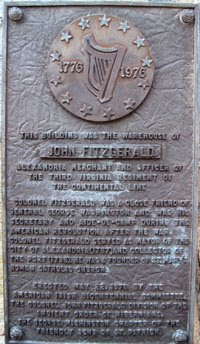
An Irishman in the American Revolution


Ever been researching a book and had somebody just keep popping his head up out of the distant past? Every time you looked into a different angle of that time and place, there he’d be, waiting for you, ready to lead you through the winding alleys of what-the heck to the glories of just-what-I-needed. Well,

Colonel John Fitzgerald was my guide to eighteenth century Alexandria, while researching THE SHADOW GUARD. He never made it into the book, at least not directly.

So I’d like to pay homage to him now by telling a few stories about him just before St. Patrick’s Day.

Born in Wicklow, Ireland, John Fitzgerald emigrated to Virginia as a young man via Philadelphia in 1769. He impressed plantation society and was soon elected to the state legislature. Despite the great many languishing glances cast by local beauties, he married a Maryland belle from across the Potomac River who shared his Catholic faith. This truly wasn’t surprising, considering that simply holding a Catholic service in Virginia was illegal.

He quickly became fast friends with George Washington, whose plantation at Mount Vernon was only a few miles away from Fitzgerald’s prosperous warehouse in Alexandria. (Okay, I admit I snuck some of these deep Virginia roots into my book.)

When the Revolution started, Colonel Washington went to Philadelphia, where he quickly became General Washington and gained command of the infant Republic’s army. Fitzgerald joined Washington at Cambridge by St. Patrick’s Day in 1776 and started handling correspondence by July 4th, as part of his Aide-de-Camp duties.

Fitzgerald was formally confirmed as Secretary (together with another Irishman) in November, just before the army went into camp at Valley Forge. The heart-rending letters from Washington to Congress, telling about the troops’ appalling conditions and begging for help, were entrusted in Irishmen’s discretion.


“Aids-de-Camp are persons in whom entire confidence must be placed: it requires men of abilities to execute the duties with propriety and dispatch, where there is a multiplicity of business as must attend the Commander-in-Chief of such an army as this and persuaded, as I am, that nothing but the zeal of those gentlemen who live with me and act in this capacity, for the great American cause and personal attachment to me, have induced them to undergo the trouble and confinement they have experienced since they became members of my family.” – Washington, April 23, 1776. (More than one Virginia historian said this description was written of Fitzgerald. How did he stay so discreet? No wonder Washington trusted him so much! Okay, maybe I used some of this to build my hero’s tendency toward taciturn.)

Fitzgerald stayed with Washington as Aide-de-Camp until 1782, after the great victory at Yorktown.) Together, they accumulated an immense list of battles, tribulations, scandals, and victories shared. The loyal colonel even testified on Washington’s behalf during General Lee’s court martial for incompetence at the Battle of Monmouth. (Some say Lee’s festering hatred afterward opened the door for Benedict Arnold’s treason.) Fitzgerald also provided Washington with the necessary proof to stomp out a Congressional conspiracy to remove him as Commander-in-Chief.

All the while, Fitzgerald’s cousin – Lord Edward Fitzgerald, later to become a great Irish patriot – served in the British Army against America.

After the Revolution, Fitzgerald and Washington remained very close. They became business partners, with Fitzgerald becoming one of the four directors in Washington’s Potomac River canal venture. They dined together frequently and slept at each other’s homes. Washington was undoubtedly careful not to show up when mass was celebrated at Fitzgerald’s house, the only place of worship for Catholics.

In 1793, they quarreled over politics. Fitzgerald felt America should greet the French Revolution warmly, while Washington believed a more deliberate approach should be taken to any group who’d executed their monarch. Washington wrote Fitzgerald a letter of explanation and asked for discretion regarding the final section. Bound by a Virginia resolution, the younger man had to publish the entire letter. It caused a sensation but ultimately changed none of America’s diplomatic tactics.

Their friendship survived even this. Within a year, letters were flying back and forth between them as if they’d always marched to the same beat.

By the early 1790’s, Alexandria’s Catholic population had outgrown the Colonel’s house. (Or perhaps there wasn’t enough room under one roof for both the priest and the colonel. Who knows?) At any rate, land was donated for a church but money was needed to build a church. Unfortunately, establishing a grand building would make it vulnerable to unkind souls, who remembered all too well when Catholic worship had been illegal.


What to do?

And so, on St. Patrick’s Day in 1794, General Washington dined with his old friend Colonel John Fitzgerald. After dinner, the first name in the subscription book to build the first Catholic church in Virginia was General George Washington, with Colonel John Fitzgerald as collector of funds.

St. Mary’s Catholic Church was dedicated in 1795 and is still in service today. (That church, with its links to Fitzgerald and Virginia’s eighteenth century past, inspired a key scene in my book.)

The General and Colonel saw each other for the last time on the General’s last public appearance, a few days before his death. The Colonel died a few months later and is buried on the road to Mount Vernon, still in service to his commander and his adopted country.

Here’s to St. Patrick’s Day, Colonel Fitzgerald! From 1775 when you joined General Washington at Cambridge to 1794 when you started laying the foundation for the church, thanks from one descendant of Eire for all you did in peace and war.

Have you ever had something pop up in research that just wouldn’t leave you alone? What did you do with it – or him?

Wednesday, March 9, 2011

Announcing the release of ROYAL PAINS


As I scramble to meet my next deadline, I thought I'd share this with my fellow hoydens and our readers:


As of March 1, my third nonfiction title about scandalous royals,

ROYAL PAINS:
A Rogues’ Gallery of Brats, Brutes, and Bad Seeds

is now available wherever books (and e-books) are sold!

In a world where sibling rivalry knows no bounds and excess is never enough,
meet some of history’s boldest, baddest, and bawdiest royals

The bad seeds on the family trees of the most powerful royal houses of Europe often became the rottenest of apples. In an effort to stave off wrinkles, sixteenth-century Hungarian Countess Erzsébet Báthory bathed in the blood of virgins, and for kicks and giggles devised even more ingenious forms of torture than the über-violent autocrats Vlad (the Impaler) Dracula and Ivan the Terrible had ever imagined. Lettice Knollys strove to mimic the appearance of her cousin Elizabeth I and even stole her man. The Duke of Cumberland’s sexcapades and subsequent clandestine marriage led to a law that still binds England’s royal family. And the libidinous Pauline Bonaparte scandalized her imperial brother by having herself sculpted nearly nude and commissioning a golden drinking goblet fashioned in the shape of her breast.

Chock-full of shocking scenes, titillating tales, and wildly wicked nobles, Royal Pains is a rollicking compendium of the most infamous, capricious, and insatiable bluebloods of Europe.

***

Praise for Leslie Carroll’s 2010 title, Notorious Royal Marriages

“For those who tackled Hilary Mantel’s Wolf Hall, and can’t get enough of the scandal surrounding Henry VIII’s wives, [Notorious Royal Marriages is] the perfect companion book.”—The New Yorker

“Carroll writes with verve and wit about the passionate—and occasionally perilous—events that occur when royals wed.”—Chicago Tribune (5 stars)

And here's a link to my March 7, 2011 appearance on Burlington Vermont's CBS affliate, WCAX/TV:

Monday, March 7, 2011

Dishing the Servant Dirt


My latest book, Mr. Bishop and the Actress, is about servants, more or less. The hero and heroine are upper servants, and their relationship with their employers is almost as strong as their relationship with each other. In her fabulous review at Dear Author, Jennie said,
*It’s a strange world we live in where romances featuring vampires, angels and werewolves (or possibly even a vampire/angel/werewolf hybrid) are de rigeur, but a simple historical romance between two commoners has to be hunted down or purchased from international sources.
I'm much more interested in commoners than dukes, and I've been researching servants for several years; servants were the largest workforce in the eighteenth and nineteenth century. Just recently, from an entry in the 1901 census, I found out that my maternal grandmother was in service before she married.

But today I want to talk about a truly extraordinary master-servant relationship that historians have tiptoed around a bit, and with good reason--that of Hannah Cullwick (1833-1909) and her master, Arthur Munby (1828-1910). Hannah wrote a diary, published in 1984 by Virago Press, UK (now out of print) that gives an extraordinarily detailed account of the everyday life of a Victorian servant.

But it's more than that.

Hannah wrote the diary at the instigation of her lover-employer-husband Arthur Mumby, who had a fetish for working class women and a form of mysophilia--in other words, he got off on dirt, specifically women getting dirty. So a passage like this would get Arthur all hot and bothered:
Lighted the fire. Brush'd the grates. Clean'd the hall & steps & flags on my knees. Swept & dusted the rooms. Got breakfast up. Made the beds & emptied the slops. Cleaned & wash'd up...Cleaned the stairs & the pantry on my knees. Clean'd the knives & got dinner. Clean'd 3 pairs of boots. Clean'd away after dinner & began the preserving about ½ past 3 & kept on till 11, leaving off only to get the supper & have my tea...Went to bed very tired & dirty.
Boots, by the way, figure rather largely in their relationship.

Hannah took great pride in her strength and endurance, choosing always to remain at the bottom of the Victorian servant food chain, as a maid of all work. A lawyer and amateur artist, poet, and anthropologist, Munby had a huge collection of photographs and other records of working women that he bequeathed to Trinity College Cambridge. You can see some of his pictures of female pit workers in Wigan here, photographed in a studio, but with authentic dirt intact.

Hannah met Munby in 1854 and he followed her around from one position to another, watching her beat carpets and so on, and she was fired from at least one household because of his interest in her--this was a period, of course, when women servants were not allowed to have gentleman followers. Working at boarding houses rather than private houses gave her greater freedom. Eventually he hired her in 1872 and they married secretly the following year. But to all intents and purposes she was still his servant, and Munby's friends--who included Ruskin, Rosetti, and Browning--had no idea of the true relationship, one that seems to have been classic BDSM.
For freedom & true lowliness, there's nothing like being a maid of all work (1872)
She wore a locking chain around her neck, for which Munby had the key, and a leather strap on one wrist as a sign of his ownership. Munby liked her to dress up in various disguises--as a man, a chimney sweep, in blackface. She referred to him as "Massa."

But she had an extraordinarily strong sense of independence outside their fantasy life. She insisted, even after marriage, on receiving wages and keeping her own name, and she left him in 1877, although he continued to visit her, but presumably on her terms.

Here's an excerpt from the movie On My Knees based on Hannah's diaries with Melora Creager of Rasputina--very haunting, particularly the soundtrack. The BBC also made a documentary but you can't view the excerpts in the US, which is a pity because the series on underground Victorian sexuality looks fascinating.

I'm fascinated by Hannah who had such courage--at least, that's the way I see it--to follow her own instincts. What do you think?

*Find Mr. Bishop and the Actress at bookdepository.com (free shipping worldwide), Amazon Kindle, or enter a contest at Pam Rosenthal's site (and do watch the wonderful video while you're there).

Wednesday, March 2, 2011

Love Scenes & Details


As I've blogged about before my attitude toward writing love scenes has evolved in the twenty some years I've been writing. When I first began co-writing Regency romances with my mom, under the name Anthea Malcolm, my friends teased me that our books started very chaste and slowly got more explicit. In our first book, The Widow’s Gambit, the characters barely embraced. In the second, The Courting of Philippa, there were more detailed kisses. In the third, Frivolous Pretence, which focused on an estranged married couple, there was an actual sex scene, though it faded to black. Our fifth book, A Touch of Scandal, had ex-lovers who resumed an illicit affair. Sex scenes were part of the story. I told my mom she had to write them. Our sixth book, An Improper Proposal, was a marriage of convenience story. My mom said, “You have to write one of the sex scenes this time.” I wrote my first draft of the scene on a day when my mom was out shopping. And (this is true, thought it sounds so funny now), I turned down the screen on my computer, so I couldn’t look at the words as I typed them. When my mom got home that night, I said, “Okay, I wrote the scene. Go look at it and tell me what you think. But I don’t want to be there when you read it.”

Oddly enough, after that first scene I stopped being embarrassed about writing sex scenes. I got to find them quite a fun challenge, especially trying to make each one true to those particular characters and that stage in their relationship. But when I wrote Secrets of a Lady, it was quite obvious to me that after the opening interrupted sex scene, Charles and Mélanie were too focused on finding the Carevalo Ring and getting their son back to be stop to have sex. On top of the fact that their relationship is so strained that Charles finds it difficult even to look Mel in the face let alone make love to her. In fact one of the reasons I had Mélanie be attacked fairly early in the story is to break through some of the distance between them so that Charles at least touches her. Their physical contact slowly increases through their desperate adventures in search of the ring and Colin, though they don't actually even kiss on the lips again.

In Beneath a Silent Moon, (which thematically is in many ways all about sex), Charles and Mélanie do make love fairly early in the story. When I wrote the scene, I automatically faded to black without thinking about it. I did the same with a later love scene in the book. When I posted one of those scenes as an excerpt on my website, I called it an "almost love scene". Some commentators responded that it actually was a love scene. Which I guess depends upon one's definition of a love scene and how explicit it needs to be.

My upcoming release Vienna Waltz is also a book very much about sex with all the romantic intrigue going on at the Congress of Vienna. There are several pairs of real life ex-lovers in the book such as Tsarina Elisabeth and Polish Prince Adam Czartoryski and Prince Metternich and Wilhelmine, Duchess of Sagan. On a revision, I realized I needed to make their love affairs more vivid, so I added moments where the characters remember moments and images from their love affairs. I wanted to use tangible, sensual imagery to bring those past love affairs to life. But the actual love scenes in Vienna Waltz between the hero and heroine (Malcolm and Suzanne who are basically alter-egos of Charles and Melanie) still fade to black.

Then in my current WIP, a sequel to Vienna Waltz set around the battle of Waterloo, I got to a love scene where without even thinking about it I didn't fade to black. It still isn't a very detailed scene, but somehow I knew instinctively that it was important to show how the scene progressed. I surprised myself, because I thought I was done writing love scenes with any detail. When I paused to think about it, I realized that in that scene the dynamic between the two characters was changing and shifting so much through out the scene and the very fact that they made love was so momentous that it was important to see how the scene played out.

How do you feel about sex scenes in the books you read? What makes them work or not? How detailed do you like them to be? Do you think some scenes require more detail than others because of plot and character dynamics? Writers, how do you approach writing sex scenes? Do you enjoy writing them or find them a chore? How much detail do you go into? Does the amount of detail very with the situation of the characters and plot? Has your approach to them changed through the years or with the type of books you write?