No, not that kind of repression, but since you've read this far don't stop now.
In 2007 I wrote a post about a literary challenge from the Biological Psychiatric Laboratory at Mclean Hospital (a research lab from Harvard Medical School) which offered a $1000 prize to anyone who could find literary evidence, written before the 19th century, of a person who suffered a traumatic event, repressed the memory and later recovered.
As I said in my two years post post, it sounds like a scam, right? But it was not. An Washington Post discussed the research of scientists and literary scholars who published their findings in the journal of Psychological Medicine.
The group, headed by Harrison Pope of Harvard Medical school, claim that repressed memory, also known as amnesia is "a culture-bound syndrome' --- creation of Western culture sometime in the 19th century." Apparently literature as far back as Homer show characters suffering from other disorders ranging from disjointed thinking, schizophrenia and depression. The literary work of other cultures was explored and no "convincing" example was found of a traumatic event followed by repressed memory and recovery of the memory before the year 1800.
In the second half of the 19th century evidence of trauma related amnesia in literature is plentiful -- the article refers to Dickens TALE OF TWO CITIES in which Dr Manette's time in the Bastille is so terrible that he has no memory of it until events in the plot cause him to recall the experience. The researchers contend that if the condition existed before this and other literary proof, evidence would be found. There in lay the challenge.
The news is that the challenge has been won. It's old news, actually, but I feel compelled to inform all historical writers so they no longer think that they must avoid stories with an amnesia plot. Here is what the Biopsychlab reported in May of 2007:
"The libretto of the 1786 opera, “Nina,” wins our $1000 award for a case of “repressed memory” in a written work before 1800.
“Nina” is a one-act opera with a score written by Nicholas Dalayrac and a libretto written by Marsollier. The full title is: Nina, ou La folle par amour, comedie en un acte, en prose, melee d’ariettes, par M. M. D. V. Musique de M. Dalayrac. It was published by Brunet in Paris in 1786. Several subsequent translations into English are available; one of the best known is the 1787 translation by Berkeley, which is available online through Eighteenth Century Collections Online. The libretto is not available online.
Nina's repressed memory is global, that is she recognizes no one and remembers nothing after the traumatic event, which involved the death of her lover in a duel with another suitor. I encourage you to read the full article at biopsychlab.com where there is a discussion of the differences between the 18th century understanding of amnesia and what it has evolved to today.
This post is based on information from a Washington Post article by Shankar Vedantam, the Biopsychlab website and from my previous post of March 6, 2007
Have you ever used amnesia in a book or do you have an idea working? How do you describe current medical conditions in historical terms in your work? How do you research medical conditions you want to use-- using current medical information or from primary sources?
posted by Mary Blayney | 2:51 PM
Monday, February 9, 2009

Thursday, February 5, 2009
Sewing boxes and embroidery
 A few months ago I blogged about dumb luck in a box and shared my discoveries on those most gorgeous of items, portable Regency writing desks. While searching around for illustrations I came across some sewing boxes from the same period and decided that at some point I should blog about those too. Naturally that got me going online in all sorts of strange directions, and squeaking OMG I want that! And that! from time to time.
Somehow I doubt I'll take up embroidery but it was close, very close, for a few minutes.
Work, for genteel women, meant sewing or embroidery, and the idea of it being a suitable, sociable occupation for women lasted well into the twentieth century. Many projects required embroidery--handkerchiefs, linens. Sometimes men embroidered too--it was a favorite pastime of sailors. One of my aunts, who worked for the Admiralty in the 1940s, surprised her boss with his embroidery project in hand.
Here's a favorite scene from one of my favorite books--the first meeting between Seth and Flora Post in Cold Comfort Farm (I have just bought yet another replacement copy to have it disappear into my daughter's reading maw).
Flora saw at once that he was not the kind that could be fobbed of with offers of tea. She was for it.
"What's that you're making?" he asked. Flora knew that he hoped it was a pair of knickers. She composedly shook out the folds of the petticoat and replied that it was an afternoon tea-cloth.

 Here's a sewing box from c. 1800, still with its original pink paper lining, exquisitely made. The box is maple with a hand-colored print on the top.

The sewing tools are made of Tunbridge ware whitewood, a process of wood mosaic originally developed to make souvenirs for those visiting the spa at Tunbridge Wells, Kent. More about Tunbridge ware here.
Does anyone know what the little bottles would have held? Images are from Antique Boxes at the Sign of the Hygra in London.
 One very popular form of embroidery work was embroidery with narrow silk ribbons instead of thread--fast, simple, and decorative. The Jane Austen Centre, Bath, magazine has a great article about it here. If you wish to explore further, Threads published an article on the basic stitches and you can buy supplies at ribbonsmyth.com.
 An early form of needlepoint, Berlin woolwork, was becoming popular in the Regency, particularly to make the uppers for slippers, which would then be taken to a shoemaker to have the soles attached. These child's slippers, possibly American, date from around 1840, although Berlin woolwork peaked in England with the 1851 Great Exhibition.
 Here are some more gorgeous sewing boxes at Hampton Antiques and Gerald Mathias and some great pictures of this tortoiseshell needle box here--yes, it looks like a snuff box until you open it up, and it has its original paper lining.
 Here's an article about the development of the famous Mountmellick whitework embroidery industry, started early in the nineteenth century in the northern Irish town of the same name. Wikipedia has an entirely different set of dates, so take your pick...
Do you embroider or collect antique linens? Do you have any books or online sources you'd like to share?
Tuesday, February 3, 2009
Declarations, Resolutions, & Other Heart-Stopping Moments
With Valentine's Day only ten days off, this seemed a good time to write a blog I've been thinking about for some time. Favorite romantic scenes--first declarations of love, resolutions of seemingly insurmountable conflicts, and other heart stopping moments. Here are a few of my favorites, scenes that bring an ache to my throat and put a smile on my face, many of them scenes I've reread so many times I know them by heart.
In no particular order:
1. "Oh, Damerel, must you be foxed just as this moment? How odious you are , my dear friend!"
The extended sequence at the end of Georgette Heyer's Venetia in which Venetia and Damerel work out their differences has it all--conflict, humor, passion, and poignancy. Damerel is a world-weary rake and Venetia is a sheltered, unmarried woman, yet they're so uniquely themselves that they pop off the page, and so obviously soul mates that you can't but feel a catch in your throat as they battle through to their happy ending.
2. "I've just won a wager with myself."
The scene in Freedom & Necessity by Steven Brust & Emma Bull in which Susan and James confess their feelings (and do rather more than confess them) may be my favorite literary love scene. It's character-driven, emotionally fraught, erotically frank, and yet still filled with mystery. The final scene between the couple in the book is also lovely, and then there's that fabulous last letter James writes to Susan, not to mention all the moments in between.
3. "Monseigneur, I would so much rather be the last woman than the first."
These Old Shades is a comfort read for me, but it isn't my favorite Georgette Heyer. It isn't even in my top three. And yet I've reread the last scene between Avon and Léonie countless times. It's beautifully written and structured, with a wonderful economy of gesture and emotion that speaks volumes. There's very little inner monologue, and yet the emotional shifts are crystal clear.
4. "Now forget your responsibility to everyone else for once in your life and give me a straight answer. Do you want me to stay?"
The final scene in The Armies of Daylight, the third book in Barbara Hambly's Darwath trilogy, may be the most satisfying lovers-getting-together-against-the-odds scene I've ever read, largely because the odds seem so very high and the happy ending so very much not guaranteed. There's also something about this scene that to me is very much parallel to the Léonie/Avon scene, though the words are very different as are the characters. Yet both stories involve heroes who are considerably older than the heroines and who men capable of shaping the world round them (one a wizard, the other a wealthy, powerful duke). Both men are convinced they'll only bring unhappiness to the woman they love and are trying to do the noble thing and give her up (as is Damerel in scene 1. Doing the right thing can be very sexy). The heroines, Léonie and Gil, are very different women. Yet both are trying to convince the man they love that they
know what they want and would much rather face the future with him, hand in hand. Like the scene from These Old Shades, this one has beautifully delineated emotional shifts.
5. "I do love nothing in the world so well as you: is not that strange?"
I got to do the church scene between Beatrice and Benedick from Shakespeare's Much Ado About Nothing in acting class in high school. My fellow sophomore Benedick and I barely scratched the surface of what the scene has to offer. But we had a lot of fun, and I still know most of the lines by heart. And every time I see the play, I find new things in this incredibly rich scene, which is funny, touching, romantic, and fraught with dark emotion.
6. "Placetne, domina?"
"Placet."
I think I studied Latin college partly so I could understand the dialogue between Peter and Harriet in the final scene of Dorothy Sayers's Gaudy Night. That this scene manages not to be trite or anticlimactic or trite after three books of angst and adventure, countless marriage
proposals, and several brushes with death is no small feat. You can really believe in the balance these two characters have fought their way to, yet there's still enough tension to keep the reading anxiously turning the pages. Harriet's done a great deal of thinking in the pages before, but here, as in some of the other scenes I've mentioned, there's very little inner monologue. And yet every word and detail is weighted with subtext, down to the traffic lights blinking Yes; No; Wait.
7. Too late, too late, too late. It had happened.
My mom and I used to call this the "Gigi" moment--where the hero suddenly realizes, with the force of a thunderclap, that he's madly in love with the heroine who's been right there under his nose for years and years or pages and pages. The moment when Francis Crawford of Lymond comes to this realization, in The Ringed Castle, book five of the Lymond Chronicles is all the more powerful for the world "love" never being used.
8. "I prefer you as you are--tainted and tarnished."
The scene where Mary casts caution and calculation aside and crawls into bed with the wounded Lord Vaughn in Lauren's The Seduction of the Crimson Rose is just lovely. A truly romantic confession of feeling on both sides, made all the stronger by the fact that you know just what it costs these two people to let their guard down and make themselves vulnerable. Both maintain their wonderfully acerbic sides, which makes their confession of their feelings (couched or allude to in character-appropriate terms) all the more powerful.
9. "A bath and some inoculations are called for, Holmes."
I think the "dock scene" from Laurie King's A Monstrous Regiment of Women may be my favorite proposal scene. Intensely romantic in large part because so much about it is is quite the opposite. Holmes and Russell are filthy and soaking wet and in the midst of an argument
about his having gone after the villain without her. There's a wonderful juxtaposition of acerbic dialogue and passionate breaking free of restraint. As with Gaudy Night and the Darwath Chronicles, and the Lymond Chronicles, it has extra power from being the culmination of
more than one book of longing. It sends chills up my spine every time I read it (play on words intended, to those familiar with the scene).
10. "Well," he said, with a transitory gleam of himself, "you're my corner and I've come to hide."
Peter and Harriet are the only couple to appear twice on this list. Much as I love the last scene of Gaudy Night, I think I may be even more fond of the final scene between them in Busman's Honeymoon. It grapples with a question I'm fond of addressing in my own writing, "what happens after happily ever after?" And it balances the scales by letting Peter need Harriet.
Ten very different scenes. And yet, as I revisited them to write this post, I realized that the very differences in scenes and characters are something the scenes have in common. Each is unique to the characters involved, in the setting and circumstances in which the scene occurs (a sitting room in the French countryside, a rocky hollow in an alternate universe the London docks, an Oxford street) to the circumstances to the words and gestures the characters find to express their feelings. There's also a wonderful tension to all of them, a sense of the fragility of emotions and the bonds between two people and the risk of letting down one's guard. None of them seem quite certain in advance and yet once the characters find their way to each other, you absolutely believe in the possibility of their happiness.
Now it's your turn. What are some of your favorite heart-stopping moments?
Monday, February 2, 2009
What about the girls . . .
When I was posting about my favorite historians, I was asked what about female historians? To be quite honest, I really don't think about the sex of those provide me with my drug of choice. But of course there are many women out there whose work sits in pride of place upon my shelves. None of them more so than Janet Arnold.
As most of you know, I'm a big fan of the minutia of history, the tiny details that made up actual everyday life. And when a new book that feeds my mania hits the shelves, I'm overjoyed. When said book just happens to be by all-time favorite historian, one who is sadly deceased, it's like a miracle.
Janet Arnold was, IMO, the most accomplished costume historian of our age. Her Patterns of Fashion books detail extant garments from the 16th century up through the early-20th. When she died, she was rumored to be working on a book about undergarments, a decade later that rumor has been proven true. Her assistant finished that book, and it was recently published as Patterns of Fashion 4. A more fitting tribute I can't imagine.
This new book details the cut and construction of shirts, smocks, neckwear (as in ruffs and rebatos), drawers, and caps from 1540 to 1660. I've been pouring over it, soaking up the details of cut and construction and, even more importantly, how each item connected to create the silhouette of the day.
My favorite item in the book is a pair of women's drawers from Italy, c. 1630 (yes, Italian women, unlike their English counterparts, wore them). It's entirely possible that this pair belonged to a courtesan. Either that, or to a woman with a rather devilish sense of humour and sexuality. Made of white linen, they are embroidered in blue silk in a pattern of double headed eagles and acorns and the words "voclio il core' (I want his heart).
These are the kinds of details that set my imagination running. Who was she? Why did she have these extraordinary underpants? What was her story? What happened to her? Did she get his heart? In my version she most certainly would.
Friday, January 30, 2009
Naughty songs of the Goliards

Medieval Europe is often referred to as the age of faith. However, assuming that the thought and action of these centuries were completely dominated by the Church gives a one-sided view. The secular poetry of the Goliards marks an early protest against the excesses of the Church, much like Bob Dylan and the literature of the Beat generation were protests against the 1950s.
The Goliards were disaffected 12th century university students and clergy who wrote (forbidden) love songs, drinking and gambling songs, satires, and parodies. The best known work is the Carmina Burana, a collection of Latin poetry discovered at the abbey of Benediktbeurn in the foothills of the Bavarian Alps, south of Munich. The abbey was founded in 733; the songs and poems were from the
11th century. Here are two of my favorites.
Let’s Away with Study
Let's away with study,
Folly's sweet.
Treasure all the pleasure
Of our youth:
Time enough for age
To think on truth.
So short a day,
And life so quickly hasting,
And in study wasting
Youth that would be gay!
Pastime With Good Company (In Taberna Quando Sumus)
When we are in the tavern,
We don’t worry about mortality,
But we hasten to have a good time,
at which we always work up a sweat...
First they toast the wealth of wine,
and drink of it very freely;
Next, a toast to those in prison,
After that, a toast to those still living,
Fourth, a toast to all good Christians,
Fifth, a toast to friends departed,
Sixth, a toast to false and fickle nuns,
Seventh, a toast to soldiers of the forest,
Eighth, a toast to crooked friars,
Ninth, a toast to monks disbanded,
Tenth, a toast to sailors at sea,
Eleventh, a toast to troublemakers,
Twelfth, a toast to penitents,
Thirteenth, a toast to those on journeys,
And at the last to King and Pope
We all inordinately tope.
The mistress drinks, the master drinks,
The soldier drinks, the cleric drinks,
He drinks, she drinks,
The servant drinks with the serving maid.
Drinks the swift and drinks the slothful,
Fair or dark, they all drink too,
The faithful drinks, the fickle drinks,
The ignorant lout, the man of letters.
The poor man drinks, the rich man too,
The exiled and the unknown do,
The boy-child drinks, so does the dog,
The dancer and the singer drink,
The sister drinks, the brother drinks,
The granny drinks, the mother drinks,
She drinks, he drinks
A hundred drink, a thousand drink.
Tuesday, January 27, 2009
The Trouble with Memoirs
Ah, memoirs. So tempting. So flawed. Last week, Mary wrote about some of her research hurdles. My snake in the garden—always offering apples which never quite convey the knowledge they promise—are contemporary memoirs. They always seem like such a great idea. You hear the actual historical figures speaking in their own actual voices! (Assuming that we’re not dealing with the eighteenth or nineteenth century equivalent of ghostwriters). They were there! They experienced the events you want to know about!
Er, yes. But do they remember them twenty years after?
Right now, I’m brushing up on my Bonapartes for a book to be set in Paris in 1804. Fouche, the dreaded Napoleonic Minister of Police, plays a large role in the book, so I happily dusted off my copy of his memoirs along with those of Josephine’s lady in waiting, Mme de Remusat; Napoleon’s secretary, Bourrienne; and Josephine’s daughter, Hortense. The Napoleonic period is particularly rich in memoirs.
 Unfortunately, there’s a reason for that. Everyone wanted to justify his own actions twenty years later, with a Bourbon King back on the throne. Everyone wanted to make himself look better—or, in the case of the big-hearted Hortense, make her mother look better. Many of these memoirs are short on details, but long on self-justification. Fouche begins his memoirs with a lengthy apologia in which he disingenuously describes himself as one who “never wielded [power] but to calm the passions, disunite factions, and prevent conspiracies; me, who was never ceasingly employed in moderating and tempering power, in conciliating and amalgamating the jarring elements and conflicting interests which divided France”. To coin a phrase, yeah, right.
Even when they do recount detailed descriptions of events and conversations, how much can one rely on them? Leaving aside the question of deliberate fraud (and there was plenty of that going on—including the made-up story of how Napoleon met Josephine that both her children vigorously perpetuated), memory is faulty. We re-remember things over time, highlighting and embroidering as we see fit, melding memory to fit new circumstances. Mme de Remusat frankly admits that her task is an elusive one, “[going] back in search of a number of impressions which were strong and vivid when [she] received them, but which now, like ruined buildings devastated by fire, have no longer any connection with one another”.
 What one does receive, though, aside from the myths people wish to perpetuate in retrospect, is a sense of voice. Sometimes it backfires on the author. The more pious Fouche attempted to sound, the more I disbelieved him and a stronger a sense I received of the crafty opportunist he had been. And I would still be friends with Hortense de Beauharnais tomorrow, even if she did fudge her memoirs to protect her mother—or maybe because she fudged her memoirs to protect her mother.
Sadly, no historical document is ever a hundred per cent without its pitfalls. One letter from Cromwell threw off some crucial dating for ages until people realized it was dated old style (with the calendar year beginning/ending in April) rather than new style (January). Hortense and Eugene Beauharnais edited their mother’s and stepfather’s correspondence, changing dates on letters to try to sanitize the early days of their love affair. But I still find memoirs particularly troublesome—because there is always that hope that the character can tell the story in his or her own voice and it will be true, the historian’s task made simple.
It never does work that way, though.
What are your research bugbears?
Er, yes. But do they remember them twenty years after?
Right now, I’m brushing up on my Bonapartes for a book to be set in Paris in 1804. Fouche, the dreaded Napoleonic Minister of Police, plays a large role in the book, so I happily dusted off my copy of his memoirs along with those of Josephine’s lady in waiting, Mme de Remusat; Napoleon’s secretary, Bourrienne; and Josephine’s daughter, Hortense. The Napoleonic period is particularly rich in memoirs.
 Unfortunately, there’s a reason for that. Everyone wanted to justify his own actions twenty years later, with a Bourbon King back on the throne. Everyone wanted to make himself look better—or, in the case of the big-hearted Hortense, make her mother look better. Many of these memoirs are short on details, but long on self-justification. Fouche begins his memoirs with a lengthy apologia in which he disingenuously describes himself as one who “never wielded [power] but to calm the passions, disunite factions, and prevent conspiracies; me, who was never ceasingly employed in moderating and tempering power, in conciliating and amalgamating the jarring elements and conflicting interests which divided France”. To coin a phrase, yeah, right.
Even when they do recount detailed descriptions of events and conversations, how much can one rely on them?
 Leaving aside the question of deliberate fraud (and there was plenty of that going on—including the made-up story of how Napoleon met Josephine that both her children vigorously perpetuated), memory is faulty. We re-remember things over time, highlighting and embroidering as we see fit, melding memory to fit new circumstances. Mme de Remusat frankly admits that her task is an elusive one, “[going] back in search of a number of impressions which were strong and vivid when [she] received them, but which now, like ruined buildings devastated by fire, have no longer any connection with one another”.
 What one does receive, though, aside from the myths people wish to perpetuate in retrospect, is a sense of voice. Sometimes it backfires on the author. The more pious Fouche attempted to sound, the more I disbelieved him and a stronger a sense I received of the crafty opportunist he had been. And I would still be friends with Hortense de Beauharnais tomorrow, even if she did fudge her memoirs to protect her mother—or maybe because she fudged her memoirs to protect her mother.
Sadly, no historical document is ever a hundred per cent without its pitfalls. One letter from Cromwell threw off some crucial dating for ages until people realized it was dated old style (with the calendar year beginning/ending in April) rather than new style (January). Hortense and Eugene Beauharnais edited their mother’s and stepfather’s correspondence, changing dates on letters to try to sanitize the early days of their love affair. But I still find memoirs particularly troublesome—because there is always that hope that the character can tell the story in his or her own voice and it will be true, the historian’s task made simple.
It never does work that way, though.
What are your research bugbears?
Monday, January 26, 2009
Dazed and Confused: Tales of Power and Privilege
Well, I was supposed to be blogging here last Friday. But somehow I got my blogging schedule confused.
We were traveling along the Oaxaca coast in Mexico (more about which later). But by Friday, we were en route to home, via a stop in LA.
Because when we booked the trip last fall, the American Airlines lady said the only way we could do it on frequent flyer miles was to stop over in LA.
Were we willing to do so, she asked?
Oh darn it, I said, I guess this means we finally have to see the Getty Museum (which includes the Villa in Malibu, built in the style of a sumptuous home of classical Rome, to house J. Paul Getty's enormous classical art collection). ;-)
Drat, added Michael, and the Watts Towers too. :-)
 Poor pitiful us, we agreed, we'll just have to stay somewhere with an ocean view, perhaps near the boardwalk in Venice. ;-)
(I hope the sprinkling of sunny images and little winky smiley emoticon things indicates just how pissed off we were to have to make this 2-day stopover. ;-) )
And in any case, I suppose that it's not so strange that while seeing wonders ancient and recent in LA that I lost bearings of my blogging schedule -- even as I was occasionally logging into this blog, and even as I was pondering (as is often the case, since she blogs before me, and since her posts are always rich and thought-provoking) Amanda Elyot's post about Great Britain's Prince Harry.
Of course I can't speak for Amanda's intentions. But the reason the topic fascinated me was that it reminded me of my own confusions and ambivalence about writing romance fiction -- which of course by general definition includes a certain amount of having-it-all fantasy, and in my specific case means that my main characters are often as not of the upper classes of Regency England (The clothes! the clubs! the estates, the carriages! The pleasures, in short, of privilege.)
And yet, by just about anybody's standards, I'm deeply egalitarian in my attitudes toward social, political, and economic matters. And apt to be particularly offended by upperclass twits (in England or -- not to mention names -- anywhere else).
So why do I write in a genre that centers itself upon the pleasures and pursuits of the Regency ton?
The answer, best as I can fathom it, is that I (or at least, god help me, my inner eleven-year-old) am genuinely enthralled by one of the romance genre's deepest messages and fantasies -- of a natural aristocracy of talent and virtue. Which phrase is an oxymoron if there ever was one, but in some ways I think that the fact that natural aristocracy even exists as a familiar string of words is something of a tipoff to what's going on here.
Despite myself almost, I seem to find something deeply satisfying in the belief in a kind of correspondence between outer rewards and inner virtues: the vision of a "true" nobility tested by adversity; of goodness of spirit adorned with the rewards of the earthly life.
The part of ourselves that likes to think of our selves this way, combined with the genuine anthropological complexity of upperclass entitlement seems like endlessly fertile ground for the sort of "fables of identity" many of us hoydens write. (I've borrowed the phrase from the literary critic Northrop Frye.)
 Even given the strength of the mythology, though, I sometimes try to complicate matters in my work. To give the servants inner lives, for example; or in my most recent book, The Edge of Impropriety, to show that the very origins of our Regency fiction (the society novels of the Regency era itself) were often the work of strivers and arrivistes, who needed the myth of natural aristocracy more than anyone, and toward whom I try to be compassionate. (For a fascinating discussion of society novelist and consummate striver Benjamin Disraeli -- who makes a cameo appearance in Edge, check this out, from yesterday's New York Times Book Review).
And finally to note that during changing history (and in another venerable phrase) the last can sometimes come to be first. Which is part of the romantic mythology as well.
And how am I going to connect this to my Mexico trip? Only to offer some worthy writer a terrific romance venue -- the places along the Oaxaca coast, like Lake Chacahua, where slave ships were sometimes wrecked, and where survivers hid in the mangroves and founded communities that endure to this day. And where you just might have to stay, in a hut built of dried palm leaves, as we did, to do some (oh darn) research.
And I'd love to know from you hoydens and other writers how you deal with class inequity and moral value in your historical romances or historical writers.
And how you readers (who might also be writers) negotiate these complex mythologies and what you get from them.
We were traveling along the Oaxaca coast in Mexico (more about which later). But by Friday, we were en route to home, via a stop in LA.
Because when we booked the trip last fall, the American Airlines lady said the only way we could do it on frequent flyer miles was to stop over in LA.
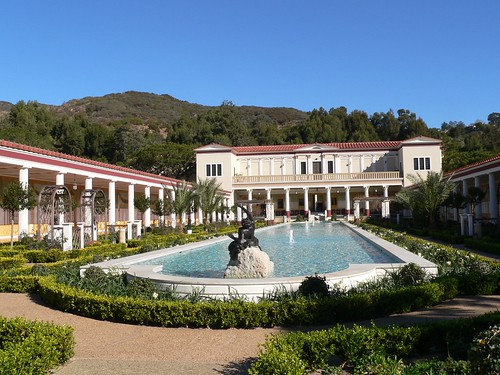
Were we willing to do so, she asked?
Oh darn it, I said, I guess this means we finally have to see the Getty Museum (which includes the Villa in Malibu, built in the style of a sumptuous home of classical Rome, to house J. Paul
 Getty's enormous classical art collection). ;-)
Drat, added Michael, and the Watts Towers too. :-)
 Poor pitiful us, we agreed, we'll just have to stay somewhere with an ocean view, perhaps near the boardwalk in Venice. ;-)
(I hope the sprinkling of sunny images and little winky smiley emoticon things indicates just how pissed off we were to have to make this 2-day stopover. ;-) )
And in any case, I suppose that it's not so strange that while seeing wonders ancient and recent in LA that I lost bearings of my blogging schedule -- even as I was occasionally logging into this blog, and even as I was pondering (as is often the case, since she blogs before me, and since her posts are always rich and thought-provoking) Amanda Elyot's post about Great Britain's Prince Harry.
Of course I can't speak for Amanda's intentions. But the reason the topic fascinated me was that it reminded me of my own confusions and ambivalence about writing romance fiction -- which of course by general definition includes a certain amount of having-it-all fantasy, and in my specific case means that my main characters are often as not of the upper classes of Regency England (The clothes! the clubs! the estates, the carriages! The pleasures, in short, of privilege.)
And yet, by just about anybody's standards, I'm deeply egalitarian in my attitudes toward social, political, and economic matters. And apt to be particularly offended by upperclass twits (in England or -- not to mention names -- anywhere else).
So why do I write in a genre that centers itself upon the pleasures and pursuits of the Regency ton?
The answer, best as I can fathom it, is that I (or at least, god help me, my inner eleven-year-old) am genuinely enthralled by one of the romance genre's deepest messages and fantasies -- of a natural aristocracy of talent and virtue. Which phrase is an oxymoron if there ever was one, but in some ways I think that the fact that natural aristocracy even exists as a familiar string of words is something of a tipoff to what's going on here.
Despite myself almost, I seem to find something deeply satisfying in the belief in a kind of correspondence between outer rewards and inner virtues: the vision of a "true" nobility tested by adversity; of goodness of spirit adorned with the rewards of the earthly life.
The part of ourselves that likes to think of our selves this way, combined with the genuine anthropological complexity of upperclass entitlement seems like endlessly fertile ground for the sort of "fables of identity" many of us hoydens write. (I've borrowed the phrase from the literary critic Northrop Frye.)
Even given the strength of the mythology, though, I sometimes try to complicate matters in my work. To give the servants inner lives, for example; or in my most recent book, The Edge of Impropriety, to show that the very origins of our Regency fiction (the society novels of the Regency era itself) were often the work of strivers and arrivistes, who needed the myth of natural aristocracy more than anyone, and toward whom I try to be compassionate. (For a fascinating discussion of society novelist and consummate striver Benjamin Disraeli -- who makes a cameo appearance in Edge, check this out, from yesterday's New York Times Book Review).And finally to note that during changing history (and in another venerable phrase) the last can sometimes come to be first. Which is part of the romantic mythology as well.

And how am I going to connect this to my Mexico trip? Only to offer some worthy writer a terrific romance venue -- the places along the Oaxaca coast, like Lake Chacahua, where slave ships were sometimes wrecked, and where survivers hid in the mangroves and founded communities that endure to this day. And where you just might have to stay, in a hut built of dried palm leaves, as we did, to do some (oh darn) research.
And I'd love to know from you hoydens and other writers how you deal with class inequity and moral value in your historical romances or historical writers.
And how you readers (who might also be writers) negotiate these complex mythologies and what you get from them.
Subscribe to:
Posts (Atom)