Friday, January 30, 2009

Naughty songs of the Goliards


Medieval Europe is often referred to as the age of faith. However, assuming that the thought and action of these centuries were completely dominated by the Church gives a one-sided view. The secular poetry of the Goliards marks an early protest against the excesses of the Church, much like Bob Dylan and the literature of the Beat generation were protests against the 1950s.

The Goliards were disaffected 12th century university students and clergy who wrote (forbidden) love songs, drinking and gambling songs, satires, and parodies. The best known work is the Carmina Burana, a collection of Latin poetry discovered at the abbey of Benediktbeurn in the foothills of the Bavarian Alps, south of Munich. The abbey was founded in 733; the songs and poems were from the
11th century. Here are two of my favorites.

Let’s Away with Study

Let's away with study,
Folly's sweet.
Treasure all the pleasure
Of our youth:
Time enough for age
To think on truth.
So short a day,
And life so quickly hasting,
And in study wasting
Youth that would be gay!


Pastime With Good Company (In Taberna Quando Sumus)

When we are in the tavern,
We don’t worry about mortality,
But we hasten to have a good time,
at which we always work up a sweat...

First they toast the wealth of wine,
and drink of it very freely;
Next, a toast to those in prison,
After that, a toast to those still living,
Fourth, a toast to all good Christians,
Fifth, a toast to friends departed,
Sixth, a toast to false and fickle nuns,
Seventh, a toast to soldiers of the forest,
Eighth, a toast to crooked friars,
Ninth, a toast to monks disbanded,
Tenth, a toast to sailors at sea,
Eleventh, a toast to troublemakers,
Twelfth, a toast to penitents,
Thirteenth, a toast to those on journeys,
And at the last to King and Pope
We all inordinately tope.

The mistress drinks, the master drinks,
The soldier drinks, the cleric drinks,
He drinks, she drinks,
The servant drinks with the serving maid.
Drinks the swift and drinks the slothful,
Fair or dark, they all drink too,
The faithful drinks, the fickle drinks,
The ignorant lout, the man of letters.

The poor man drinks, the rich man too,
The exiled and the unknown do,
The boy-child drinks, so does the dog,
The dancer and the singer drink,
The sister drinks, the brother drinks,
The granny drinks, the mother drinks,
She drinks, he drinks
A hundred drink, a thousand drink.

Tuesday, January 27, 2009

The Trouble with Memoirs

Ah, memoirs. So tempting. So flawed. Last week, Mary wrote about some of her research hurdles. My snake in the garden—always offering apples which never quite convey the knowledge they promise—are contemporary memoirs. They always seem like such a great idea. You hear the actual historical figures speaking in their own actual voices! (Assuming that we’re not dealing with the eighteenth or nineteenth century equivalent of ghostwriters). They were there! They experienced the events you want to know about!

Er, yes. But do they remember them twenty years after?

Right now, I’m brushing up on my Bonapartes for a book to be set in Paris in 1804. Fouche, the dreaded Napoleonic Minister of Police, plays a large role in the book, so I happily dusted off my copy of his memoirs along with those of Josephine’s lady in waiting, Mme de Remusat; Napoleon’s secretary, Bourrienne; and Josephine’s daughter, Hortense. The Napoleonic period is particularly rich in memoirs.

Unfortunately, there’s a reason for that. Everyone wanted to justify his own actions twenty years later, with a Bourbon King back on the throne. Everyone wanted to make himself look better—or, in the case of the big-hearted Hortense, make her mother look better. Many of these memoirs are short on details, but long on self-justification. Fouche begins his memoirs with a lengthy apologia in which he disingenuously describes himself as one who “never wielded [power] but to calm the passions, disunite factions, and prevent conspiracies; me, who was never ceasingly employed in moderating and tempering power, in conciliating and amalgamating the jarring elements and conflicting interests which divided France”. To coin a phrase, yeah, right.

Even when they do recount detailed descriptions of events and conversations, how much can one rely on them? Leaving aside the question of deliberate fraud (and there was plenty of that going on—including the made-up story of how Napoleon met Josephine that both her children vigorously perpetuated), memory is faulty. We re-remember things over time, highlighting and embroidering as we see fit, melding memory to fit new circumstances. Mme de Remusat frankly admits that her task is an elusive one, “[going] back in search of a number of impressions which were strong and vivid when [she] received them, but which now, like ruined buildings devastated by fire, have no longer any connection with one another”.

What one does receive, though, aside from the myths people wish to perpetuate in retrospect, is a sense of voice. Sometimes it backfires on the author. The more pious Fouche attempted to sound, the more I disbelieved him and a stronger a sense I received of the crafty opportunist he had been. And I would still be friends with Hortense de Beauharnais tomorrow, even if she did fudge her memoirs to protect her mother—or maybe because she fudged her memoirs to protect her mother.

Sadly, no historical document is ever a hundred per cent without its pitfalls. One letter from Cromwell threw off some crucial dating for ages until people realized it was dated old style (with the calendar year beginning/ending in April) rather than new style (January). Hortense and Eugene Beauharnais edited their mother’s and stepfather’s correspondence, changing dates on letters to try to sanitize the early days of their love affair. But I still find memoirs particularly troublesome—because there is always that hope that the character can tell the story in his or her own voice and it will be true, the historian’s task made simple.

It never does work that way, though.

What are your research bugbears?

Monday, January 26, 2009

Dazed and Confused: Tales of Power and Privilege

Well, I was supposed to be blogging here last Friday. But somehow I got my blogging schedule confused.

We were traveling along the Oaxaca coast in Mexico (more about which later). But by Friday, we were en route to home, via a stop in LA.

Because when we booked the trip last fall, the American Airlines lady said the only way we could do it on frequent flyer miles was to stop over in LA.

Were we willing to do so, she asked?

Oh darn it
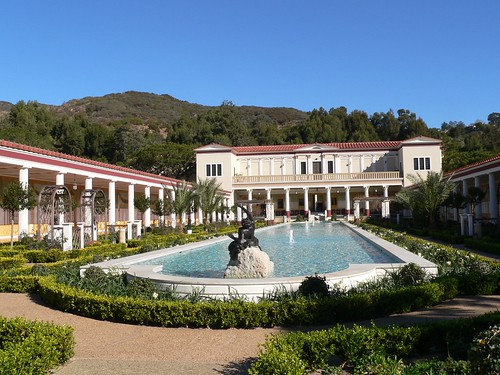
, I said, I guess this means we finally have to see the Getty Museum (which includes the Villa in Malibu, built in the style of a sumptuous home of classical Rome, to house J. Paul Getty's enormous classical art collection). ;-)


Drat, added Michael, and the Watts Towers too. :-)


Poor pitiful us, we agreed, we'll just have to stay somewhere with an ocean view, perhaps near the boardwalk in Venice. ;-)

(I hope the sprinkling of sunny images and little winky smiley emoticon things indicates just how pissed off we were to have to make this 2-day stopover. ;-) )

And in any case, I suppose that it's not so strange that while seeing wonders ancient and recent in LA that I lost bearings of my blogging schedule -- even as I was occasionally logging into this blog, and even as I was pondering (as is often the case, since she blogs before me, and since her posts are always rich and thought-provoking) Amanda Elyot's post about Great Britain's Prince Harry.

Of course I can't speak for Amanda's intentions. But the reason the topic fascinated me was that it reminded me of my own confusions and ambivalence about writing romance fiction -- which of course by general definition includes a certain amount of having-it-all fantasy, and in my specific case means that my main characters are often as not of the upper classes of Regency England (The clothes! the clubs! the estates, the carriages! The pleasures, in short, of privilege.)

And yet, by just about anybody's standards, I'm deeply egalitarian in my attitudes toward social, political, and economic matters. And apt to be particularly offended by upperclass twits (in England or -- not to mention names -- anywhere else).

So why do I write in a genre that centers itself upon the pleasures and pursuits of the Regency ton?

The answer, best as I can fathom it, is that I (or at least, god help me, my inner eleven-year-old) am genuinely enthralled by one of the romance genre's deepest messages and fantasies -- of a natural aristocracy of talent and virtue. Which phrase is an oxymoron if there ever was one, but in some ways I think that the fact that natural aristocracy even exists as a familiar string of words is something of a tipoff to what's going on here.

Despite myself almost, I seem to find something deeply satisfying in the belief in a kind of correspondence between outer rewards and inner virtues: the vision of a "true" nobility tested by adversity; of goodness of spirit adorned with the rewards of the earthly life.

The part of ourselves that likes to think of our selves this way, combined with the genuine anthropological complexity of upperclass entitlement seems like endlessly fertile ground for the sort of "fables of identity" many of us hoydens write. (I've borrowed the phrase from the literary critic Northrop Frye.)

Even given the strength of the mythology, though, I sometimes try to complicate matters in my work. To give the servants inner lives, for example; or in my most recent book, The Edge of Impropriety, to show that the very origins of our Regency fiction (the society novels of the Regency era itself) were often the work of strivers and arrivistes, who needed the myth of natural aristocracy more than anyone, and toward whom I try to be compassionate. (For a fascinating discussion of society novelist and consummate striver Benjamin Disraeli -- who makes a cameo appearance in Edge, check this out, from yesterday's New York Times Book Review).

And finally to note that during changing history (and in another venerable phrase) the last can sometimes come to be first. Which is part of the romantic mythology as well.

And how am I going to connect this to my Mexico trip? Only to offer some worthy writer a terrific romance venue -- the places along the Oaxaca coast, like Lake Chacahua, where slave ships were sometimes wrecked, and where survivers hid in the mangroves and founded communities that endure to this day. And where you just might have to stay, in a hut built of dried palm leaves, as we did, to do some (oh darn) research.

And I'd love to know from you hoydens and other writers how you deal with class inequity and moral value in your historical romances or historical writers.

And how you readers (who might also be writers) negotiate these complex mythologies and what you get from them.

Wednesday, January 21, 2009

Not Too Wild About Harry


A video made in 2006 surfaced a couple of weeks ago , featuring England's Prince Harry. Evidently, the third in line to Queen Elizabeth's throne referred to a fellow cadet as a "Paki," and made another anti-Arab slur as well.

This little episode follows a previously released series of photos of the prince at a "fancy dress" party (on this side of the pond we call them costume parties), taken in January, 2005, in which the prince was attired as a Nazi, complete with swastika armband. Naturally, Harry apologized after those images of him emerged.


Both incidents occurred a few years ago. But is Harry older and wiser now? Has he "learned his lesson?" Is the prince merely thoughtless? Clueless? Laddish? Racist? Sorry?


Or was it simply an odd form of noblesse oblige?


Even though it's the twenty-first century and, in the words of William Shakespeare, the "royal throne of kings, this sceptred isle, this earth of majesty, this seat of Mars, this other Eden, demi-paradise, this fortress built by Nature for herself against infection and the hand of war, this happy breed of men, this little world, this precious stone set in the silver sea, which serves it in the office of a wall or as a moat defensive to a house, against the envy of less happier lands,-this blessed plot, this earth, this realm, this England" has become a much less insular and more ployglot kingdom -- has much really changed in the way the British royal family as an institution views those of other nations and religions?


Over the centuries among England's royals and aristocracy, anti-Semitism and anti-Arabic sentiment was perfectly acceptable. In 1189 when Richard I (the "Lionhearted") ascended the throne, and during the first few months of his reign in 1190, Jews were massacred at York and in London. Richard also led Crusades to the holy land to make war against the Infidel (of course the Muslims referred to the Christians as "the Infidel" as well!), destroy his nemesis Saladin, and take Jerusalem.


In 1290, the Jews were expelled from England by an edict of Edward I. And Prince Harry's twice-great-uncle Edward VIII, who preferred to abdicate the throne than give up his paramour, the twice-divorced American Wallis Warfield Simpson, was a notorious anti-Semite.
Isn't anyone minding the store over there? One would think that if Harry's old enough to take up a gun and go to war, he's expected to be old enough to mind his p's and q's; but that's evidently not the case. I couldn't help thinking when I read about his latest antiracial gaffe that if his mother were still alive, she would smack him across the mouth. Or wash it out with soap. After all, Diana embraced people from all nations, religions, colors, and creeds and I believe she would have been appalled by her son's behavior.


What do you think (apart from what I imagine is disgust at his intolerant remarks)? Is Harry just being an immature jerk? Or is he expressing the same beliefs of some of his royal ancestors and the issue isn't just about Harry, but is deeper and more insidious, with centuries of historical precedent?

Monday, January 19, 2009

The Truth About My Research

Here it is the: the truth about my research. Research comes in two big waves for me. When I am planning a story I consider the elements that are still in the “unknown zone” and, with each book, discover exactly how much I don’t know about the Regency. At the end of the book I fill in the gaps that come up in the process of writing.


As I began my WIP I needed some very basic information on Parliament. In the process of my research, and thanks to Regina Scott’s website (ReginaScott.com), I learned some useful and surprising details: that Parliament met Monday, Tuesday, Thursday and Friday at 3:45, that the session ran until late at night, which still left everyone time to party.


I still don’t know how often Lords and Commons met in joint session and am still looking. It is also unclear if the Regency was a period when spectators were allowed in the gallery. I have managed without those details, but would love it if someone could tell me or tell me where to find it.


True confession: I have finally learned what the Whigs and Tories stood for, but still have to check my notes to remember which is which. Has everyone heard the joke about the Navy Admiral who would go to his safe each day, look at a piece of paper and then close and lock the safe. When he died, his staff rushed to the safe to see what was on the paper – six words: Port is Left, Starboard is Right. Well, there is a little note on my desk reminding me that Whigs were more liberal than the Tories!


In 1818 the end of the regency was two years away and the Regent was not a popular man. The picture above is not flattering but is an accurate reflection of his lifestyle at this point in his life. Liverpool was the Prime Minister and there are two disparate schools of thought about the work he did. I still wonder why habeas corpus was suspended in 1817 and then reinstated very early in the session of 1818. Surely they realized that the problem had not evaporated. Or was it an the suspension an overreaction to the attack on the Regent at the opening of Parliament in 1817? The cartoon at the right is Cruikshank's Death of Liberty, his interpretation of the suspension of habeas corpus.


It took longer for the Seditious Meeting Acts to be dropped – until the end of the session. The Seditious Meetings Act (aka The Gag Acts) prohibited gatherings of more than fifty people without permission of a magistrate. In addition seven local householders had to be advised of the place, nature and time of the meeting. Even lawfully convened meetings could be dispersed if considered seditious by the magistrates.


What I want to know is how much of this is news to you, as reader, writer and historian. I have avoided Parliament for years but now that I have a hero who is a Duke I find him so responsible I can ignore Parliament no longer. Surprisingly the subject is more interesting to me than I thought it would be. What areas of your period do you love and what would you just as soon ignore?

Friday, January 16, 2009

America's Women: 400 Years of Dolls, Drudges, Helpmates and Heroines

Sometimes I read a book that is just so good I want to tell everyone about it!

That's the case with Gail Collins' "America's Women: 400 Years of Doll, Drudges, Helpmates and Heroines." If you are a true history hoyden (and part feminist, too), go buy this book. For nonfiction, it's truely one riviting read. Stacy Schiff, who wrote a review of the book for The Times, called the book a "bravura accomplishment."

Here's what she said and I believe it sums it up completely: "American Women.... happens to make for a story more complex, and more inspiring, than anything Harriet (Tubman) or Susan B. (Anthony) could have imagined."

"The book begins in 1587 with the arrival of New World colonist Eleanor Dare, who would give birth to the first English child born in what has become the United States, and ends in 1970 with Betty Friedan leading a feminist march down New York's Fifth Avenue."

"In between Collins writes about the icons and the ordinary. This is the part I love, reading and learning about how the everyday woman survived the last 400 years. She also covers birth control (a historical topic we've all had to deal with in our novels), Kotex (and lack thereof--Collins could find no more information about what women did when they mensturated then most of us could--she speculates Pilgrams used grass and moss as the native American women taught them to), Playboy clubs, colonial diapering (yikes! They didn't wash them...they just scraped them off and set them by the fire to dry!), bra-burning, personal grooming and toilet facilities."
"Whenever there is a history moment, I want to know how they got to the bathroom," writes the author, Gail Collins says. (Weirdly, me too!)

"The central theme of women's history, Collins discovered, was the urge to create a home and the yearning to get out of it."

"The idea of a woman's place being in the home was "laced with hypocrisy," Collins says, given that most women had to work in the fields or factories. Meanwhile, when black women tried to become traditional housewives after the Civil War, whites in the North and South were horrified."

"Women were always excused from working only in the home whenever there was a national emergency such as a war or an economic downturn."

"And there were so many emergencies that you could cite the entire history of women in America just by the emergencies," Collins says. "Any time you needed literate, low paid workers--teachers, nurses, and secretaries--women always turned out to be the answer."

I have only praise for this author and her coverage of an amazing topic. The stories of the lesser known women in American history are captivating, and the stories behind many of the historical personalities of the day are a little disconcerting (Thomas Jefferson was a sexist to the bone, Harriet Beecher Stowe, Susan B. Anthony, Elizabeth Cady Stanton and others of their ilk often objected to black women participating in the sufferrage movments).

Gail Collins was the first female head of The New York Times editorial board. I have a feeling she has a lot of first hand experience with what she rights about. Check out America's Women: 400 Years of Dolls, Drudges, Helpmates and Heroines.

Thursday, January 15, 2009

Guest blogger Amanda McCabe


"Smell the salt spray, feel the deck beneath your feet, and hoist the Jolly Roger as McCabe takes you on an entertaining, romantic ride!" -- RomanticTimes Book Reviews

I'm pleased to introduce today's guest, Amanda McCabe, whose latest release is High Seas Stowaway. As well as being a prolific writer, Amanda is one of the most awesome and thorough researchers I know, tackling different eras and settings with aplomb and thoroughness. She's also a member of the Risky Regencies blog where I'm blogging today. And now I'm turning things over to Amanda.
--Janet

Once I came up with the plot of High Seas Stowaway, I was very excited! I loved Balthazar Grattiano, who appeared in A Notorious Woman and A Sinful Alliance, and was glad I found him the right woman, and the right setting in the Caribbean of the 1530s. But I also realized a lot of work—and research—was in my future. I’ve always been fascinated by the subject of sixteenth century exploration, by the adventure and courage of it all. However, aside from a long-ago college class on the history of Spanish North America, I knew little of the period, and almost nothing of the mechanics of sailing a ship, and finding the way across the sea in a little wooden tub. So I dove right into a pile of books from the library!

The heroine of High Seas Stowaway, Bianca Simonetti Montero, owns a tavern in Santo Domingo, which meant lots of research on the town and the islands. And Balthazar is a sailor, a navigator and mapmaker (sort of like the rock stars of the sixteenth century!). I decided his ship, the Calypso, would be a caravel. Small-ish and lightly built, they were fast, responsive, and comparatively stable in stormy seas. Between 62 and 72 feet in length, with a raised quarterdeck and stern, and three masts (2 for square-rigged sails and 1 for lateen rigs at stern, it could sail easily in cross-winds). They were nimble, versatile, and cost effective (with a relatively small crew). But they were also cramped for space, especially with a full cargo in the hold!

Among the navigational equipment Balthazar would use, one of the most important would be a mariner’s astrolabe. These were made of brass (heavy enough to use on a heaving deck in high winds), in a graduated circle with an aldilade used to measure vertical angles. The essential function was to measure angles and therefore determine latitude by determining the distance of a star or other object above the horizon. Early instruments were only graduated for 90 degrees; later ones were graduated for the full 360 degrees. The navigator would align the plane of the astrolabe to the direction of the object of interest, and therefore read the altitude off the outer degree scale.

Compasses were also used, though they gave only a relative bearing and were therefore not useful with no point of reference. These were a magnetized needle on a pivoting base, with a rough scale of 32 points, generally located on the quarterdeck.

A cross-staff was a piece of wood, about 30 inches long with a sliding cross piece. The long edge was held up to the eye, and the cross piece was moved until the bottom edge aligned with the horizon and the top edge with the rim of the sun, thus reading the angular height of the sun (not easy on a pitching deck! Maybe that’s why all the eye patches…). The navigator would then use this to consult an astronomical table, which gave the sun’s declination (the degree of angle directly overhead) for that date. By subtracting the number from the cross-staff reading, it would determine the ship’s latitude.

(Longitude was not possible until the 18th century. Instead, sixteenth century sailors would use a log-weighted piece of wood tied to a reeled line with knots of equal distances along the length. The sailor would throw it overboard, and count the number of knots unreeled in a half-minute, measured by a sandglass. Thus this would calculate the ship’s speed through the water. Average speed + Direction from the compass readings = Rough idea where they were headed, and how fast. Thus “dead reckoning.” Too much math for me!)

Here are a few of the sources I found especially useful in helping me navigate this mystifying new world, and build a realistic shipboard atmosphere for my characters:

Kenneth Andrews: The Spanish Caravel: Trade and Plunder
Carl Sauer: The Early Spanish Main
CH Haring: The Spanish Empire in America
Jan Rogozinski: A Brief History of the Caravel
Mendel Peterson: The Funnel of Gold
The Oxford Companion to Ships and the Sea
Lois Ann Swanick: An Analysis of Navigational Instruments in the Age of Exploration
Wayne Curtis: And a Bottle of Rum: A History of the New World in Ten Cocktails